The tiny Pacific nation of Vanuatu turns to the world court as climate disasters mount
Advertisement
Read this article for free:
or
Already have an account? Log in here »
To continue reading, please subscribe:

Digital Subscription
One year of digital access for only $205*
- Enjoy unlimited reading on winnipegfreepress.com
- Read the E-Edition, our digital replica newspaper
- Access News Break, our award-winning app
- Play interactive puzzles
*First annual payment billed as $205.00 + GST for one year. This annual subscription will automatically renew at $233.00 + GST every 52 weeks (10% off the regular annual price of $259.35). Offer available to new and qualified returning subscribers only. Cancel any time.
To continue reading, please subscribe:
Add Free Press access to your Brandon Sun subscription for only an additional
$1 for the first 4 weeks*
- Enjoy unlimited reading on winnipegfreepress.com
- Read the E-Edition, our digital replica newspaper
- Access News Break, our award-winning app
- Play interactive puzzles
*Your next Brandon Sun subscription payment will increase by $1.00 and you will be charged $17.95 plus GST for four weeks. After four weeks, your payment will increase to $24.95 plus GST every four weeks.
Read unlimited articles for free today:
or
Already have an account? Log in here »
Hey there, time traveller!
This article was published 21/07/2025 (452 days ago), so information in it may no longer be current.
PORT VILA, Vanuatu (AP) — When John Warmington first began diving the reefs outside his home in Vanuatu’s Havannah Harbor a decade ago, the coral rose like a sunken forest — tall stands of staghorns branched into yellow antlers, plate corals layered like canopies, and clouds of darting fish wove through the labyrinth.
“We used to know every inch of that reef,” he said. “It was like a friend.”
Now, it’s unrecognizable. After Cyclone Pam battered the reef in 2015, sediment from inland rivers smothered the coral beds. Crown-of-thorns starfish swept in and devoured the recovering polyps. Back-to-back cyclones in 2023 crushed what was left. Then, in December 2024, a 7.3 magnitude earthquake shook the seabed.
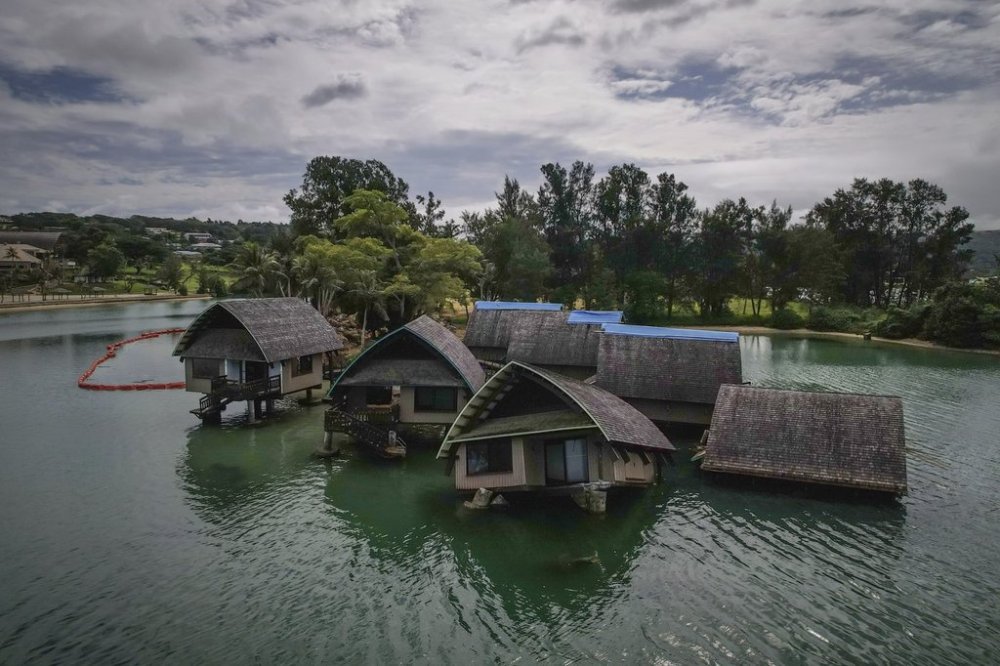
What remains is a coral graveyard — bleached rubble scattered across the seafloor, habitats collapsed, life vanished. “We’ve come out of the water in tears,” said Warmington, who has logged thousands of dives on this single reef. “We just see heartbreak.”
That heartbreak is becoming more common across this Pacific island nation, where intensifying cyclones, rising seas and saltwater intrusion are reshaping coastlines and threatening daily life. Since 1993, sea levels around Vanuatu’s shores have risen by about 6 millimeters (.24 inches) per year — significantly faster than the global average — and in some areas, tectonic activity has doubled that rate.
International court to opine on nations’ obligations to address climate change
On Wednesday, Vanuatu will get its day in the world’s highest court. The International Court of Justice will issue an advisory opinion on what legal obligations nations have to address climate change and what consequences they may face if they don’t. The case, led by Vanuatu and backed by more than 130 countries, is seen as a potential turning point in international climate law.
“Seeing large, polluting countries just continue business as usual and not take the climate crisis seriously can get really sad and disappointing,” said 16-year-old climate activist Vepaiamele Trief. “If they rule in our favor, that could change everything.”
The opinion won’t be legally binding, but could help shape future efforts to hold major emitters accountable and secure the funding and action small island nations need to adapt or survive.
It comes after decades of frustration for Pacific nations who’ve watched their homelands disappear. In Tuvalu, where the average elevation is just 2 meters (6.6 feet), more than a third of the population has applied for a climate migration visa to Australia. By 2100, much of the country is projected to be under water at high tide. In Nauru, the government has begun selling passports to wealthy foreigners — offering visa-free access to dozens of countries — in a bid to generate revenue for possible relocation efforts.
“The agreements being made at an international level between states are not moving fast enough,” said Ralph Regenvanu, Vanuatu’s minister for climate change. “They’re definitely not being met according to what the science tells us needs to happen.”
Vanuatu has already sought opinions from other international courts and is pushing for the recognition of ecocide — the destruction of the environment — as a crime under the International Criminal Court. “We have to keep fighting till the last bit,” Regenvanu said.
How climate change is decimating Vanuatu
For children in Vanuatu, climate change isn’t a theory — it’s a classroom, or the lack of one.
At Sainte Jeanne D’Arc school on Efate Island, elementary school teacher Noellina Tavi has spent two of the last three years teaching her students in tents — first after the 2023 cyclones and again following the 2024 earthquake.
With a shortage of emergency tents, her class was combined with another. Students fidget and lose focus. “It’s too crowded,” Tavi said. “We can’t work peacefully.”
When it rains, the tents turn cold and muddy. Tavi often sends students home so they don’t get sick. Anytime a storm approaches, the tents must be dismantled, the furniture carried to shelter and the children sent home. “That disrupts their education for a whole week,” she said.
In rural areas, extreme weather hits something even more basic: food security. On Nguna Island, farmer Kaltang Laban has watched cyclones wipe out the banana, cassava and taro crops that feed his community.
“After a cyclone, we would have nothing for months,” he said. Now, with support from Save the Children, Laban and other farmers are storing preserved fruits and vegetables in a facility beside their gardens. “But not every community has this,” he said.
More than 70% of Vanuatu’s population lives in rural areas and depends on small-scale farming.
In 2025, USAID cut funding for a rainwater harvesting initiative designed to improve water access at cyclone evacuation centers in one of the country’s most remote, drought-prone provinces, said Vomboe Shem, climate lead for Save the Children Vanuatu. The materials had already been shipped and distributed, but the project was halted.
“These disasters are happening over and over again,” Shem said. “It’s pushing our communities to their limits.”
Not all of these impacts can be pinned solely on climate change, said Christina Shaw, CEO of the Vanuatu Environmental Science Society. Coastal development, tectonic sinking, volcanic eruptions, deforestation and pollution are also contributing to ecosystem decline.
“Vanuatu’s environment is quite fragile by its inherent nature in that it’s young with narrow reefs, has small amounts of topsoil and is insulted regularly by natural disasters,” she said. “But we do have to think about the other human impacts on our environment as well.”
The damage isn’t limited to homes, gardens and reefs — it’s reaching into places once thought to be untouchable.
On the island of Pele, village chief Amos Kalsont sits at his brother’s grave as waves lap against broken headstones half-buried in sand. At high tide, both his brother’s and father’s graves sit just a few arm’s lengths from the sea. Some homes and gardens have already been moved inland, and saltwater intrusion has tainted the community’s primary drinking water source. Now, the community is considering relocating the entire village — but that would mean leaving the land their grandparents cleared by hand.
“The sea is catching up and we don’t know what else to do,” Kalsont said. “It’s not fair that we have to face the consequences when we didn’t contribute to this in the first place.”
Many in Vanuatu remain committed to building something stronger and hope the rest of the world will support them.
“This is our future, and it’s particularly our children’s future, our grandchildren’s future,” said Regenvanu. “We just have to keep pushing for the best one we can.”
Back in Havannah Harbor, John Warmington still dives the reef he considers part of his family. While much of it is gone, he and his wife Sandy have begun replanting coral fragments in hopes of restoring what’s left.

“Our friend is still here,” he said. “Life is coming back.”
___
Follow Annika Hammerschlag on Instagram @ahammergram.
___
The Associated Press’ climate and environmental coverage receives financial support from multiple private foundations. AP is solely responsible for all content. Find AP’s standards for working with philanthropies, a list of supporters and funded coverage areas at AP.org.