Bosnia’s mountain resorts pivot to summer tourism as climate changes

Advertisement

Advertise with us

SARAJEVO, Bosnia-Herzegovina (AP) — A short drive from the Mediterranean coast, mid-altitude mountain resorts near Sarajevo — traditionally dependent on snow sports — are slowly but steadily pivoting to attract summertime tourists.

Read this article for free:


or

Already have an account? Log in here »

To continue reading, please subscribe:

Subscribe and receive a limited-edition Free Press branded hat or tote.

Digital Subscription

One year of digital access for only $205*

  • Enjoy unlimited reading on winnipegfreepress.com
  • Read the E-Edition, our digital replica newspaper
  • Access News Break, our award-winning app
  • Play interactive puzzles

*First annual payment billed as $205.00 + GST for one year. This annual subscription will automatically renew at $233.00 + GST every 52 weeks (10% off the regular annual price of $259.35). Offer available to new and qualified returning subscribers only. Cancel any time.

To continue reading, please subscribe:

Add Free Press access to your Brandon Sun subscription for only an additional

$1 for the first 4 weeks*

  • Enjoy unlimited reading on winnipegfreepress.com
  • Read the E-Edition, our digital replica newspaper
  • Access News Break, our award-winning app
  • Play interactive puzzles
Start now

*Your next Brandon Sun subscription payment will increase by $1.00 and you will be charged $17.95 plus GST for four weeks. After four weeks, your payment will increase to $24.95 plus GST every four weeks.

Hey there, time traveller!
This article was published 11/08/2025 (421 days ago), so information in it may no longer be current.

SARAJEVO, Bosnia-Herzegovina (AP) — A short drive from the Mediterranean coast, mid-altitude mountain resorts near Sarajevo — traditionally dependent on snow sports — are slowly but steadily pivoting to attract summertime tourists.

Despite Bosnia’s notoriously poor record-keeping, tourism officials in the mountainous Balkan country of 3.3 million say a clear trend is emerging.

“We used to rely on snow, but there is no escaping the fact that snow is now likely to fall and accumulate at altitudes above 2,500 meters (8,000 feet) and our mountains are simply not that high,” said Haris Fazlagic, the Sarajevo tourism board president.
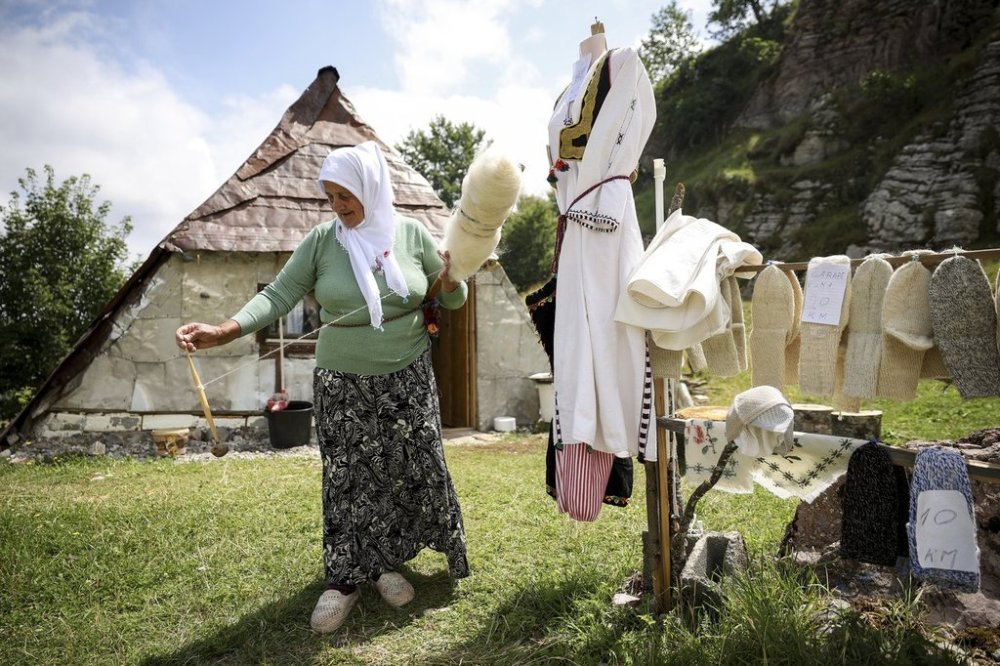
A Bosnian Muslim woman prepares wool that she later knits into sweaters or socks and sells to tourists in Umoljani village on Bjelasnica mountain near Sarajevo, Bosnia, Tuesday, Aug. 5, 2025. (AP Photo/Armin Durgut)

Fazlagic believes that by expanding their summer offerings, mountain resorts can lure tourists away from the scorching heat and high costs of traditional seaside vacations along the Adriatic coast of Croatia and Montenegro. He said increasing the area’s year-round appeal is “the future of tourism,” but acknowledged it’s a long-term strategy.

In 2017, after several winters with little snow, the Jahorina and Bjelasnica mountains near Sarajevo began to expand their summer offerings. These mountains, which hosted the 1984 Winter Olympics, have elevations of 1,906 meters (6,253 feet) and 2,067 meters (6,781 feet), respectively.

They now operate ski lifts year-round for scenic views and are steadily adding new hiking, biking and ATV trails and tours.

“The weather here is fantastic — it’s not hot at all,” said Dusko Kurtovic, a visitor from the Bosnian town of Doboj, while on a walk during a short vacation in Jahorina last week.

Like other visitors exploring the forest trails and riding ski lifts around Sarajevo, Kurtovic was dressed for balmy summer weather. Temperatures here typically stay between 24 and 30 degrees Celsius (75-86 degrees Fahrenheit).

The weather is a welcome change for tourists, as coastal regions in Central and Eastern Europe have experienced increasingly frequent and prolonged heat waves, with daily temperatures often reaching 40 degrees Celsius (104 degrees Fahrenheit) in the past few years.

Vasilije Knezevic, who leads quad tours of Jahorina’s highest peaks, noted that while the ski season was “bleak” because of the snow shortage, they are “having a fabulous summer so far.”

Business might be growing in the mountains of Sarajevo, but it remains far less profitable than seaside destinations in neighboring Croatia, where tourism accounts for up to 20% of the country’s gross domestic product.

Just a five-hour drive from Sarajevo, the ancient city of Dubrovnik is grappling with an abundance of tourists. Unlike their Bosnian counterparts who are trying to increase visitors, Dubrovnik’s tourism authorities are focused on managing crowds, limiting the number of tourists from cruise ships in the city to 4,000 at any one time during the day and restricting traffic around the Old Town to local permit holders.

Despite these restrictions and extreme summer heat, Dubrovnik recorded nearly two million overnight stays in the first seven months of 2025, almost double that of the Sarajevo region.

While climate change is driving Bosnia and Croatia toward different tourism strategies, both countries share a common objective: to “extend the season” and become a “year-round tourist destination,” in the words of Aida Hodzic of the Dubrovnik tourism board.

___

Associated Press writer Sabina Niksic in Sarajevo contributed.

Report Error Submit a Tip

More Stories

’Disgusting’ posters being investigated by police

Morgan Modjeski 4 minute read Updated: Yesterday at 1:32 PM CDT

The Winnipeg Police Service major crimes unit is investigating what some have labelled offensive and hateful posters on full-display at a Winnipeg home.

Essential workers ruling raises questions

Editorial 4 minute read Preview

Essential workers ruling raises questions

Editorial 4 minute read 2:00 AM CDT

Ever been to a Dynacare clinic? Most of us have been. It’s an amazing demographic and ethnic slice of the city we’ve become. Old patients. Young patients. New arrivals. Long-time Canadians. People who know the ropes — others who are startled by the crowds and the noise and the lockstep forward motion of professionals doing what they have been trained to do. It seems, all at the same time, both chaotic and diagnostic, as names of patients are steadily called out and thousands of tests are performed.

But Dynacare is at the centre of a new kind of test and this time, we’re all in the test tube together.

It’s the first real test for new labour law put in place by the government of Premier Wab Kinew in 2024 — a law that redefined what essential services are for provincially-regulated workplaces. Under this law, companies and their employee and unions must have an agreement of which employees are essential — which ones must stay on the job during a legal strike for the protection of the health and safety of the public.

Dynacare had that kind of essential employee agreement with its staff and union — the company and the union had agreed the employees were not essential.

Read
2:00 AM CDT

Former host/VJ Rick Campanelli revisits his gambling addiction in new memoir

Jen Zoratti 7 minute read Preview

Former host/VJ Rick Campanelli revisits his gambling addiction in new memoir

Jen Zoratti 7 minute read Yesterday at 6:00 AM CDT

To many Canadians, veteran media personality Rick Campanelli is better known as Rick the Temp, the energetic, baby-faced intern-turned-VJ on MuchMusic in the 1990s and early 2000s.

But behind that winning smile was a much darker reality.

In his new memoir, Tempted: My Story, released last month via HarperCollins Canada and co-written with John Meyer, Campanelli, 56, opens up for the first time about his struggles with a serious — and secret — gambling addiction, which reached its nadir in 2008 when the then-host of Entertainment Tonight Canada was detained by U.S. Homeland Security for unpaid casino debts on a flight back from Las Vegas.

The Free Press caught up with Campanelli in advance of his Winnipeg launch Monday evening at McNally Robinson Grant Park. This interview has been lightly edited for length and clarity.

Read
Yesterday at 6:00 AM CDT

Mayoral candidates Klein, Vogiatzakis continue to snipe over inducement allegations

Chris Kitching and Joyanne Pursaga 6 minute read Preview

Mayoral candidates Klein, Vogiatzakis continue to snipe over inducement allegations

Chris Kitching and Joyanne Pursaga 6 minute read Updated: Yesterday at 5:50 PM CDT

Winnipeg mayoral candidate Mike Vogiatzakis told reporters Monday he will contact the city clerk to report his allegation that rival Kevin Klein offered him a job to drop out of the race.

Vogiatzakis and Klein both doubled down a day after accusing each other of offering the other a position at city hall, if they were victorious in the Oct. 28 election, in exchange for a withdrawal.

“Do I want to get him charged? Not really. I don’t want to destroy anybody’s life,” Vogiatzakis told reporters.

“Kevin’s a good guy. I thought he was a friend of mine, but he’s not. Kevin uses leverage to get ahead, and he tried to use me as leverage.”

Read
Updated: Yesterday at 5:50 PM CDT

Pimp sentenced to 11 years in prison

Erik Pindera 5 minute read Preview

Pimp sentenced to 11 years in prison

Erik Pindera 5 minute read 2:00 AM CDT

A man who picked up a vulnerable 17-year-old child-welfare ward on the streets of Winnipeg and coerced her into providing sexual services for several months has been sent to prison for more than a decade.

After a trial, Hassan Kargbo, who’s in his early 30s, was found guilty of sexual exploitation, making child sexual abuse and exploitation material, receiving a material benefit from sexual services provided by a person under 18, procuring a person under 18 and advertising sexual services.

Provincial court Judge Julie Frederickson sentenced him to 11 years behind bars late last month.

“Mr. Kargbo picked up a young Indigenous girl walking over the Osborne Street bridge and quickly got her involved in drug use and escorting,” Frederickson said in a written decision.

Read
2:00 AM CDT

Letters, Oct. 6

6 minute read 2:00 AM CDT

High road not so easy

Re: Khan should’ve taken high road: Goertzen (Oct. 3)

Politics is a tough game. Just ask former provincial Liberal leader Dougald Lamont. He got thrown under the bus by a prominent Manitoba/Canadian Liberal who advised people to vote NDP in the last provincial election.

As Lamont said when he lost the election, he is “human” and what happened to him “hurt.” Khan is also human. It is easy to criticize him for not taking the “high road.”