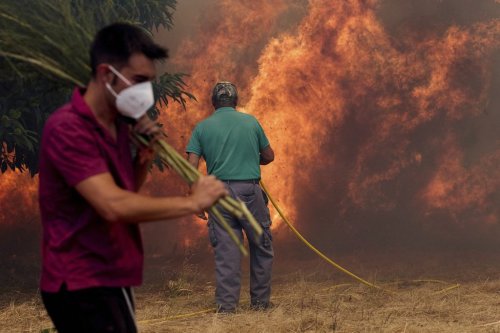
Spain battles one of its most destructive fire seasons even as its heat wave eases
Advertisement
Read this article for free:
or
Already have an account? Log in here »
To continue reading, please subscribe:

Digital Subscription
One year of digital access for only $205*
- Enjoy unlimited reading on winnipegfreepress.com
- Read the E-Edition, our digital replica newspaper
- Access News Break, our award-winning app
- Play interactive puzzles
*First annual payment billed as $205.00 + GST for one year. This annual subscription will automatically renew at $233.00 + GST every 52 weeks (10% off the regular annual price of $259.35). Offer available to new and qualified returning subscribers only. Cancel any time.
To continue reading, please subscribe:
Add Free Press access to your Brandon Sun subscription for only an additional
$1 for the first 4 weeks*
- Enjoy unlimited reading on winnipegfreepress.com
- Read the E-Edition, our digital replica newspaper
- Access News Break, our award-winning app
- Play interactive puzzles
*Your next Brandon Sun subscription payment will increase by $1.00 and you will be charged $17.95 plus GST for four weeks. After four weeks, your payment will increase to $24.95 plus GST every four weeks.
Read unlimited articles for free today:
or
Already have an account? Log in here »
Hey there, time traveller!
This article was published 19/08/2025 (415 days ago), so information in it may no longer be current.
MADRID (AP) — Spain tackled several major wildfires Tuesday in one of the country’s most destructive fire seasons in recent decades, despite temperatures dropping across the Iberian Peninsula.
Thousands of firefighters aided by soldiers and water-bombing aircraft fought fires tearing through parched woodland that were especially severe in northwestern Spain, where the country’s weather agency AEMET reported a still “very high or extreme” fire risk — particularly in the Galicia region.
The fires in Galicia have ravaged small, sparsely populated towns, forcing locals in many cases to step in before firefighters arrive.
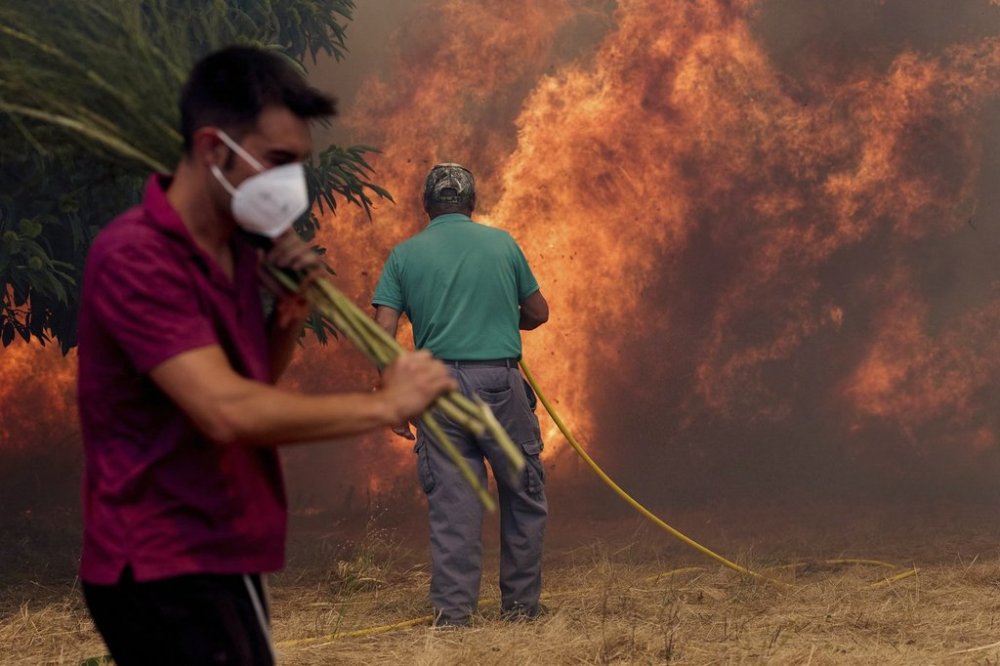
Firefighting units from Germany arrived in northern Spain on Tuesday to help fight the blazes, Spain’s Interior Ministry announced. More than 20 vehicles were deployed to help fight an ongoing blaze in Jarilla in the Extremadura region that borders Portugal, the ministry said.
Spanish Prime Minister Pedro Sánchez visited the area Tuesday and spoke of the heat that has fueled the fires. Temperatures across Spain dropped by about 4 degrees Celsius (about 7 degrees Fahrenheit) Tuesday after a 16-day heat wave with several days above 40 C (104 F), Spain’s weather agency reported.
“Science tells us, common sense tells us too, especially that of farmers and ranchers, of those who live in rural areas, that the climate is changing, that the climate emergency is becoming more and more recurrent, more frequent and has an ever greater impact,” Sánchez said.
In Galicia, land management has also played a role. Large stretches of unmanaged vegetation and depopulated villages in forested land have led to the buildup of wildfire fuel, said Adrian Regos, an ecologist at the Biological Mission of Galicia, a research institute.
The fires in Spain have killed four people this year and burned more than 382,000 hectares or about 1,475 square miles, according to the European Union’s European Forest Fire Information System. That surface area is more than twice the size of metropolitan London, more than six times the 2006-2024 average for land burned during the same period, according to EFFIS.

Air quality deteriorated across large parts of Spain over the past week as a result of the wildfires, data from the EU’s Copernicus climate monitoring agency showed. Smoke from the Iberian Peninsula fires reached France, the UK, and Scandinavia, it said.
Several fires have been caused by human activity. Police have detained 23 people for suspected arson and are investigating 89 more, Spain’s Civil Guard said Tuesday.
In Portugal, more than 3,700 firefighters were tackling blazes, including four major ones in the north and center.
Wildfires there have burned about 235,000 hectares or 907 square miles, according to EFFIS — nearly five times more than the 2006-2024 average for this period. Two people there have died.
Europe has been warming twice as fast as the global average since the 1980s, according to Copernicus. Scientists say that climate change is exacerbating the frequency and intensity of heat and dryness in parts of Europe, making the region more vulnerable to wildfires.