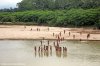
Isolated Amazon tribe seen near logging bridge site, alarming rights group

Advertisement

Advertise with us

BOGOTA, Colombia (AP) — Members of an Indigenous tribe who live deep in Peru’s Amazon rainforest and avoid contact with outsiders have been reported entering a neighboring village in what activists consider an alarming sign that the group is under stress from development.

Read this article for free:


or

Already have an account? Log in here »

To continue reading, please subscribe:

Subscribe and receive a limited-edition Free Press branded hat or tote.

Digital Subscription

One year of digital access for only $205*

  • Enjoy unlimited reading on winnipegfreepress.com
  • Read the E-Edition, our digital replica newspaper
  • Access News Break, our award-winning app
  • Play interactive puzzles

*First annual payment billed as $205.00 + GST for one year. This annual subscription will automatically renew at $233.00 + GST every 52 weeks (10% off the regular annual price of $259.35). Offer available to new and qualified returning subscribers only. Cancel any time.

To continue reading, please subscribe:

Add Free Press access to your Brandon Sun subscription for only an additional

$1 for the first 4 weeks*

  • Enjoy unlimited reading on winnipegfreepress.com
  • Read the E-Edition, our digital replica newspaper
  • Access News Break, our award-winning app
  • Play interactive puzzles
Start now

*Your next Brandon Sun subscription payment will increase by $1.00 and you will be charged $17.95 plus GST for four weeks. After four weeks, your payment will increase to $24.95 plus GST every four weeks.

Hey there, time traveller!
This article was published 28/08/2025 (383 days ago), so information in it may no longer be current.

BOGOTA, Colombia (AP) — Members of an Indigenous tribe who live deep in Peru’s Amazon rainforest and avoid contact with outsiders have been reported entering a neighboring village in what activists consider an alarming sign that the group is under stress from development.

The sightings of members of Mashco Piro tribe come as a logging company is building a bridge that could give outsiders easier access to the tribe’s territory, a move that could raise the risk of disease and conflict, according to Survival International, which advocates for Indigenous rights.

The Mashco Piro are among the world’s largest uncontacted groups, living without regular interaction with outside society to protect their culture and health. Even a simple cold can be deadly to the group because it lacks immunity to common diseases.
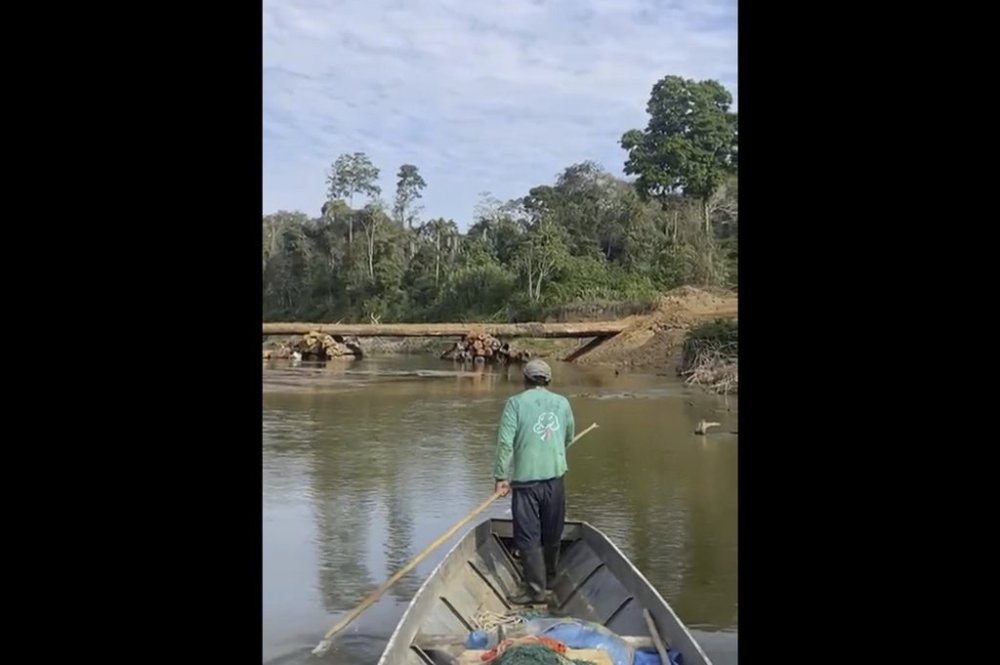
In this frame from video provided by Survival International, Dabi Nishida, of the Yine Indigenous group, maneuvers a boat near a bridge built by the company Maderera Canales Tahuamanu along the Tahuamanu River in the Peruvian Amazon’s Mashco Piro territory near the Nueva Oceania village on Aug. 18, 2025. (Courtesy of Survival International via AP)

Loggers who encroached on the tribe’s lands have previously been killed.

Enrique Añez, president of the nearby Yine community, another Indigenous group, said in a statement Tuesday that Mashco Piro members had been seen around the Yine village of Nueva Oceania.

“It is very worrying; they are in danger,” Añez said.

Añez said heavy machinery near Nueva Oceania is cutting paths through the jungle and across rivers into Mashco Piro territory. The village sits at a key access point to the Mashco Piro’s territory, making it one of the few places where members of the tribe have occasionally been seen.

Increased risk for logging workers and Indigenous peoples

Survival International last year released photos showing dozens of Mashco Piro close to active logging zones. The group warns that contact with outsiders could spread disease or lead to violent conflict — risks that have previously wiped out other isolated groups in the Amazon.

Last year, two loggers were killed in bow-and-arrow attacks after entering Mashco Piro territory.

“Exactly one year after the encounters and the deaths, nothing has changed in terms of land protection and the Yine are now reporting to have seen both the Mashco Piro and the loggers exactly in the same space almost at the same time,” said Teresa Mayo, a researcher at Survival International. “The clash could be imminent.”

Mayo said the logging company near the Indigenous group has restarted operations as normal.

“They still have the license of the government, and that is how they back their activities even if they know they are putting both Mashco Piro and their workers’ lives at risk,” she said.

The Forest Stewardship Council — an international body that certifies sustainable wood products — has suspended its approval of the logging company, Maderera Canales Tahuamanu, until November. However, Survival International said the bridge and heavy machinery footprints are evidence that logging is still taking place.

The company’s concessions, or licensed logging areas, border the Madre de Dios Territorial Reserve and overlap recognized Mashco Piro land proposed by Indigenous organizations for new protections.

The Associated Press reached out to Maderera Canales Tahuamanu but did not receive an immediate response.

Peru’s Culture Ministry — tasked with promoting cultural identity and overseeing Indigenous rights — told AP it is reviewing Survival International’s report.

When questioned on what measures the government is taking to protect groups like the Mashco Piro it noted it has created eight reserves for Indigenous peoples in isolation, has five more pending, and operates 19 control posts with 59 protection agents. It said more than 440 patrols have been carried out this year and that its budget for protecting isolated communities more than doubled in 2025.

Encroachment fuels more encounters with isolated group

The Tahuamanu River is a key transport route in this part of the Amazon. A permanent bridge will allow year-round truck access, which environmentalists say could accelerate logging and deforestation deeper inside the forest.

Rights advocates say logging is pushing the Mashco Piro toward nearby villages, making encounters more likely.

César Ipenza, a Peruvian environmental lawyer following the issue, told AP “these Indigenous peoples are exposed and vulnerable to any type of contact or disease, yet extractive activities continue despite all the evidence of the problems they cause in the territory.”

He noted that the Madre de Dios Territorial Reserve — created by the Peruvian government in 2002 to protect the lands of uncontacted and recently contacted Indigenous peoples — has not prevented conflict because “they do not necessarily know its boundaries.”

Madre de Dios is a remote southeastern Amazon region bordering Brazil and Bolivia. It is one of Peru’s most biodiverse areas, but it has also been a hot spot for illegal gold mining, logging and other extractive industries that bring outsiders into contact with isolated tribes.

“The growing presence of forestry operations will almost certainly lead to renewed contact with isolated Indigenous peoples, creating a violent situation that endangers them as well as the workers in the area,” Ipenza said.

___

The Associated Press’ climate and environmental coverage receives financial support from multiple private foundations. AP is solely responsible for all content. Find AP’s standards for working with philanthropies, a list of supporters and funded coverage areas at AP.org.

Report Error Submit a Tip

More Stories

Defenceman Morrissey focused on season ahead

Ken Wiebe 8 minute read Preview

Defenceman Morrissey focused on season ahead

Ken Wiebe 8 minute read Yesterday at 12:08 PM CDT

Josh Morrissey insists that a trade request from the franchise goalie doesn’t change his desire to be a lifelong Winnipeg Jet.

The top-pairing defenceman and alternate captain reinforced that view on Monday morning when speaking to a group of reporters prior to the Winnipeg Jets Golf Classic at St. Charles Country Club.

“At the end of the day, I love being here and I love being a Jet. That’s how I’ve always felt,” said Morrissey, who spoke for just over nine minutes on a variety of topics. “That doesn’t change because of somebody else’s decision. Nothing is finalized, so who knows, he could be back. My position doesn’t change.”

Morrissey has two years left on a contract that pays him US$6.25 million and he’s only eligible to sign an extension on July 1, but the future of the franchise pillar will be a topic of discussion as the Jets work to sort through the situation with franchise goaltender Connor Hellebuyck, which remains unresolved.

Read
Yesterday at 12:08 PM CDT

Premier touts Port of Churchill opportunities at Canadian investment summit

Carol Sanders 5 minute read Preview

Premier touts Port of Churchill opportunities at Canadian investment summit

Carol Sanders 5 minute read Updated: Yesterday at 6:58 PM CDT

Premier Wab Kinew announced Monday that major capital investments in the Port of Churchill Plus project will receive an exemption from Manitoba’s seven per cent retail sales tax.

Kinew made the announcement at the start of the two-day Canada investment summit in Toronto. The premier made the pitch to a room of 250 Canadian and global investors representing more than US$13 trillion in assets.

“We are here in Toronto to tell global investors that the Port of Churchill is open and ready to expand,” Kinew told the Canadian Global Growth Forum, a provincial government news release said.

“These new capital incentives make it easier for investors to get in on the ground floor of the largest project featured at the Canada investment summit. The grain and critical minerals we are already shipping out of the port are reaching Europe faster than the Port of Vancouver. With the right investments we can ship commodities year-round, strengthening trade between reliable partners and creating good jobs,” the premier, who was not made available for an interview, said in the release.

Read
Updated: Yesterday at 6:58 PM CDT

Don’t deny kids a bedtime bond with Gran

Maureen Scurfield 5 minute read Yesterday at 2:00 AM CDT

DEAR MISS LONELYHEARTS: My mother is coming to visit and our little kids want her to sleep in their bedroom, where there’s a double bed and a single. My husband thinks this idea is ridiculous and says grandma needs her sleep, but I disagree.

I remember sleeping with my grandma — who’s now with the angels — and she told us grandkids (two girls) some wonderful bedtime stories she made up herself. She even put our names into them, making us the stars of the stories.

The best part was getting into our pyjamas with our grandmother, who showed us the magic cord from the little thing that ran from her near-deaf ear down to the secret battery pocket hidden in the bra of her slip. It made her hear us better in the daytime. We thought, “Wow!”

Not surprisingly my own mother has inherited her mom’s fantastic storytelling talent and who knows what else she has to teach the kids when she’s alone with them? I want them to be close.

Letters, Sept 15

7 minute read 2:00 AM CDT

Building for the future

It’s hard to argue with Tom Brodbeck’s column Carney cashes in standing to U.S. bully, Free Press, Sept. 12, because everything in the article makes sense.

But I think Canada is cashing in as well.

The rather depressing environment created by Trump has given impetus to an aggressive slate of policies promulgated by Prime Minister Mark Carney that with a little luck (that’s code for preparation, opportunity and hard work) will position Canada for a much brighter future once the tin-pot dictator is gone.

Winnipeg venues saying no to AI-made advertisements

Sheldon Birnie 8 minute read Preview

Winnipeg venues saying no to AI-made advertisements

Sheldon Birnie 8 minute read Updated: Yesterday at 10:22 AM CDT

Although the days when telephone poles and notice boards across the city were thick with gig posters, either slopped up with wheat paste or wrapped tight with packing tape, are behind us, the art of making an appealing visual ad for live music events is still a vital part of the local creative scene.

However, a widespread backlash against a new kind of slop — the use of generative AI images — has been building, especially among creatives when it comes to promoting live music.

“Live music is and always has been a DIY type of scene, especially locally,” says Evan Simpson, who has been working as a graphic designer for nearly a decade.

“For years people have been making their own flyers, or if they have the budget, hiring a designer or artist to come up with some artwork for their flyers. It’s a whole ecosystem, a scene supporting itself. If you take away the visual side of it, the spark, individuality and uniqueness of each gig poster is lost. What a sad world it would be if all art were made by AI.”

Read
Updated: Yesterday at 10:22 AM CDT

Winnipeg and choosing its future direction

Kate Kehler 5 minute read 2:00 AM CDT

Winnipeg, the capital of ‘Friendly Manitoba’, is becoming far less friendly to anyone who is struggling to survive. The city is also less and less supportive of the not-for-profit sector which struggles to support those struggling to survive.

Municipal politicians have long insisted that social services are provincial responsibilities. However, the city charter makes it clear that mayor and council are “to promote and maintain the health, safety and welfare of the inhabitants.”

Mayor and council are empowered to decide how they do that. Every four years, we citizens get to vote on what we think and feel about those decisions. That’s our democracy, weighted against the disenfranchised though it is.

In 2022, only 37.17 per cent of eligible voters, the lowest percentage since 1989, voted. Recent Probe Research data demonstrates that only one-third of Winnipeggers believe the next mayor and council will make even a minor difference in addressing Winnipeg’s challenges, and another third believe they will make no difference at all.