Uncontacted Indigenous groups could vanish within a decade without stronger protections, experts say
Advertisement
Read this article for free:
or
Already have an account? Log in here »
To continue reading, please subscribe:

Digital Subscription
One year of digital access for only $205*
- Enjoy unlimited reading on winnipegfreepress.com
- Read the E-Edition, our digital replica newspaper
- Access News Break, our award-winning app
- Play interactive puzzles
*First annual payment billed as $205.00 + GST for one year. This annual subscription will automatically renew at $233.00 + GST every 52 weeks (10% off the regular annual price of $259.35). Offer available to new and qualified returning subscribers only. Cancel any time.
To continue reading, please subscribe:
Add Free Press access to your Brandon Sun subscription for only an additional
$1 for the first 4 weeks*
- Enjoy unlimited reading on winnipegfreepress.com
- Read the E-Edition, our digital replica newspaper
- Access News Break, our award-winning app
- Play interactive puzzles
*Your next Brandon Sun subscription payment will increase by $1.00 and you will be charged $17.95 plus GST for four weeks. After four weeks, your payment will increase to $24.95 plus GST every four weeks.
Read unlimited articles for free today:
or
Already have an account? Log in here »
Hey there, time traveller!
This article was published 26/10/2025 (343 days ago), so information in it may no longer be current.
BOGOTA, Colombia (AP) — From the depths of Brazil’s Amazon to Indonesia’s rainforests, some of the world’s most isolated peoples are being squeezed by roads, miners and drug traffickers — a crisis unfolding far from public view or effective state protection.
A new report by Survival International, a London-based Indigenous rights organization, attempts one of the broadest tallies yet, identifying at least 196 uncontacted Indigenous groups in 10 countries, primarily in the South American nations sharing the Amazon rainforest. Released Sunday, the report estimates that nearly 65% face threats from logging, about 40% from mining and around 20% from agribusiness.
“These are what I would call silent genocides — there are no TV crews, no journalists. But they are happening, and they’re happening now,” said Fiona Watson, Survival’s research and advocacy director, who has worked on Indigenous rights for more than three decades.
The issue often receives little priority from governments, which critics say see uncontacted peoples as politically marginal because they don’t vote and their territories are often coveted for logging, mining and oil extraction. Public debate is also shaped by stereotypes — some romanticize them as “lost tribes,” while others view them as barriers to development.
Survival’s research concludes that half of these groups “could be wiped out within 10 years if governments and companies do not act.”
Who the uncontacted peoples are
Uncontacted peoples are not “lost tribes” frozen in time, Watson said. They are contemporary societies that deliberately avoid outsiders after generations of violence, slavery and disease.
“They don’t need anything from us,” Watson said. “They’re happy in the forest. They have incredible knowledge and they help keep these very valuable forests standing — essential to all humanity in the fight against climate change.”
Survival’s research shows that more than 95% of the world’s uncontacted peoples live in the Amazon, with smaller populations in South and Southeast Asia and the Pacific. These communities live by hunting, fishing and small-scale cultivation, maintaining languages and traditions that predate modern nation-states.
Why contact can be deadly
Groups living in voluntary isolation have “minimal to no contact with those outside of their own group,” said Dr. Subhra Bhattacharjee, director general of the Forest Stewardship Council and an Indigenous rights expert based in Bonn, Germany. “A simple cold that you and I recover from in a week … they could die of that cold.”
Beyond disease, contact can destroy livelihoods and belief systems. International law requires free, prior and informed consent — known as FPIC — before any activity on Indigenous lands.
“But when you have groups living in voluntary isolation, who you cannot get close to without risking their lives, you cannot get FPIC,” Bhattacharjee said. “No FPIC means no consent.”
Her organization follows a strict policy: “No contact, no-go zones,” she said, arguing that if consent cannot be obtained safely, contact should not occur at all.
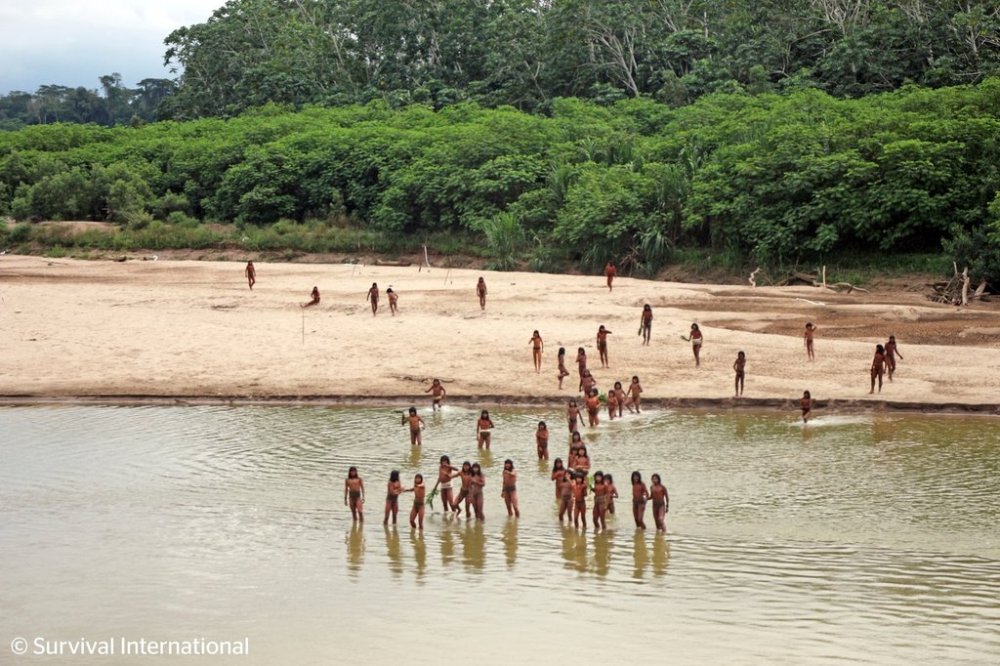
The Associated Press reported last year on loggers killed by bow and arrow after entering Mashco Piro territory in Peru’s Amazon, with Indigenous leaders warning that such clashes are inevitable when frontier zones go unpoliced.
How the threats have evolved
Watson, who has worked across the Amazon for 35 years, said early threats stemmed from colonization and state-backed infrastructure. During Brazil’s military dictatorship between 1964 and 1985, highways were bulldozed through the rainforest “without due regard” for the people living there.
“The roads acted as a magnet for settlers,” she said, describing how loggers and cattle ranchers followed, bringing gunmen and disease that wiped out entire communities.
A railway line now planned in Brazil could potentially affect three uncontacted peoples, she said, but the rise of organized crime poses an even greater risk.
Across Peru, Brazil, Colombia, Venezuela and Ecuador, drug traffickers and illegal gold miners have moved deep into Indigenous territories. “Any chance encounter runs the risk of transmitting the flu, which can easily wipe out an uncontacted people within a year of contact,” she said. “And bows and arrows are no match for guns.”
Evangelical missionary incursions have also caused outbreaks. Watson recalled how, under former Brazilian President Jair Bolsonaro, an evangelical pastor was placed in charge of the government’s unit for uncontacted peoples and gained access to their coordinates. “Their mission was to force contact — to ‘save souls,’” she said. “That is incredibly dangerous.”
Ways to protect uncontacted peoples
Protecting uncontacted peoples, experts say, will require both stronger laws and a shift in how the world views them — not as relics of the past, but as citizens of the planet whose survival affects everyone’s future.
Advocates have several recommendations.
First, governments must formally recognize and enforce Indigenous territories, making them off-limits to extractive industries.
Mapping is crucial, Bhattacharjee said, because identifying the approximate territories of uncontacted peoples allows governments to protect those areas from loggers or miners. But, she added, it must be done with extreme caution and from a distance to avoid contact that could endanger the groups’ health or autonomy.
Second, corporations and consumers must help stop the flow of money driving destruction. Survival’s report calls for companies to trace their supply chains to ensure that commodities such as gold, timber and soy are not sourced from Indigenous lands.
“Public opinion and pressure are essential,” Watson said. “It’s largely through citizens and the media that so much has already been achieved to recognize uncontacted peoples and their rights.”
Finally, advocates say the world must recognize why their protection matters. Beyond human rights, these communities play an outsized role in stabilizing the global climate.
“With the world under pressure from climate change, we will sink or swim together,” Bhattacharjee said.
Governments’ uneven response
International treaties such as the International Labor Organization’s Convention 169 and the U.N. Declaration on the Rights of Indigenous Peoples affirm the right to self-determination and to remain uncontacted if they choose. But enforcement varies widely.
In Peru, Congress recently rejected a proposal to create the Yavari-Mirim Indigenous Reserve, a move Indigenous federations said leaves isolated groups exposed to loggers and traffickers.
In Brazil, President Luiz Inácio Lula da Silva has sought to rebuild protections weakened under Bolsonaro, boosting budgets and patrols.
And in Ecuador, the Inter-American Court of Human Rights ruled this year that the government failed to protect the Tagaeri and Taromenane peoples who live in voluntary isolation in Yasuni National Park.
Watson warned that political forces tied to agribusiness and evangelical blocs are now working to roll back earlier gains.
“Achievements of the last 20 or 30 years are in danger of being dismantled,” she said.
What the new report calls for
Survival International’s report urges a global no-contact policy: legal recognition of uncontacted territories, suspension of mining, oil and agribusiness projects in or near those lands and prosecution of crimes against Indigenous groups.
Watson said logging remains the biggest single threat, but mining is close behind. She pointed to the uncontacted Hongana Manyawa on Indonesia’s Halmahera Island, where nickel for electric-vehicle batteries is being mined.
“People think electric cars are a green alternative,” she said, “but mining companies are operating on the land of uncontacted peoples and posing enormous threats.”
In South America, illegal gold miners in the Yanomami territory of Brazil and Venezuela continue to use mercury to extract gold — contamination that has poisoned rivers and fish.
“The impact is devastating — socially and physically,” Watson said.
___
The Associated Press’ climate and environmental coverage receives financial support from multiple private foundations. AP is solely responsible for all content. Find AP’s standards for working with philanthropies, a list of supporters and funded coverage areas at AP.org.
Related Articles
Peru rejects creation of Amazon reserve to protect uncontacted tribes, drawing Indigenous outcry
Advertisement Advertise With Us
Advertisement Advertise With Us