India’s solar industry, aiming to compete with China, finds strength as US tariffs hit home
Advertisement
Read this article for free:
or
Already have an account? Log in here »
To continue reading, please subscribe:

Digital Subscription
One year of digital access for only $205*
- Enjoy unlimited reading on winnipegfreepress.com
- Read the E-Edition, our digital replica newspaper
- Access News Break, our award-winning app
- Play interactive puzzles
*First annual payment billed as $205.00 + GST for one year. This annual subscription will automatically renew at $233.00 + GST every 52 weeks (10% off the regular annual price of $259.35). Offer available to new and qualified returning subscribers only. Cancel any time.
To continue reading, please subscribe:
Add Free Press access to your Brandon Sun subscription for only an additional
$1 for the first 4 weeks*
- Enjoy unlimited reading on winnipegfreepress.com
- Read the E-Edition, our digital replica newspaper
- Access News Break, our award-winning app
- Play interactive puzzles
*Your next Brandon Sun subscription payment will increase by $1.00 and you will be charged $17.95 plus GST for four weeks. After four weeks, your payment will increase to $24.95 plus GST every four weeks.
Read unlimited articles for free today:
or
Already have an account? Log in here »
Hey there, time traveller!
This article was published 04/09/2025 (407 days ago), so information in it may no longer be current.
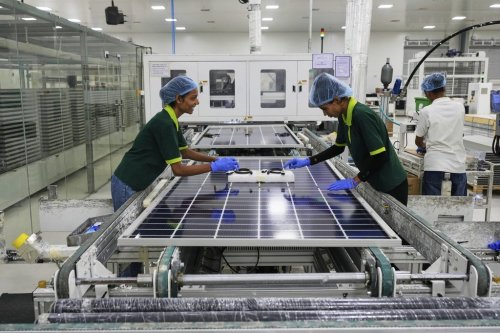
JAIPUR, India (AP) — On the edge of Jaipur, an Indian city known for its colorful bazaars and palaces, a bustling industrial complex is the epicenter of the country’s push to compete with China in making components for solar technology.
India, the world’s most populous nation, is jockeying for market share against the global leader in solar in part by selling to its own citizens, which helps the country with its other goal: meeting growing domestic demand for electricity.
In the government-subsidized zone that provides tax breaks, solar manufacturer ReNew’s sprawling factory makes enough modules to produce 4 gigawatts of power each year — equivalent to the energy needed for approximately 2.5 million Indian homes. The 2-year-old facility that employs nearly 1,000 people serves as a symbol of the solar industry’s momentum. India’s capacity to build key solar components more than doubled in the fiscal year ending in March.
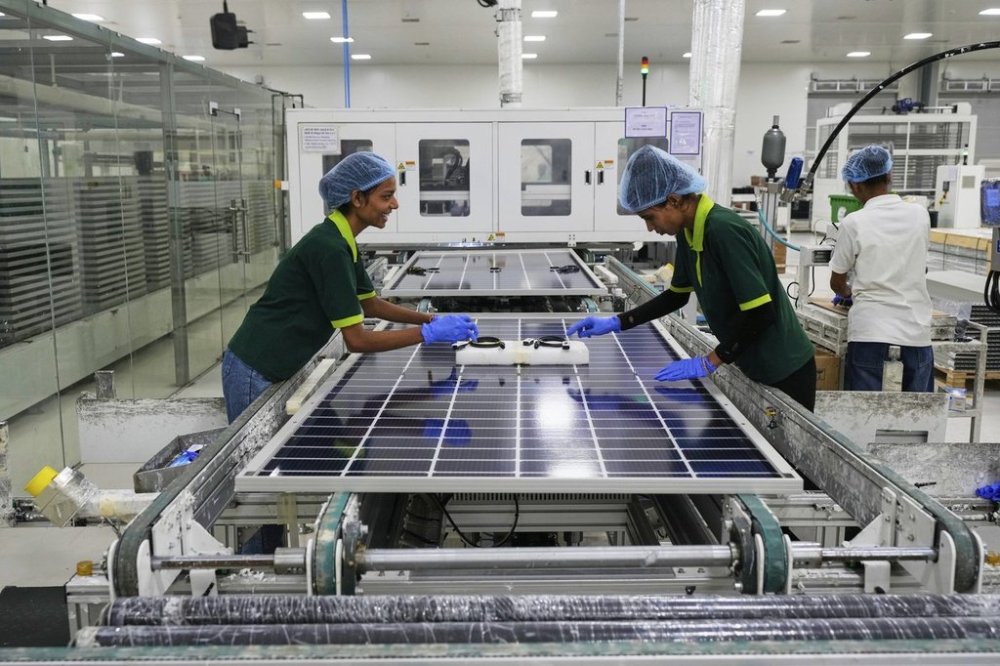
“When I got this opportunity, I was really happy that I was directly contributing to the clean energy transition,” said Monisha, an engineer at ReNew who goes by one name. She said the work has helped her become independent and assist her family with their finances.
The country still faces a steep climb in its efforts to develop solar manufacturing that could one day rival China, which makes more than 80% of all solar components in the world and supplies key materials to Indian manufacturers.
India’s solar industry must also contend with a tougher sell to its biggest foreign customer, the United States. President Donald Trump’s tariffs of 50% on Indian goods took effect last month, while Trump’s administration and Republican lawmakers have taken other steps to hinder U.S. adoption of solar and other clean energy.
Still, India’s clean energy appetite is helping its solar manufacturers deal with the external pressures. Energy analysts said India’s domestic demand for solar power will likely reduce disruption from tariffs imposed by the U.S., where about a third of the solar panels produced by India were sold in a recent fiscal year. Proceeds from selling in the lucrative U.S. market have helped Indian solar manufacturers update their supply chains in recent years so they were less dependent on imported Chinese parts and materials.
While Indian solar manufacturers can sell at higher prices abroad, ambitious domestic clean energy targets and domestic demand will help them find buyers within India if sales in the U.S. slow, analysts said.
“This is a huge industry that can absorb these modules and cells that are being produced. We are not necessarily as export dependent as other countries are,” said Charith Konda, an energy analyst at the Institute for Energy Economics and Financial Analysis.
India’s domestic solar market has already helped Hyderabad-based Vega Solar shift its customer base for off-grid solar modules for RVs, electric fences and other uses to customers in India in the years since the COVID-19 pandemic, said Vinay Keesara, a company director.
“Before the pandemic, 90% of my business was exports and 10% used to be domestic supply, now this has just flipped the other way around,” he said.
Government policies, demand push solar industry’s growth
One of the most carbon-polluting countries, India is making huge efforts to harness the power of the sun and other clean energy sources. The cost of solar power — now half that of new coal-powered plants — and India’s many sunny days are reasons that experts said installed solar power increased 30 times in the last decade.
Before the U.S. tariffs were announced, researchers with IEEFA and Gurugram, India-based JMK Research wrote that India’s demand for solar modules during the next two years could exceed what its manufacturers are selling within the country because so many are being exported. India has also been importing solar modules from China.
Konda said it was too early to determine how the U.S. tariffs will affect Indian solar manufacturers, but that the impact won’t be felt for at least another year because solar component orders are placed well in advance. And uncertainty remains over the fate of all of Trump’s tariffs. Despite a U.S. court ruling against Trump’s tariffs, they remain in place until at least October while his administration files appeals.
India has nearly 170 gigawatts of renewable energy projects in the pipeline — most of which are solar — and are expected to be completed in the next few years. The country also has an ambitious clean energy target of 500 gigawatts by 2030.
Government policies restricting imports of solar components, incentives for solar manufacturers and mandates for solar power producers to purchase material from government-approved sources gave Indian companies the right signals to ramp up solar manufacturing, said Sanjay Verghese, ReNew’s group president for solar manufacturing and solar projects.
“We are in a good phase right now,” he said. “We are highly dependent on policy support, but we expect that momentum to be maintained.”
Despite supply chain bottlenecks, Indian manufacturing will likely grow
India still depends on imports of raw materials as well as finished solar components from China but is making progress on reducing its reliance. Government data showed India imported $1.3 billion worth of solar cells and modules from China in the first quarter of the year, down by more than one-third from the same period a year earlier. Cells are individual units that convert sunlight into energy, while modules are made up of multiple cells.
Neshwin Rodrigues, an analyst at climate energy think tank Ember, predicted that by 2030, India might be in a position of needing to import only the raw material polysilicon while producing other solar panel ingredients in the country.
According to India’s renewable energy ministry, the country’s solar module manufacturing capacity more than doubled to 74 gigawatts over the fiscal year ending March 2025. Solar cell manufacturing tripled in the same period, from 9 gigawatts to 25 gigawatts.
India still needs Chinese raw materials because it lacks infrastructure to mine and process them, but government initiatives to produce critical minerals are slowly addressing the problem, experts said.
Shubhang Parekh of the National Solar Energy Federation of India said the supply chains needed to process the raw materials are still a work in progress, but he’s confident the challenges can be overcome.
“The next few years will be critical in determining how far we can go,” Parekh said.
___

Follow Sibi Arasu on X at @sibi123
___
Arasu reported from Bengaluru, India.
___
The Associated Press’ climate and environmental coverage receives financial support from multiple private foundations. AP is solely responsible for all content. Find AP’s standards for working with philanthropies, a list of supporters and funded coverage areas at AP.org.