Liberal MPs reluctant to lower 2030 and 2035 climate targets

Advertisement

Advertise with us

EDMONTON - Some Liberal MPs are reluctant to see their government lower its greenhouse gas emission reduction targets for 2030 and 2035, as Prime Minister Mark Carney stays quiet on whether Canada is still committed to meeting its climate goals.

Read this article for free:


or

Already have an account? Log in here »

To continue reading, please subscribe:

Subscribe and receive a limited-edition Free Press branded hat or tote.

Digital Subscription

One year of digital access for only $205*

  • Enjoy unlimited reading on winnipegfreepress.com
  • Read the E-Edition, our digital replica newspaper
  • Access News Break, our award-winning app
  • Play interactive puzzles

*First annual payment billed as $205.00 + GST for one year. This annual subscription will automatically renew at $233.00 + GST every 52 weeks (10% off the regular annual price of $259.35). Offer available to new and qualified returning subscribers only. Cancel any time.

To continue reading, please subscribe:

Add Free Press access to your Brandon Sun subscription for only an additional

$1 for the first 4 weeks*

  • Enjoy unlimited reading on winnipegfreepress.com
  • Read the E-Edition, our digital replica newspaper
  • Access News Break, our award-winning app
  • Play interactive puzzles
Start now

*Your next Brandon Sun subscription payment will increase by $1.00 and you will be charged $17.95 plus GST for four weeks. After four weeks, your payment will increase to $24.95 plus GST every four weeks.

Hey there, time traveller!
This article was published 11/09/2025 (387 days ago), so information in it may no longer be current.

EDMONTON – Some Liberal MPs are reluctant to see their government lower its greenhouse gas emission reduction targets for 2030 and 2035, as Prime Minister Mark Carney stays quiet on whether Canada is still committed to meeting its climate goals.

Carney and several of his ministers have created uncertainty in recent days by refusing to clearly reaffirm these early targets, which are intended to lead to carbon neutrality by 2050.

Canada’s commitments under the Paris Agreement include reducing emissions by at least 40 per cent from 2005 levels by 2030.
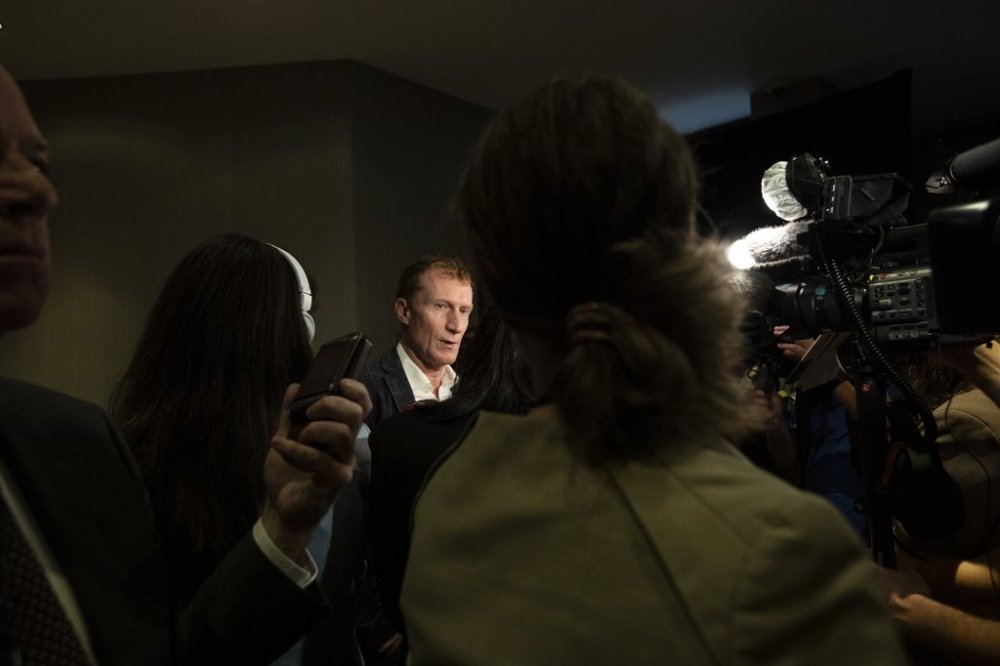
MP Mark Miller speaks to the media at the Liberal caucus in Edmonton on Wednesday, Sept. 10, 2025. THE CANADIAN PRESS/Amber Bracken. The Canadian Press

“Personally, I’m not keen to see these targets reduced,” said Montreal MP and former minister Marc Miller on Wednesday when asked about the targets, which were enshrined in 2021 legislation.

Miller, who was speaking ahead of a Liberal caucus meeting in Edmonton, noted it remains to be seen what option the prime minister will pursue. Carney has been dodging reporters who have been trying to ask him questions since his arrival on Tuesday in the Alberta city where he grew up.

In a speech on Wednesday, Carney reiterated his plan to eventually unveil what he called a “climate competitiveness strategy,” but did not mention the 2030 and 2035 milestones. The strategy, he said, “will focus on results rather than targets, on investments rather than bans.”

On Thursday, he unveiled the first five major projects selected for fast-track approval under new legislation — the Building Canada Act. The projects include an expansion of the Port of Montreal and work to double liquefied natural gas production in British Columbia. The legislation gives federal ministers the power to designate projects as being of national interest based on specific “factors,” which include “contributing to clean growth.”

Once designated, the projects can proceed without having to comply with multiple laws, including the Canadian Environmental Protection Act.

For Miller, if the 2030 and 2035 targets are changed, the government would need to explain “what the goal is, what steps need to be taken to ensure that Canadians can live with an economy that works, but also an environment that is healthy.”

“I think that, precisely for young people and for the people who elect us, it’s very important to have that balance,” he continued.

Ontario MP Nathaniel Erskine-Smith was unequivocal in saying he opposes a revision of the targets. 

“Backsliding on our commitments around climate, if you read (Carney’s book) ‘Values’, would be a very odd thing for us to do,” said Toronto MP Nate Erskine-Smith. 

B.C. MP Jonathan Wilkinson, who has served as both energy and environment minister, said there is no mechanism under the Paris Agreement that allows Canada to officially lower its targets. 

“We can raise the targets, but it’s very difficult to lower them,” he told reporters. “However, the federal government must continue to work toward achieving the targets.”

Erskine-Smith added that he understands the political reasons that led the prime minister to decide to shelve consumer carbon pricing on fuels, commonly referred to as the “carbon tax” but said that means the government has to strengthen things like industrial carbon pricing. 

He added that he didn’t yet have the “full portrait” of the situation.

His colleague Chris Bittle, also an Ontario MP, hesitated when asked if he was open to changing the 2030 target.

He finally answered in the affirmative, but seemed uncomfortable as he noted that Edmonton is covered in smoke from forest fires. Bittle said the government still needs to show it will be strong on climate change, when people can see it happening right in front of them.

Heritage Minister Steven Guilbeault, who formerly held the environment portfolio, did not want to comment on the possibility of revising the 2030 and 2035 targets, saying only that “climate change remains a priority issue for (the) government,” and that it “continues to move forward” with measures already in place, such as industrial carbon pricing.

This report by The Canadian Press was first published Sept. 11, 2025.

Report Error Submit a Tip

More Stories

Letters, Oct. 3

7 minute read 2:01 AM CDT

A morning in the life …

My very first lesson does not start when I walk into that lecture hall, oh no — it starts long before. It begins when I walk to my car, check the estimated arrival time to the University of Manitoba and hope that Winnipeg traffic agrees with it.

A drive that appears completely manageable changes almost immediately when I’m greeted by a tsunami of orange pylons and a line of cars that appears to go on forever. Traffic moves by the inch, lanes magically disappear and the detour I took yesterday now has a detour of its own. These factors make me do a calculation that I have become all too familiar with. How late can I arrive and still find parking, run to my class across campus and get to class with enough time left to make it worth it?

I have grown used to people saying, “Why not just leave earlier?” I do. But when I’m already leaving for my 8:30 a.m. class at 7 a.m., there’s only so much I can do. This drive that some would think is relaxing is one that feels like an assignment that I didn’t know I had to complete and is due at 8:30 a.m.

Free Press staff 2 minute read 2:01 AM CDT

Advance voting for civic and school board elections begins next week.

Voters can cast early ballots for the Oct. 28 election in certain locations from Monday through Oct. 23.

Eligible voters can use their address to search for a convenient location.

Early votes can be cast at the council building at city hall (510 Main St.) every day, except weekends and Thanksgiving, from Monday to Oct. 23.

Health minister warns $1.2 billion in annual federal funding set to expire in March

Scott Billeck 4 minute read Preview

Health minister warns $1.2 billion in annual federal funding set to expire in March

Scott Billeck 4 minute read Thursday, Oct. 1, 2026

Manitoba’s health minister is warning of possible cuts to health care with $1.2 billion in annual funding from Ottawa set to expire next year.

“We’re very concerned that what would be the largest cut to health care in a generation is right in front of us,” Health Minister Uzoma Asagwara said Thursday at the Manitoba legislature. “It means that services that Manitobans depend on will be in jeopardy and be at risk.

“Any reductions, any cuts from Canada, will have direct impacts on the health outcomes of Manitobans.”

Asagwara, who serves as the provincial and territorial health minister lead, chaired a virtual meeting Tuesday with provincial and territorial health ministers to discuss federal funding for health care, mental health care and substance use services, which is scheduled to expire March 31, 2027.

Read
Thursday, Oct. 1, 2026

Brandonmeat packer thriving on its own

Abiola Odutola 3 minute read Preview

Brandonmeat packer thriving on its own

Abiola Odutola 3 minute read 2:01 AM CDT

BRANDON — Canada Packers has strengthened its business and laid the foundation for future growth during its first year as an independent company, its president says.

The Brandon-based pork producer, separated from Maple Leaf Foods in October 2025, established its own leadership, strategy, systems, culture and identity while continuing operations across its hog production farms and regional hog barns in southern and eastern Manitoba.

The company’s first year was focused on building a successful standalone business while continuing to serve customers, communities and shareholders, president Dennis Organ said.

“Market conditions over the past year have been more challenging than we anticipated when we became a separate entity,” he said in an email. “Despite that, we continued to execute against our priorities, including increasing processing volumes, maintaining disciplined operations and strengthening the business.”

Read
2:01 AM CDT

International flavour: Canadian investors may want to make like Ottawa, diversify beyond U.S.

Joel Schlesinger 6 minute read Preview

International flavour: Canadian investors may want to make like Ottawa, diversify beyond U.S.

Joel Schlesinger 6 minute read 2:01 AM CDT

Canada is learning the hard way about the dangers of putting too many eggs in its U.S. economic basket.

Much has been made about the need to diversify our economy away from the United States.

Diversification is understandably beneficial. The more varied streams of revenue a nation has, the less affected the economy will be when one of those sources is interrupted.

The same can be said about investment portfolios.

Read
2:01 AM CDT

Liberal MPs reluctant to lower 2030 and 2035 climate targets

Émilie Bergeron, The Canadian Press 4 minute read Preview

Liberal MPs reluctant to lower 2030 and 2035 climate targets

Émilie Bergeron, The Canadian Press 4 minute read Friday, Sep. 12, 2025

EDMONTON - Some Liberal MPs are reluctant to see their government lower its greenhouse gas emission reduction targets for 2030 and 2035, as Prime Minister Mark Carney stays quiet on whether Canada is still committed to meeting its climate goals.

Carney and several of his ministers have created uncertainty in recent days by refusing to clearly reaffirm these early targets, which are intended to lead to carbon neutrality by 2050.

Canada's commitments under the Paris Agreement include reducing emissions by at least 40 per cent from 2005 levels by 2030.

"Personally, I'm not keen to see these targets reduced," said Montreal MP and former minister Marc Miller on Wednesday when asked about the targets, which were enshrined in 2021 legislation.

Read
Friday, Sep. 12, 2025