Lacking community resilience centers, Houston neighbors opt for solar-powered ‘hub homes’
Advertisement
Read this article for free:
or
Already have an account? Log in here »
To continue reading, please subscribe:

Digital Subscription
One year of digital access for only $205*
- Enjoy unlimited reading on winnipegfreepress.com
- Read the E-Edition, our digital replica newspaper
- Access News Break, our award-winning app
- Play interactive puzzles
*First annual payment billed as $205.00 + GST for one year. This annual subscription will automatically renew at $233.00 + GST every 52 weeks (10% off the regular annual price of $259.35). Offer available to new and qualified returning subscribers only. Cancel any time.
To continue reading, please subscribe:
Add Free Press access to your Brandon Sun subscription for only an additional
$1 for the first 4 weeks*
- Enjoy unlimited reading on winnipegfreepress.com
- Read the E-Edition, our digital replica newspaper
- Access News Break, our award-winning app
- Play interactive puzzles
*Your next Brandon Sun subscription payment will increase by $1.00 and you will be charged $17.95 plus GST for four weeks. After four weeks, your payment will increase to $24.95 plus GST every four weeks.
Read unlimited articles for free today:
or
Already have an account? Log in here »
Hey there, time traveller!
This article was published 23/10/2025 (350 days ago), so information in it may no longer be current.
HOUSTON (AP) — Doris Brown was nearly asleep when a neighbor knocked on her door, telling her to look outside. “There were no lights, nowhere,” said Brown, recalling the power outage that summer night in 2023. “I didn’t even know it.”
Brown’s solar panel and battery system was keeping her power on. She’d prepared for a night like this. “Call everybody,” she told the neighbor.
Soon around 15 “neighbors and neighbors’ neighbors” were inside Brown’s three-bedroom, 1 1/2-bath home in Northeast Houston. They charged phones, cooked, and showered before work and school. Some slept over.
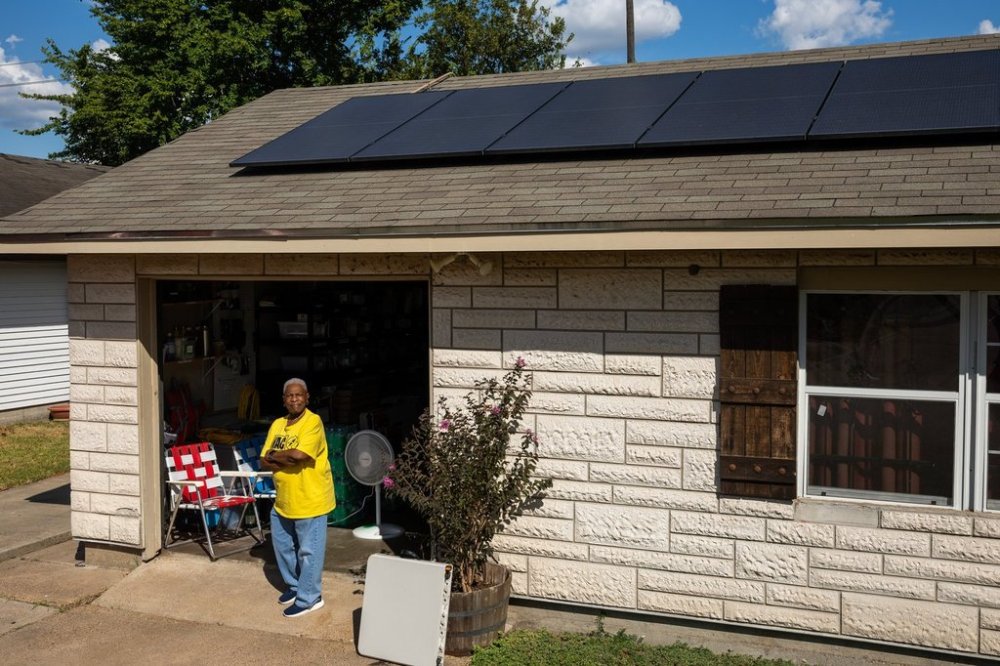
“There were people sleeping everywhere,” said Brown, 75. She was happy to be “a port in a storm,” despite one downside: “They ate all my snacks.”
Brown’s house is a “hub home,” one of seven in a Northeast Houston pilot program meant to create emergency safe havens — not at shelters or community centers, but inside neighbors’ houses.
The idea was a grassroots response to decades of community disinvestment and neglect that got neighbors talking about what they could do to be ready for extreme weather and power outages.
“It’s us helping us,” said Brown.
The project was set to reach 30 more homes, until the Environmental Protection Agency in August canceled the $7 billion Solar for All program which would have funded its expansion. Harris County, which includes Houston, is now a plaintiff in one of multiple lawsuits over the cancellation.
People involved with the program acknowledge hub homes are unconventional — requiring trust and community cooperation and impacting fewer people than a larger resilience center.
But they also say they’re effective in creating pockets of preparedness in communities confronting more extreme weather but lacking resources to do more.
“It was a way to increase resilience in those neighborhoods that are often forgotten,” said Sam Silerio, Texas program director at Solar United Neighbors, one of the nonprofits involved with the pilot program which is also suing over the cuts.
A unique approach
The hub homes idea started after Winter Storm Uri in 2021, when freezing temperatures crippled Texas’ power grid for five days and led to 246 storm-related deaths, according to the Texas Department of Health Services.
Power loss contributed to many of the deaths, as people with health conditions couldn’t refrigerate medicines or run life-sustaining medical devices. Nineteen people died from carbon monoxide poisoning from improperly using generators and grills to stay warm.
“We were like, ‘Shoot, power grid failure is a serious thing that we are not prepared for’,” said Becky Selle, co-director of disaster preparedness, organizing, and operations at West Street Recovery, a Northeast Houston nonprofit founded after Hurricane Harvey in 2017.
WSR bought some generators for residents willing to share the resource. Brown, who almost froze to death herself in Uri, stepped up.
WSR added more supplies to the hubs, like life jackets and kayaks for flood evacuations, and held preparedness trainings for members.
When the Washington, D.C.-based nonprofit Solar United Neighbors approached them with a private grant from the Hive Fund to add free solar panels and batteries to several houses, WSR knew exactly where to install them.
The pilot had its challenges — some roofs had to be repaired before they could hold solar panels, and hub captains had to learn how to manage their batteries to not deplete them.
Success also required neighborly connection that modern communities often lack.
“You have to build that trust,” said David Espinoza, a hub home captain and West Street Recovery’s co-director of community organizing and language access. The 34-year-old went door-to-door on his block, introducing himself to sometimes wary neighbors. “I got to know my neighborhood a lot better,” he said.
About a dozen people are signed up on Espinoza’s “roster,” but he said the hub is there for anyone in need, prioritizing older neighbors and those with children or medical conditions.
There are other upsides, too: The solar and battery system reduces greenhouse gas emissions, and cut Espinoza’s utility bill in half.
Espinoza, who is bilingual, said that for neighborhoods like his with mixed-status, Spanish-speaking, and medically vulnerable households, hub homes are useful even with other shelters nearby.
“They can access me a little easier,” he said.
‘Social capital’
Efforts to bolster local resilience have grown in recent years as extreme weather, power outages, and electricity prices overburden communities.
Average annual power interruption hours across the U.S. have jumped in the last decade, largely due to extreme weather, according to Sarah Kotwis, senior associate at the clean energy nonprofit RMI.
“Communities do need to be thinking more strategically about resilience,” said Kotwis.
That preparedness begins with connections between neighbors, said Renae Hanvin, CEO and founder of Resilient Ready and an expert on “social capital,” or the “connections, trust and cooperation between people.”
“It’s the missing link in the disaster resilience ecosystem,” said Hanvin. “At the end of the day, the first thing you need (in an emergency) to help you is a person.”
As disasters worsen, first responders simply can’t help everyone at once, she said, so neighbors must think of themselves as “zero responders.”
Many communities have also turned to “resilience centers,” or locally trusted institutions like community centers or churches that are outfitted with backup power, emergency supplies, and even year-round social services.
Ideally, resilience investments aren’t an either-or decision, said Dori Wolfe, SUN senior Texas program associate. “Hub homes are one piece of the web, and there should be a resilience center at the center of each of these nodes,” she said. “We need all of it.”
‘A huge letdown’
Solar United Neighbors and West Street Recovery planned to expand the program this fall as part of a $54 million grant awarded to Harris County by the EPA.
They intended to grow the number of hub homes to 30, and add more batteries to existing ones to better run heating and air conditioning during outages. The money would have also funded a local resilience center.
In August, EPA Administrator Lee Zeldin canceled the EPA’s Solar for All program, intended to support residential solar for more than 900,000 lower-income households. Zeldin said authority for the “boondoggle” program was eliminated under Trump’s tax-and-spending bill.
“It’s a huge letdown,” said Silerio. Both Solar United Neighbors and Harris County sued the EPA in separate lawsuits this month over the cuts, as did over a dozen state attorneys general.

The termination “pulls the rug out from the very people the federal government should be protecting,” Harris County Interim County Administrator Jesse Dickerman said in a statement to The Associated Press.
West Street Recovery isn’t giving up on more hub homes. The nonprofit intends to fundraise through the community and seek other grants.
“These programs have been a big help to the community,” said Espinoza. “It’s going to be a lot harder without the funds from the federal government.”
___
Associated Press coverage of philanthropy and nonprofits receives support through the AP’s collaboration with The Conversation US, with funding from Lilly Endowment Inc. The AP is solely responsible for this content. For all of AP’s philanthropy coverage, visit https://apnews.com/hub/philanthropy.