Climate summit hears from countries suffering from harms, destruction linked to global warming
Advertisement
Read this article for free:
or
Already have an account? Log in here »
To continue reading, please subscribe:

Digital Subscription
One year of digital access for only $205*
- Enjoy unlimited reading on winnipegfreepress.com
- Read the E-Edition, our digital replica newspaper
- Access News Break, our award-winning app
- Play interactive puzzles
*First annual payment billed as $205.00 + GST for one year. This annual subscription will automatically renew at $233.00 + GST every 52 weeks (10% off the regular annual price of $259.35). Offer available to new and qualified returning subscribers only. Cancel any time.
To continue reading, please subscribe:
Add Free Press access to your Brandon Sun subscription for only an additional
$1 for the first 4 weeks*
- Enjoy unlimited reading on winnipegfreepress.com
- Read the E-Edition, our digital replica newspaper
- Access News Break, our award-winning app
- Play interactive puzzles
*Your next Brandon Sun subscription payment will increase by $1.00 and you will be charged $17.95 plus GST for four weeks. After four weeks, your payment will increase to $24.95 plus GST every four weeks.
Read unlimited articles for free today:
or
Already have an account? Log in here »
Hey there, time traveller!
This article was published 07/11/2025 (314 days ago), so information in it may no longer be current.
BELEM, Brazil (AP) — Officials from countries most vulnerable to global warming offered searing dispatches of life on the front line of a warming planet Friday, as world leaders gathered on the edge of the Amazon rainforest for the annual United Nations climate talks.
Ahead of Monday’s official kickoff, officials have sought to build support for initiatives to protect forests and to streamline carbon markets, which seek to reduce the emissions that drive warming. But the meetings also took time to hear impassioned testimony about the harms climate change is dealing around the world.
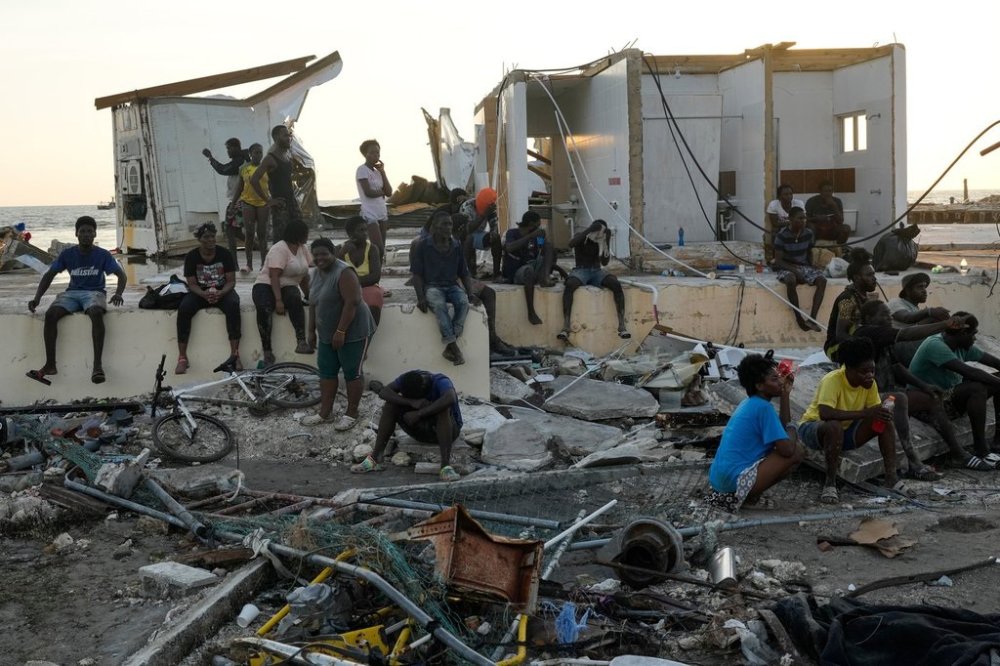
Haitian diplomat Smith Augustin, whose country was pummeled by Hurricane Melissa, appealed to wealthier countries that produce the greatest share of the world’s emissions to support Haiti in preparing for bigger storms. Developed countries pledged $300 billion to help poor nations cope with climate shocks at last year’s summit, but the money has yet to be distributed.
“The hurricanes and the heavy rain devastated my country,” said Augustin. “Developing countries, and especially the small island states, are the least responsible for climate change.”
Kithure Kindiki, Kenya’s vice president, said rescuers in his country are still searching for scores of people missing after a deadly landslide triggered by torrential rain sent muddy water crashing into villages last week.
“A previously once-in-a-century cycle of extreme droughts alternating with devastating floods continues to wipe out lives,” he said. “This has now become common.”
And Kalani Kaneko, the foreign minister of the Pacific Island nation of the Marshall Islands, said his country already is living a nightmare.
“All we have to do is look out our front doors to witness the impact of climate change,” he said. “Now the sea rises, the coral dies and the fish stock leaves our shores for cooler waters.”
Time running out
Officials warn that it has become almost impossible to keep global warming below the key Paris Agreement benchmark of 1.5 degrees Celsius (2.7 Fahrenheit).
Last year was the hottest year on record. Scientists say that every fraction of a degree of atmospheric heating unleashes longer droughts, deadlier heat waves and more intense storms.
Hurricane Melissa has made that painfully clear, said Racquel Moses, director of the Caribbean Climate-Smart Accelerator, a coalition investing in climate resilience.
“It will be much, much harder to ignore the Caribbean, to talk around the issues that are absolutely real, because we just had this experience,” said Moses, who has family in Jamaica. “The very way that we live is dependent on these negotiations going according to plan.”
Reduced summit participation hangs over talks

World leaders who were not in the room on Friday were perhaps as important as those who were.
U.S. President Donald Trump, who calls climate change a hoax and prioritizes fossil fuels, boycotted the summit, leaving a hole that many other world powers sought to fill.
Although China’s leader, Xi Jinping, and Prime Minister Narendra Modi of India also skipped the conference, the officials sent in their place used the podium to revive lagging enthusiasm about the global energy transition and assure the gathering that multilateralism was not dead just because the U.S. wished it so.
Praising his country’s massive installations of wind and solar power, Chinese Vice Premier Ding Xuexiang promised to “accelerate the green transition in all areas.” Although China is by far the world’s biggest carbon emitter, Ding made clear it was still a leader in switching to cleaner forms of energy.
“China is a country that honors its commitments,” he said.
Indian diplomat Dinesh Bahata on Friday touted his country’s expansion of renewables to half of all energy capacity, portraying the Global South as bending toward the future of affordable, clean power while political calculations trapped wealthier nations in an outdated addiction to fossil fuels.
“While developing countries take decisive climate action,” he said, “developed countries fall short.”
Others criticized that imbalance, with Mahmoud Ali Youssouf, the chairman of the African Union Commission, questioning how developing nations were expected to decarbonize at a time when financial assistance for poor countries is faltering and the U.S., the world’s biggest oil producer, is cashing in on heightened demand for hydrocarbons.
“We do not ask for charity, but for climate justice,” he said.
Maina Vakafua Talia, the environmental minister of the island nation of Tuvalu, at one point addressed Trump directly over the U.S. withdrawal from the Paris Agreement. “Mr. President, this is a shameful disregard for the rest of the world,” he said.
The White House shot back that Trump “will not jeopardize our country’s economic and national security to pursue vague climate goals that are killing other countries.”

Progress on forest protections and carbon markets
Attendees said they made progress on two initiatives over the past two days: Financial incentives to support endangered forests and a shared global carbon market.
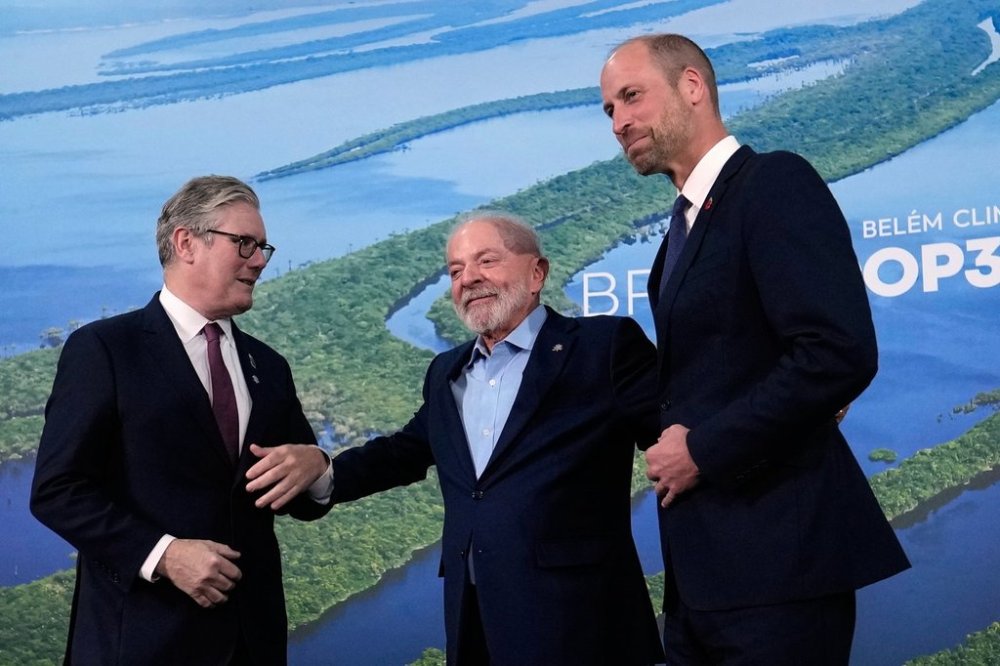
Brazilian President Luiz Inácio Lula da Silva was working to win support for a signature new fund that would pay 74 developing countries to better preserve their rainforests.
The fund drew $5.5 billion in pledges on the first day of the U.N. climate summit, as Norway and France joined Brazil and Indonesia in investing. Germany said Friday it would make a “considerable” commitment. The scheme eventually seeks to leverage investments into $125 billion.
Finland’s President Alexander Stubb hailed the fund as a model for how to drive climate solutions.
“What we might be seeing now, according to studies, is a turn of the tide on carbon dioxide emissions,” he told The Associated Press. “This is because of financing. This is because of innovation. … That’s why I think (the fund) is a good idea.”
Also on Friday, Brazil and the European Union announced that they were joining forces with China and several other countries to create a coalition aimed at uniting the world’s different emission trading systems into a single global carbon market.
A shared carbon pricing framework would motivate countries and companies to reduce greenhouse gas emissions by allowing those that pollute less than their assigned emission caps to sell credits to counterparts that exceed theirs. It has long been notoriously difficult to get nations on the same page about emission limits and prices.
Indigenous people eye a spot at the table
Brazil has billed this summit in the Amazonian city of Belem as uniquely inclusive of Indigenous leaders who have long been sidelined from decision-making in past climate talks despite feeling the most adverse effects of global warming.
Lula’s government, which includes Brazil’s first-ever Indigenous Peoples’ Ministry, expects over 3,000 Indigenous delegates to participate this month as both members of civil society and negotiators. For comparison, last year’s summit in Azerbaijan drew just 170 Indigenous people.
“This time, world leaders are coming Belem, to the heart of the Amazon, closer to our homes, our rivers, our territories,” said Olivia Bisa, leader of the Chapra nation in Peru. Although Indigenous people cannot represent tribal nations in the talks, Bisa and others will have a greater role as delegates negotiating on behalf of their nation-states.
“We need to be in the room, not right outside of it,” she said.

Their protests have also shined a light on the contradictions of host Brazil promoting itself as a defender of the Amazon rainforest. Lula’s recent approval of an oil drilling project at the mouth of the Amazon river has set off demonstrations and outrage.
On Friday, outside Belem in the wider state of Para, hundreds of Indigenous people scaled cargo boats on the strategic Tapajos River to denounce separate plans for a new railway that would slice through their lands.
“This is our message to the leaders of the world,” Marília Sena, a leader of the Tupinamba nation, told reporters. “We want people to see us who have been here for centuries, caring for the forest and the river.”
___
The Associated Press’ climate and environmental coverage receives financial support from multiple private foundations. AP is solely responsible for all content. Find AP’s standards for working with philanthropies, a list of supporters and funded coverage areas at AP.org
Related Articles
More than 1,300 dead from floods in Indonesia, Sri Lanka and Thailand as rescue efforts intensify
Advertisement Advertise With Us
Advertisement Advertise With Us