Ocean warmed by climate change fed intense rainfall and deadly floods in Asia, study finds

Advertisement

Advertise with us

BENGALURU, India (AP) — Ocean temperatures warmed by human-caused climate change fed the intense rainfall that triggered deadly floods and landslides across Asia in recent weeks, according to an analysis released Wednesday.

Read this article for free:


or

Already have an account? Log in here »

To continue reading, please subscribe:

Subscribe and receive a limited-edition Free Press branded hat or tote.

Digital Subscription

One year of digital access for only $205*

  • Enjoy unlimited reading on winnipegfreepress.com
  • Read the E-Edition, our digital replica newspaper
  • Access News Break, our award-winning app
  • Play interactive puzzles

*First annual payment billed as $205.00 + GST for one year. This annual subscription will automatically renew at $233.00 + GST every 52 weeks (10% off the regular annual price of $259.35). Offer available to new and qualified returning subscribers only. Cancel any time.

To continue reading, please subscribe:

Add Free Press access to your Brandon Sun subscription for only an additional

$1 for the first 4 weeks*

  • Enjoy unlimited reading on winnipegfreepress.com
  • Read the E-Edition, our digital replica newspaper
  • Access News Break, our award-winning app
  • Play interactive puzzles
Start now

*Your next Brandon Sun subscription payment will increase by $1.00 and you will be charged $17.95 plus GST for four weeks. After four weeks, your payment will increase to $24.95 plus GST every four weeks.

Hey there, time traveller!
This article was published 10/12/2025 (305 days ago), so information in it may no longer be current.

BENGALURU, India (AP) — Ocean temperatures warmed by human-caused climate change fed the intense rainfall that triggered deadly floods and landslides across Asia in recent weeks, according to an analysis released Wednesday.

The rapid study by World Weather Attribution focused on heavy rainfall from cyclones Senyar and Ditwah in Malaysia, Thailand, Indonesia and Sri Lanka starting late last month. The analysis found that warmer sea surface temperatures over the North Indian Ocean added energy to the cyclones.

Floods and landslides triggered by the storms have killed more than 1,600 people, with hundreds more still missing. The cyclones are the latest in a series of deadly weather disasters affecting Southeast Asia this year, resulting in loss of life and property damage.
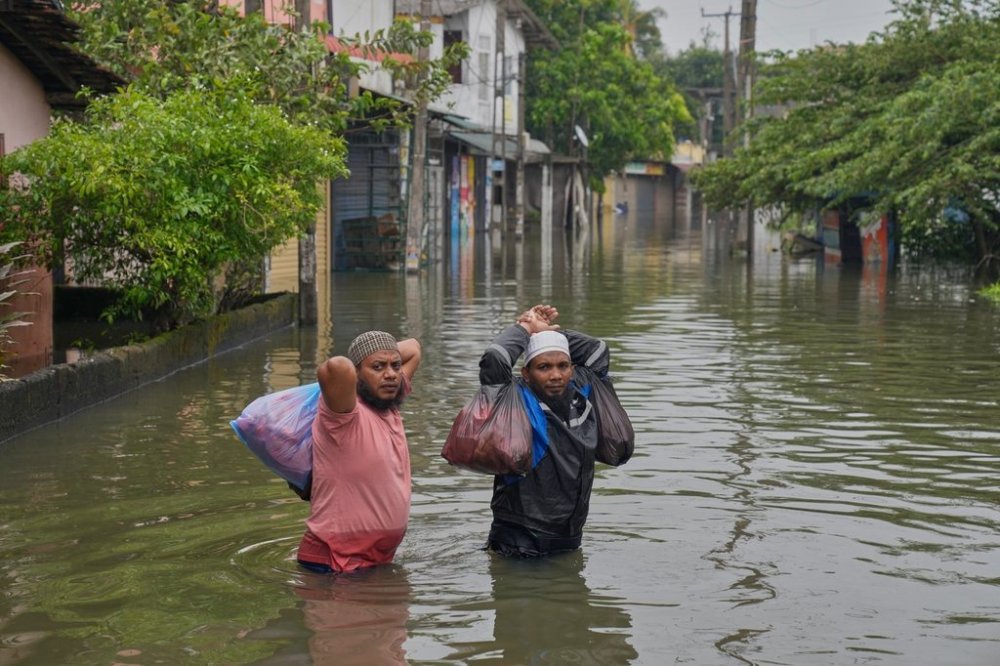
FILE - People wade through floodwaters in the aftermath of Cyclone Ditwah in Colombo, Sri Lanka, Nov. 29, 2025. (AP Photo/Eranga Jayawardena, File)

“It rains a lot here but never like this. Usually, rain stops around September but this year it has been really bad. Every region of Sri Lanka has been affected, and our region has been the worst impacted,” said Shanmugavadivu Arunachalam, a 59-year-old schoolteacher in the mountain town of Hatton in Sri Lanka’s Central Province.

Warmer sea surface temperatures

Sea surface temperatures over the North Indian Ocean were 0.2 degrees Celsius (0.3 degrees Fahrenheit) higher than the average over the past three decades, according to the WWA researchers.

Without global warming, the sea surface temperatures would have been about 1 degree Celsius (1.8 degrees Fahrenheit) colder than they were, according to the analysis. The warmer ocean temperatures provided heat and moisture to the storms.

When measuring overall temperatures, the world is currently 1.3 degrees Celsius (2.6 degrees Fahrenheit) warmer than global average during pre-industrial times in the 19th century, according to the National Oceanic and Atmospheric Administration.

“When the atmosphere warms, it can hold more moisture. As a result, it rains more in a warmer atmosphere as compared to a world without climate change,” said Mariam Zachariah, with the Centre for Environmental Policy at Imperial College London and one of the report’s authors.

Using tested methods to measure climate impacts quickly

The WWA is a collection of researchers who use peer-reviewed methods to conduct rapid studies examining how extreme weather events are linked to climate change.

“Anytime we decide to do a study, we know what is the procedure that we have to follow,” said Zachariah, who added that they review the findings in house and send some of their analysis for peer review, even after an early version is made public.

The speed at which the WWA releases their analysis helps inform the general public about the impacts of climate change, according to Zachariah.

“We want people everywhere to know about why something happened in their neighborhood,” Zachariah said. “But also be aware about the reasons behind some of the events unfurling across the world.”

The WWA often estimates how much worse climate change made a disaster using specific probabilities. In this case, though, the researchers said they could not estimate the precise contribution of climate change to the storms and ensuing heavy rains because of limitations in climate models for the affected islands.

Climate change boosts Asia’s unusually heavy rainfall

Global warming is a “powerful amplifier” to the deadly floods, typhoons and landslides that have ravaged Asia this year, said Jemilah Mahmood, with the Sunway Centre for Planetary Health, a Malaysia-based think tank that was not involved with the WWA analysis.

“The region and the world have been on this path because, for decades, economic development was prioritized over climate stability,” Mahmood said. “It’s created an accumulated planetary debt, and this has resulted in the crisis we face.”

The analysis found that across the affected countries, rapid urbanization, high population density and infrastructure in low lying flood plains have elevated exposure to flood events.

“The human toll from cyclones Ditwah and Senyar is staggering,” said Maja Vahlberg, a technical adviser with the Red Cross Red Crescent Climate Centre. “Unfortunately, it is the most vulnerable people who experience the worst impacts and have the longest road to recovery.”

___

Follow Sibi Arasu on X at @sibi123.

___

Delgado reported from Bangkok, Thailand.

___

The Associated Press’ climate and environmental coverage receives financial support from multiple private foundations. AP is solely responsible for all content. Find AP’s standards for working with philanthropies, a list of supporters and funded coverage areas at AP.org.

Report Error Submit a Tip

More Stories

Jets’ game flies south against Ducks

Mike McIntyre 7 minute read Preview

Jets’ game flies south against Ducks

Mike McIntyre 7 minute read Friday, Oct. 9, 2026

The Winnipeg Jets sure looked like a team that was running on fumes Friday night.

Playing for the fifth time in eight days, the club suffered its first regulation loss of the young season — a lacklustre 5-1 showing against the Anaheim Ducks at Canada Life Centre.

While we won’t question the effort, the execution was a different story. Sloppy plays, missed passes, porous defensive-zone coverage and iffy goaltending made this a tough watch for the 13,693 fans in attendance.

“Just some mental things that happened. Obviously some physical things as well,” said head coach Scott Arniel.

Read
Friday, Oct. 9, 2026

Puppies, stocks — ‘zoomies’ abound

Andrew Froese 4 minute read Yesterday at 2:01 AM CDT

This spring, I adopted a three-month-old rescued German Shepherd mix. To say she is easily excitable is an understatement.

It is not really her fault. A puppy’s frontal cortex, the part of the brain that helps with decision-making and impulse control, is still developing. When an older dog, or a human, gets tired, we generally understand we should rest. Puppies have not quite figured that out. They often interpret tiredness as a signal something is wrong, which makes them more alert, more reactive and harder to settle.

That creates a feedback loop. The puppy gets tired, which makes her frantic, which makes her more tired, which makes her even more frantic. Eventually, this becomes what people call the “zoomies”: frantic sprinting, biting, jumping and general chaos.

From the outside, it looks like the puppy has too much energy. In reality, the opposite is true. The zoomies are not a sign of excess energy. They are a sign the puppy is overtired and does not know it yet.

Ocean warmed by climate change fed intense rainfall and deadly floods in Asia, study finds

Sibi Arasu And Anton L. Delgado, The Associated Press 4 minute read Preview

Ocean warmed by climate change fed intense rainfall and deadly floods in Asia, study finds

Sibi Arasu And Anton L. Delgado, The Associated Press 4 minute read Wednesday, Dec. 10, 2025

BENGALURU, India (AP) — Ocean temperatures warmed by human-caused climate change fed the intense rainfall that triggered deadly floods and landslides across Asia in recent weeks, according to an analysis released Wednesday.

The rapid study by World Weather Attribution focused on heavy rainfall from cyclones Senyar and Ditwah in Malaysia, Thailand, Indonesia and Sri Lanka starting late last month. The analysis found that warmer sea surface temperatures over the North Indian Ocean added energy to the cyclones.

Floods and landslides triggered by the storms have killed more than 1,600 people, with hundreds more still missing. The cyclones are the latest in a series of deadly weather disasters affecting Southeast Asia this year, resulting in loss of life and property damage.

“It rains a lot here but never like this. Usually, rain stops around September but this year it has been really bad. Every region of Sri Lanka has been affected, and our region has been the worst impacted,” said Shanmugavadivu Arunachalam, a 59-year-old schoolteacher in the mountain town of Hatton in Sri Lanka’s Central Province.

Read
Wednesday, Dec. 10, 2025

Longtime voice of the Blue and Gold marks major milestone

David Sanderson 8 minute read Preview

Longtime voice of the Blue and Gold marks major milestone

David Sanderson 8 minute read Friday, Oct. 9, 2026

Bob McGregor made his debut as the Winnipeg Blue Bombers’ public-address announcer on June 7, 1997, during a pre-season game at Winnipeg Stadium between the hometown Blue Bombers and their western rivals, the Calgary Stampeders.

McGregor will be behind the microphone again this Saturday, detailing the action on the field in addition to leading a boisterous Princess Auto Stadium crowd through what has become his signature call, “And that is another Winnipeg Blue Bombers first down!”

The Bombers’ final home date of the 2026 regular season will mark a major milestone for McGregor, and the former newscaster feels it’s only fitting the same two teams as 10,717 days ago — the Bombers and Stampeders — will be the ones butting helmets.

“I knew at the start of the season I was closing in on 300 games as the PA guy, only it wasn’t until I went through the schedule that I realized my 300th would be Winnipeg-Calgary, which struck me as kind of cool,” McGregor says, seated in a St. James breakfast nook, dressed in dark trousers and a blue-and-gold Blue Bombers golf shirt.

Read
Friday, Oct. 9, 2026

Bombers ride Collaros’s arm to win over Stamps

Taylor Allen 6 minute read Preview

Bombers ride Collaros’s arm to win over Stamps

Taylor Allen 6 minute read Yesterday at 11:51 PM CDT

Zach Collaros must’ve found the fountain of youth during his most recent absence.

Nobody has feared the Winnipeg Blue Bombers’ passing attack all season, and yet, their veteran pivot aired it out early and often on Saturday night in a game they needed to win.

Led by Collaros and go-to target Dorian Singer, the Bombers prevailed 33-28 over the Calgary Stampeders in front of a sold-out crowd at Princess Auto Stadium to heavily increase their odds of making the playoffs.

“That’s vintage Eight-Ball right there. You love to see it,” said receiver Nic Demski. “Especially the opportunity that we had and him coming back this week, it was just a picture-perfect story.”

Read
Yesterday at 11:51 PM CDT

Chopped trees will leave a ‘blight’ on Windsor Park

Kelly-Anne Riess 3 minute read Preview

Chopped trees will leave a ‘blight’ on Windsor Park

Kelly-Anne Riess 3 minute read Friday, Oct. 9, 2026

Robert Gordon has watched the trees grow along a popular Windsor Park walking path for nearly six decades.

Now, as Manitoba Hydro cuts them down to protect nearby power lines, he says a familiar part of his childhood neighbourhood is disappearing.

Although he no longer lives in the area, Gordon regularly returns to walk or cycle along the tree-lined path, which runs parallel to Archibald Street.

He was concerned when he recently spotted crews clearing vegetation near the entrance to the path, but initially assumed they were removing brush. When he returned, he discovered the clearing had extended farther along the corridor.

Read
Friday, Oct. 9, 2026