Iran war’s environmental toll could leave damage and health risks for decades, experts say
Advertisement
Read this article for free:
or
Already have an account? Log in here »
To continue reading, please subscribe:

Digital Subscription
One year of digital access for only $205*
- Enjoy unlimited reading on winnipegfreepress.com
- Read the E-Edition, our digital replica newspaper
- Access News Break, our award-winning app
- Play interactive puzzles
*First annual payment billed as $205.00 + GST for one year. This annual subscription will automatically renew at $233.00 + GST every 52 weeks (10% off the regular annual price of $259.35). Offer available to new and qualified returning subscribers only. Cancel any time.
To continue reading, please subscribe:
Add Free Press access to your Brandon Sun subscription for only an additional
$1 for the first 4 weeks*
- Enjoy unlimited reading on winnipegfreepress.com
- Read the E-Edition, our digital replica newspaper
- Access News Break, our award-winning app
- Play interactive puzzles
*Your next Brandon Sun subscription payment will increase by $1.00 and you will be charged $17.95 plus GST for four weeks. After four weeks, your payment will increase to $24.95 plus GST every four weeks.
Read unlimited articles for free today:
or
Already have an account? Log in here »
Hey there, time traveller!
This article was published 26/03/2026 (201 days ago), so information in it may no longer be current.
Oil depots spewing black smoke. Debris sinking in the Persian Gulf. Missiles pounding military sites.
The Iran war has unleashed a toxic mix of chemicals, heavy metals and other pollutants that threaten everything from agriculture to drinking water to people’s health — and will leave behind environmental damage and health risks that could persist for decades, experts said.
“All the burning of oil and gas fields in the coastal areas, all the ships that are there, the oil tankers that are being burned or (sunk) — all of these mean pollution,” said Kaveh Madani, an Iranian scientist and director of the United Nations University Institute for Water, Environment and Health. “For someone like me who has fought for sustainability and protection of the environment in that region, this is like going many years backward.”
Documenting the damage has proved daunting, with a full accounting impossible for now, said Doug Weir, director of the Conflict and Environment Observatory, a U.K.-based nonprofit that monitors environmental harms from armed conflicts.
The group uses remote satellite sensing and open-source intelligence to identify damage and score environmental risks to people, ecosystems and agricultural land. So far, it has recorded more than 400 environmentally concerning incidents related to the war, though much is still unknown due to delays in satellite imagery and an internet blackout in Iran, Weir said.
Attacks on oil- and gas-related sites create some of the worst environmental risks because of impacts to air quality and soil and water pollution, as well as health threats to people. Harder to quantify are risks from bombed military sites, some of which are deeply buried and some near populated areas, adding to “huge uncertainties” around potential impacts, Weir said.
The air pollution unleashed could lead to many health problems
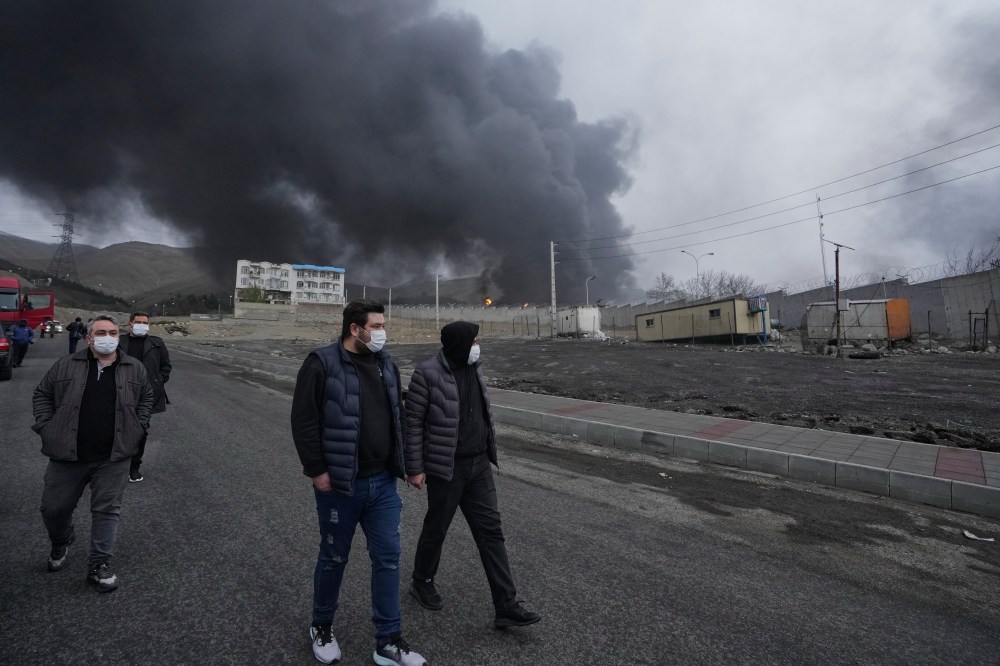
Perhaps the most enduring images of the war are of darkened skies from oil infrastructure set ablaze by airstrikes, including two weeks ago when black rain fell near Tehran, Iran’s capital.
Soot, ash and toxic chemicals from strikes on fuel depots and a refinery combined with water droplets in the atmosphere and fell back to Earth as an oily, acidic rain that prompted warnings to stay indoors. Microscopic soot raises risks of lung and heart problems, while toxic chemicals pose long-term cancer risks and heavy metals from the fallout could contaminate soil and water supplies, experts said.
Debris and contamination from missiles, as well as potential strikes on manufacturing facilities and other infrastructure also could unleash harmful pollution throughout the region, experts said.
“If you hit an ammonia-producing plant for fertilizer or for food production … those release chemicals that are absolutely toxic and harmful if they spread,” said Mohammed Mahmoud, head of Middle East Climate and Water Policy with the United Nations University Institute of Water, Environment and Health and founder of the Climate and Water Initiative.
Intensive fossil fuel emissions also are spiking levels of greenhouse gases that cause climate change, experts said. The carbon accounting platform Greenly estimated that the U.S. military alone released almost 2 billion metric tons of greenhouse gases in just the first six days of the war, meaning the actual amount generated by the fighting is certainly much higher, when accounting for Israeli and Iranian emissions and damage to infrastructure.
That is a significant amount in such a short time, as in an entire year around 50 billion metric tons of greenhouse gases are released around the entire world, according to the National Oceanic and Atmospheric Administration.
Global oil shortages also are causing some countries to resume or increase their use of coal, which creates more air pollution that hurts people, and more greenhouse gas emissions.
Continued access to clean water is a big concern
Countries in the arid Persian Gulf region rely on hundreds of desalination plants for drinking water, raising health and security risks if plants are damaged or water is polluted, experts say.
Iran has said a U.S airstrike damaged one of its desalination plants, while neighboring Bahrain accused Iran of damaging one of its plants. Experts fear more could be targeted the longer the war goes on.
People in the region “struggle with having access to clean drinking water, even at peace times,” said Madani, the Iranian scientist and U.N. official. “Any damage to water infrastructure can have long-lasting impacts.”
Weir worries that pollution, including oil, from sunken ships and other sources could clog desalination plants or that they could be knocked offline by attacks on power plants.
Experts say pollution also could damage fisheries and important ecosystems. Though some contaminants will be dispersed and diluted by water that moves through the gulf, heavy metals and toxic chemicals still could settle in sediment.
“It’s an enclosed basin, quite shallow,” Weir said. “There are sensitive habitats there, coral reefs, seagrass meadows, sensitive species which could be impacted.”
Nuclear risks are largely unknown
The U.N. nuclear watchdog has not had access to Iranian nuclear sites, including facilities targeted in June by the United States and Israel, meaning their status is largely unknown.
Possible attacks on large and small nuclear sites throughout the region is “another thing to worry about,” because of immediate and long-term health and environmental impacts, said Madani. Exposure can cause skin damage and radiation sickness, while long-term risks include cancer, heart disease and genetic damage.
U.S. and Israeli officials have said one of the war’s aims is to destroy Iran’s ability to produce nuclear weapons.
After Israel and the U.S. this month bombed an Iranian uranium enrichment installation, Iran retaliated by firing missiles at two Israeli towns, including one with a nuclear research center. Israel said the facility wasn’t damaged.
“We are hearing that there is no major radiation or change in the level of pollutants so that makes us hopeful that nothing has gone wrong,” Madani said. “But the risk is always there.”
Addressing environmental damage could take decades
After the war, as Iran and other countries rebuild, environmental damage could be a low priority, experts said.

The focus will be on energy and water infrastructure, manufacturing plants and food production facilities, Mahmoud said. Some pollution, especially to the gulf or other waterways, “I doubt will be addressed soon, and in some cases, not at all.”
Weir said environmental damage isn’t addressed properly after most conflicts because it’s expensive and “humanitarian needs come first,” even if environmental risks are high.
In densely populated Tehran, for example, a huge number of strikes have hit not just oil infrastructure, but also buildings and residential areas, generating harmful contamination from pulverized building materials. People are being exposed to dust and chemicals, which may continue for a long time after the war eventually ends and rebuilding begins.
___
The Associated Press’ climate and environmental coverage receives financial support from multiple private foundations. AP is solely responsible for all content. Find AP’s standards for working with philanthropies, a list of supporters and funded coverage areas at AP.org.