Argentina approves Milei’s bill that eases protections for glaciers despite environmental backlash

Advertisement

Advertise with us

BUENOS AIRES, Argentina (AP) — Argentina's Congress on Thursday approved a bill promoted by libertarian President Javier Milei that eases protections on glaciers to facilitate investments in mining for metals — a move that environmental groups vow to challenge in courts.

Read this article for free:


or

Already have an account? Log in here »

To continue reading, please subscribe:

Subscribe and receive a limited-edition Free Press branded hat or tote.

Digital Subscription

One year of digital access for only $205*

  • Enjoy unlimited reading on winnipegfreepress.com
  • Read the E-Edition, our digital replica newspaper
  • Access News Break, our award-winning app
  • Play interactive puzzles

*First annual payment billed as $205.00 + GST for one year. This annual subscription will automatically renew at $233.00 + GST every 52 weeks (10% off the regular annual price of $259.35). Offer available to new and qualified returning subscribers only. Cancel any time.

To continue reading, please subscribe:

Add Free Press access to your Brandon Sun subscription for only an additional

$1 for the first 4 weeks*

  • Enjoy unlimited reading on winnipegfreepress.com
  • Read the E-Edition, our digital replica newspaper
  • Access News Break, our award-winning app
  • Play interactive puzzles
Start now

*Your next Brandon Sun subscription payment will increase by $1.00 and you will be charged $17.95 plus GST for four weeks. After four weeks, your payment will increase to $24.95 plus GST every four weeks.

BUENOS AIRES, Argentina (AP) — Argentina’s Congress on Thursday approved a bill promoted by libertarian President Javier Milei that eases protections on glaciers to facilitate investments in mining for metals — a move that environmental groups vow to challenge in courts.

The legislation, approved by the Senate in February, was passed with 137 votes in favor, 111 against and three abstentions.

According to mining sector estimates, the new regulatory framework could unlock over $30 billion in investments over the next decade. Approximately 70% of those funds are slated for new copper, gold and silver projects.
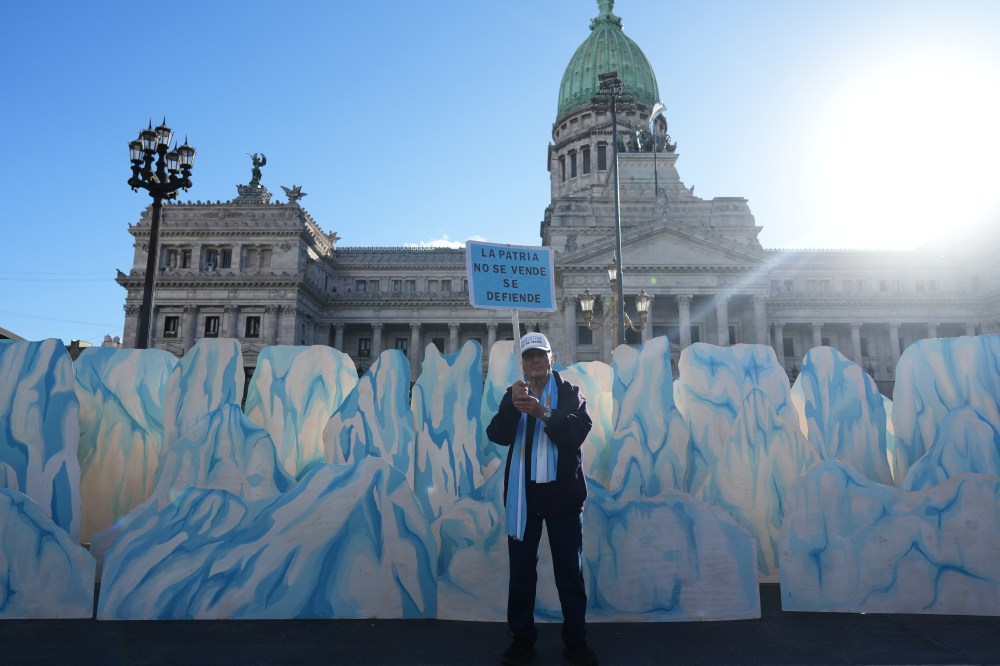
A demonstrator holds a banner that reads in Spanish,
A demonstrator holds a banner that reads in Spanish, "The homeland is not for sale, it's defended" as lawmakers debate the Javier Milei government's proposal to reform the glacier protection law, outside Congress in Buenos Aires, Argentina, Wednesday, April 8, 2026. (AP Photo/Rodrigo Abd)

Milei is expected to sign the legislation in the coming days.

On his X account, Milei shared a statement from his party hailing the new framework as a “significant improvement” that will help “strike a balance between environmental protection and economic development, moving away from an approach that tended to stifle investment, job creation and growth.”

Environmental advocates are shifting to legal action to prevent the law from taking effect.

Groups including Greenpeace and the Environment and Natural Resources Foundation are organizing a public class-action lawsuit describing the bill’s passage as a flawed process that dismissed public concerns over water safety.

“If they refuse to listen in Congress, they will be forced to listen in the courts,” the organizations said in a statement, urging citizens to join a lawsuit that argues the reform threatens water access and the fragile ecosystems surrounding glaciers.

Opposition lawmakers have labeled the legislation unconstitutional, contending that it rolls back essential environmental protections.

Mining Secretary Luis Lucero told a local radio station that the previous regulation featured “absolute prohibitions without room for exceptions or environmental impact studies.” He noted that the rigid rules and imprecise definitions of “protected areas” discouraged investment in large-scale mining projects, which typically require investments of up to $3 billion.

In 2010, Argentina passed a landmark law banning all mining activity on glaciers and within periglacial zones — areas of frozen ground that act as vital water regulators.

The most significant shift in the Milei administration’s reform is a narrowing of these protections. Under the new framework, only glaciers and land forms with “specific hydrological functions” would be shielded, with each province responsible for making that determination.

Argentina is home to 16,968 glaciers distributed across the Andes Mountain Range and the South Atlantic Islands, covering a total surface area of 8,484 square kilometers (3,276 square miles).

Glaciology experts have warned that climate change is already causing glaciers to retreat at an accelerated pace. Scientists caution that weakening these protections could jeopardize water security in arid regions and deplete the reserves that sustain river flows.

___

Follow AP’s coverage of Latin America and the Caribbean at https://apnews.com/hub/latin-america
Report Error Submit a Tip

More Stories

Wab Kinew as ‘communicator in chief’

Paul G. Thomas 6 minute read Preview

Wab Kinew as ‘communicator in chief’

Paul G. Thomas 6 minute read 2:00 AM CDT

Premier Wab Kinew and his party have been riding high in the polls longer than normal for a government one year or less away from its first re-election contest. One reason is his ubiquitous, dominating communications presence as NDP leader and premier.

The argument here is that Kinew has supplemented his prerogatives as premier and party leader (such as appointing cabinet ministers and approving party nominations) with the skilful use of communications to advance his policy agenda, boost his personal popularity and maintain the competitive advantage of his party over the opposition Progressive Conservatives.

Communications has always been a significant part of politics and policy making. However, in the contemporary political and media environments, communications considerations have moved from the background to the foreground of decision-making by political parties, including when they are performing in the role of government. Campaigning and governing now overlap in what has been described as a permanent election campaign.

Political parties use communications strategies for several purposes: to establish an image of the leader which makes a positive emotional connection with voters; to promote a coherent message and to keep party members on message; and to gain favourable media coverage for its policies and other actions on almost a daily basis.

Read
2:00 AM CDT

Letters, Sept. 28

7 minute read 2:00 AM CDT

Other options are closer

Every Winnipeg driver learns this lesson eventually: keep your eyes on the horizon too long and the pothole gets you. Manitoba’s energy debate has the same problem. We keep looking far down the road for the next big project and missing what’s close at hand.

Scott Forbes (Time for 21st-century leadership at MB Hydro, Think Tank, Sept. 24) makes a strong case for more wind and storage. But much of this debate is still measured in thousands of megawatts, generated far from where the power is used.

The more immediate opportunity is close to home.

Today’s horoscope

Georgia Nicols 4 minute read Preview

Today’s horoscope

Georgia Nicols 4 minute read 2:00 AM CDT

MOON ALERT: Avoid shopping or important decisions from 4:30 a.m. until 10:15 a.m. After that, the moon moves from Aries into Taurus.

ARIES (March 21-April 19)

Financial discussions, especially about speculation, sports or dealing with your kids, might be confrontational. However, the bigger news is that a partner, spouse or close friend might surprise you by saying or doing something you least expect. Stay tuned.

TAURUS (April 20-May 20)

Read
2:00 AM CDT

Signs of local neo-Nazi recruiting efforts spark concern

Conrad Sweatman 7 minute read Preview

Signs of local neo-Nazi recruiting efforts spark concern

Conrad Sweatman 7 minute read Saturday, Sep. 26, 2026

A far-right canvassing push in Manitoba this month is raising concerns among Winnipeg residents.

Stickers promoting Nationalist-13, a men’s-only neo-Nazi group also known as NS-13 based primarily in Hamilton, Ont., have appeared in Winnipeg and parts of southern Manitoba. The stickers bear national socialist branding and messages such as “White Man, Fight Back” and “White Community, Political Action, Training and Fitness.”

Winnipeg writer Jess Woolford recently encountered an NS-13 poster on Pembina Highway.

“It was appalling,” Woolford said. “It has the Nazi death heads covering people’s faces. It was pretty disturbing to come across this … I just didn’t expect to see it so blatantly displayed in my neighbourhood.”

Read
Saturday, Sep. 26, 2026

Winnipeg Police Service recognizes, honours residential school survivors as Orange Shirt Day approaches

Malak Abas 3 minute read Preview

Winnipeg Police Service recognizes, honours residential school survivors as Orange Shirt Day approaches

Malak Abas 3 minute read Yesterday at 7:27 PM CDT

Winnipeg Police Service members lit a sacred fire outside of their North District Station in recognition of residential school survivors ahead of the upcoming Orange Shirt Day.

“We know that the relationship between policing and Indigenous communities has not always been one of trust,” WPS Chief Gene Bowers told visitors at a gathering outside of the station Sunday afternoon.

“We cannot change that history, but we can acknowledge it, we can learn from it, and we can take responsibility for how we move forward.”

The sacred fire, guided by elder Mike Calder, will burn for 24 hours at the Sinclair Street station, and then be allowed to extinguish naturally. It’s the second year the WPS has lit a sacred fire in recognition of residential school survivors — last year, the fire was lit outside of WPS headquarters on Smith Street.

Read
Yesterday at 7:27 PM CDT

Jets place two on waivers

1 minute read Yesterday at 1:12 PM CDT

The Winnipeg Jets are one step closer to being down to numbers.

On Sunday afternoon, centre Danny Zhilkin and defenceman Henry Thrun were placed on waivers.

That decision would suggest  defenceman Tyrel Bauer is in line to break camp with the NHL club for the first time in his career.

The final roster, with a maximum of 23 players, must be submitted on Monday afternoon.