Trump administration aims to roll back limits on toxic wastewater from coal-fired power plants

Advertisement

Advertise with us

HARRISBURG, Pa. (AP) — The U.S. Environmental Protection Agency moved Thursday to roll back limits that require coal-fired power plants to prevent the release of toxic heavy metals into streams and rivers through polluted groundwater, saying a three-year-old rule is unduly costly for the energy industry at a time when energy demand is spiking.

Read this article for free:


or

Already have an account? Log in here »

To continue reading, please subscribe:

Subscribe and receive a limited-edition Free Press branded hat or tote.

Digital Subscription

One year of digital access for only $205*

  • Enjoy unlimited reading on winnipegfreepress.com
  • Read the E-Edition, our digital replica newspaper
  • Access News Break, our award-winning app
  • Play interactive puzzles

*First annual payment billed as $205.00 + GST for one year. This annual subscription will automatically renew at $233.00 + GST every 52 weeks (10% off the regular annual price of $259.35). Offer available to new and qualified returning subscribers only. Cancel any time.

To continue reading, please subscribe:

Add Free Press access to your Brandon Sun subscription for only an additional

$1 for the first 4 weeks*

  • Enjoy unlimited reading on winnipegfreepress.com
  • Read the E-Edition, our digital replica newspaper
  • Access News Break, our award-winning app
  • Play interactive puzzles
Start now

*Your next Brandon Sun subscription payment will increase by $1.00 and you will be charged $17.95 plus GST for four weeks. After four weeks, your payment will increase to $24.95 plus GST every four weeks.

HARRISBURG, Pa. (AP) — The U.S. Environmental Protection Agency moved Thursday to roll back limits that require coal-fired power plants to prevent the release of toxic heavy metals into streams and rivers through polluted groundwater, saying a three-year-old rule is unduly costly for the energy industry at a time when energy demand is spiking.

It is the latest step that President Donald Trump’s administration has taken to pull back regulations on coal mining and coal-fired power and empower fossil fuels as a primary energy source to feed the rapid growth of artificial intelligence data centers.

In its proposed rule, the EPA said a 2024 rule under President Joe Biden misjudged the effectiveness and cost of the regulation, and had the effect of shutting down coal-fired power plants at a time when energy demand is spiking.
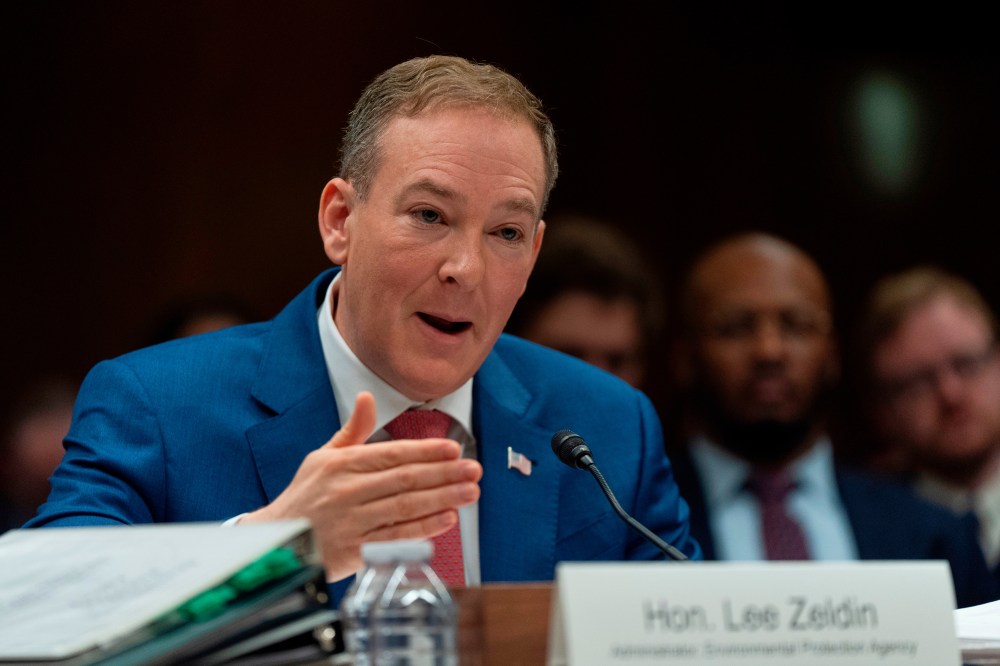
Environmental Protection Agency administrator Lee Zeldin, testifies to the Senate Appropriations subcommittee on Interior, Environment and related agencies on the budget request for the EPA, on Capitol Hill, Wednesday, May 13, 2026, in Washington. (AP Photo/Manuel Balce Ceneta)

Changing the rule is critical to making electricity more affordable and reliable, while advancing the economy, EPA Administrator Lee Zeldin said in a statement.

“The AI and data center revolution is creating an electricity and baseload power demand that cannot be met under the overly restrictive policies of past administrations,” Zeldin said. “The Trump EPA will continue doing its part to address these burdensome regulations on the coal-fired power plant sector that hold American communities back from the new opportunities presented by this new 21st century energy reality.”

In 2024, the EPA strengthened wastewater rules over coal-fired power plants that keep coal ash — a byproduct of burning coal — in unlined, uncovered dumps that leach toxic heavy metals such as mercury, arsenic and selenium into groundwater.

In the rule, the EPA required plant owners to report whether the groundwater was contaminated and, if so, pump and treat the contaminated groundwater before discharging it into streams and rivers, Thom Cmar, an attorney for environmental advocacy group Earthjustice, said.

The EPA initially had given power plant owners until Dec. 31, 2029, to meet the new limits.

The EPA said the rule proposed Thursday, if finalized, would reduce power generation costs by as much as $1.1 billion a year. Coal and power industry trade associations cheered the EPA’s move. Environmental groups slammed it as a public health danger and giveaway to the coal-power industry.

Earthjustice said the lakes, rivers and other waterways that will see more pollution as a result of the EPA’s proposal are often sources of drinking water that tens of millions of people rely on. Coal-fired power plants are by far one of the largest sources of toxic pollutants in America’s rivers, lakes and streams, Earthjustice said.

“This plan would eliminate safeguards on hundreds of millions of pounds of wastewater with neurotoxins and cancer-causing contaminants. It would allow coal power plants to avoid cleaning up contamination that threatens our drinking water sources,” Cmar said.

The proposal unveiled Thursday would exempt contaminated groundwater seeping into waterways from the mandatory treatment requirements, Earthjustice said. Power plant owners would only be required to treat the contaminated groundwater if they were already complying with the 2024 rule to pump it to the surface to treat it, Earthjustice said.

States could, however, still investigate whether power plants are polluting the groundwater and, if they are, try to force owners to treat the polluted groundwater under federal clean water laws, Cmar said.

“The problem is, at the state level, many states are reluctant to use that tool that they all have to hold up the permitting process and force the companies to do an adequate job of documenting and limiting the pollution,” Cmar said.

The EPA said dozens of coal-fired power plants — likely up to 104 — are polluting groundwater through the uncontrolled runoff. It found seven plants were complying with the rule to pump and treat the groundwater, it said.

The EPA had estimated in 2024 that its new rule that year would reduce pollutant discharges by 660 to 672 million pounds per year, provide $3.2 billion in public health benefits each year and especially benefit “low-income communities and communities of color that are disproportionately impacted by pollution from coal-fired power plants.”

It had projected that electricity bills for the average residential household would increase by less than $3.50 per year.

___

Follow Marc Levy at http://twitter.com/timelywriter

Report Error Submit a Tip

More Stories

Manitoba abandoning spring, fall clock changes

Carol Sanders 8 minute read Preview

Manitoba abandoning spring, fall clock changes

Carol Sanders 8 minute read Updated: Yesterday at 8:48 AM CDT

Time’s up for the time change in Manitoba.

Manitobans won’t be setting their clocks back an hour in November. The province has decided to permanently stay on daylight time after surveying residents on the twice annual clock adjustment.

“We heard from Manitobans loud and clear — no more changing the clocks in Manitoba,” Premier Wab Kinew said in a news release Thursday.

Most of the 72,000 votes submitted in an online EngageMB survey — 92 per cent — said they would like to see the practice end. The survey asked if they preferred earlier sunrises in winter with standard time or the later sunsets in summer with daylight time. More than half of survey participants (58 per cent) indicated a preference to stay on permanent daylight time; 34 per cent voted to eliminate the time change but stay on standard time.

Read
Updated: Yesterday at 8:48 AM CDT

Near-future U.S. the setting for surreal dual-world storyline

Reviewed by Morley Walker 4 minute read Preview

Near-future U.S. the setting for surreal dual-world storyline

Reviewed by Morley Walker 4 minute read 2:01 AM CDT

It’s not every day you encounter a seriously intended literary novel that attempts to dramatize a mind-bending physics theory like quantum entanglement.

But then the B.C.-born-and-raised Emily St. John Mandel is not your everyday Canadian literary writer.

In her late 40s, she has lived in the U.S. for her entire writing career. She is best known for her 2014 dystopian novel Station Eleven, about a Shakespearean acting troupe navigating a pandemic-ravaged America.

Her new outing, her seventh, Exit Party, shares DNA with detective and sci-fi genres more than with conventional literary fiction.

Read
2:01 AM CDT

Family account spiced with magic realism, geopolitical intrigue and a ghost story

Reviewed by Zilla Jones 4 minute read Preview

Family account spiced with magic realism, geopolitical intrigue and a ghost story

Reviewed by Zilla Jones 4 minute read 2:01 AM CDT

Tom Lin’s second novel Babylon, South Dakota moves beyond a historical account of an immigrant family’s struggle, delightfully blending and bending genres.

Lin is a Chinese-born novelist whose family emigrated to the U.S. when he was four years old. His debut novel, The Thousand Crimes of Ming Tsu, won the 2022 Andrew Carnegie Medal for Excellence in Fiction, making him the youngest ever recipient of that award. He earned a PhD in English from the University of California Davis and is currently an assistant professor of English and creative writing at the University of Iowa.

Babylon, South Dakota takes place in an unspecified time period that can be understood to be during the Mao era — likely the 1950s or ’60s. A young Chinese couple, the Hsuis, immigrate to the rural community that gives the book its title. They take the names Saul and Mei and settle on a 160-acre homestead left to them by a distant relative.

Saul’s dream is to breed and sell chrysanthemums from seeds he brought from China, while Mei wants to raise livestock. They speak no English, know nothing of life in the United States, are unprepared for the harshness of winter and the isolation of the farm and bring nothing with them except some gold, which Mei hides around the house for emergencies. Their only link to the outside world is a discarded and marginally functioning TV set, which Saul rescues and rigs up.

Read
2:01 AM CDT

Grieving child builds backyard rocket ship

Harriet Zaidman 4 minute read 2:01 AM CDT

I Built a Rocket Ship (Kids Can Press, 32 pages, hardcover, $22) by Winnipegger Anna Lazowski is a tender story for children ages 4-8 about a little girl trying to make sense of her mother’s death. The child engages in conversation with her late mom, agreeing and disagreeing about things said as she carries objects (and of course, the cat) to the backyard. There, she is building a rocket ship she will pilot into the skies to find her mom again.

Jennica Lounsbury’s varied perspectives show the range of emotions the little girl experiences.

● ● ●

Northwoods Lullaby by Mary Casanova (University of Minnesota Press, 32 pages, hardover, $25) is a bedtime book for readers up to age eight, perfect to bring a busy, happy day to a close. Just like children who are listening to adults reading the book, all the animal babies are being tucked into their nests and burrows by loving parents: “Thump and scamper,/nimble clover./ Soon it’s time to rest. Baby loon/ nestles in/as Papa floats along.”

Day 1 of Jets training camp in the books with pairings essentially cemented

Ken Wiebe 7 minute read Preview

Day 1 of Jets training camp in the books with pairings essentially cemented

Ken Wiebe 7 minute read Thursday, Sep. 17, 2026

Nearly six minutes into his question-and-answer session, Scott Arniel took a welcome detour from the news of the day.

After exhausting the discussion around the goalie who wasn’t in training camp, the head coach of the Winnipeg Jets finally got a query about the line combinations and defensive pairings that were unveiled in training camp.

And unlike past years, when exhibition games were more frequent and the training camp wasn’t this condensed, Arniel conceded these groupings were intentional and were likely staying together for some time.

The expansion to an 84-game regular season brings with it a reduction to four pre-season games and a much shorter training camp, which could limit the amount of experimentation that Arniel can do during the next two weeks.

Read
Thursday, Sep. 17, 2026

Trump administration aims to roll back limits on toxic wastewater from coal-fired power plants

Marc Levy, The Associated Press 4 minute read Preview

Trump administration aims to roll back limits on toxic wastewater from coal-fired power plants

Marc Levy, The Associated Press 4 minute read Thursday, May. 14, 2026

HARRISBURG, Pa. (AP) — The U.S. Environmental Protection Agency moved Thursday to roll back limits that require coal-fired power plants to prevent the release of toxic heavy metals into streams and rivers through polluted groundwater, saying a three-year-old rule is unduly costly for the energy industry at a time when energy demand is spiking.

It is the latest step that President Donald Trump's administration has taken to pull back regulations on coal mining and coal-fired power and empower fossil fuels as a primary energy source to feed the rapid growth of artificial intelligence data centers.

In its proposed rule, the EPA said a 2024 rule under President Joe Biden misjudged the effectiveness and cost of the regulation, and had the effect of shutting down coal-fired power plants at a time when energy demand is spiking.

Changing the rule is critical to making electricity more affordable and reliable, while advancing the economy, EPA Administrator Lee Zeldin said in a statement.

Read
Thursday, May. 14, 2026