Safety board report says doomed Titan submersible operated with no federal oversight

Advertisement

Advertise with us

ST. JOHN'S - The Transportation Safety Board of Canada says a submersible that imploded on its way to the Titanic wreck was operating in Canada without any oversight, and it is asking federal authorities to look closer at uncertified vessels.

Read this article for free:


or

Already have an account? Log in here »

To continue reading, please subscribe:

Subscribe and receive a limited-edition Free Press branded hat or tote.

Digital Subscription

One year of digital access for only $205*

  • Enjoy unlimited reading on winnipegfreepress.com
  • Read the E-Edition, our digital replica newspaper
  • Access News Break, our award-winning app
  • Play interactive puzzles

*First annual payment billed as $205.00 + GST for one year. This annual subscription will automatically renew at $233.00 + GST every 52 weeks (10% off the regular annual price of $259.35). Offer available to new and qualified returning subscribers only. Cancel any time.

To continue reading, please subscribe:

Add Free Press access to your Brandon Sun subscription for only an additional

$1 for the first 4 weeks*

  • Enjoy unlimited reading on winnipegfreepress.com
  • Read the E-Edition, our digital replica newspaper
  • Access News Break, our award-winning app
  • Play interactive puzzles
Start now

*Your next Brandon Sun subscription payment will increase by $1.00 and you will be charged $17.95 plus GST for four weeks. After four weeks, your payment will increase to $24.95 plus GST every four weeks.

ST. JOHN’S – The Transportation Safety Board of Canada says a submersible that imploded on its way to the Titanic wreck was operating in Canada without any oversight, and it is asking federal authorities to look closer at uncertified vessels.

The board released a report Wednesday examining the Titan sub’s doomed voyage nearly three years ago, which killed all five people on board. Among the dead was Stockton Rush, chief executive of OceanGate Inc., the Washington-based company that owned the small vessel.

Transport Canada knew the uncertified submersible was operating out of St. John’s, N.L., but the department did not oversee those operations, leaving its occupants at risk, the federal investigation concluded.
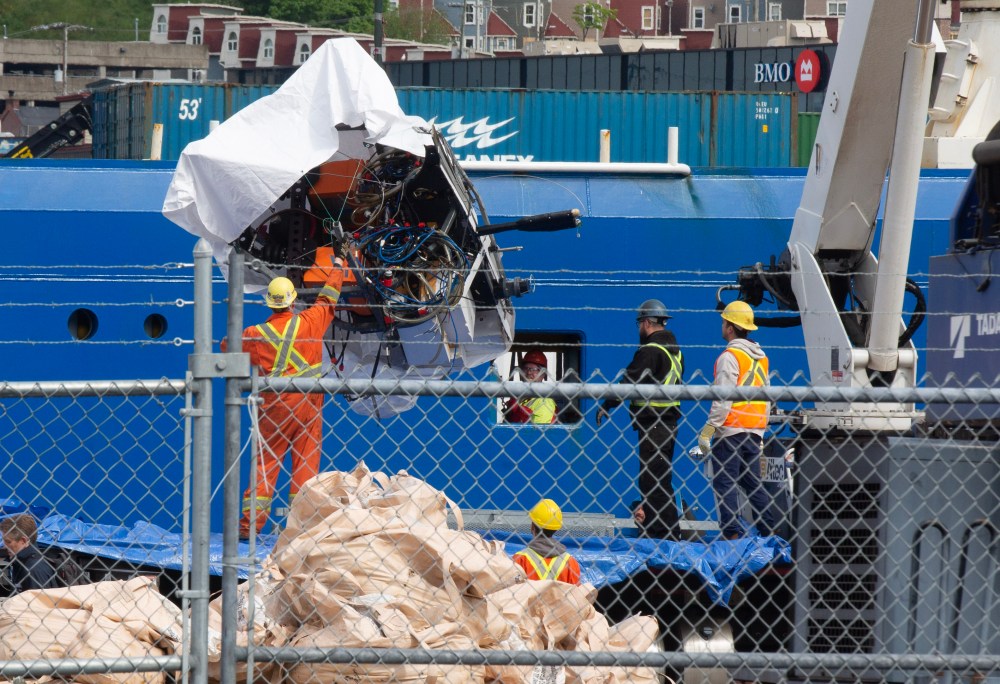
Debris from the Titan submersible, recovered from the ocean floor near the wreck of the Titanic, is unloaded from the ship Horizon Arctic at the Canadian Coast Guard pier in St. John’s on Wednesday, June 28, 2023. THE CANADIAN PRESS/Paul Daly

It also found that several other government agencies knew about the Titan’s dives to the Titanic, but the information they shared with each other — and with Transport Canada — was limited.

“A lot of these government departments had pieces of the puzzle, they knew about certain aspects of OceanGate’s operations in Canada — and these departments include Transport Canada,” Yoan Marier, chair of the federal safety board, said in an interview.

“However, nobody could put all the pieces of the puzzle together.”

The Titan went missing on June 18, 2023, as it descended to the remains of the Titanic, which sank on April 15, 1912. The famous wreck sits on the ocean floor about 700 kilometres south of St. John’s, in waters nearly four kilometres deep. The Titan’s support crew lost contact with the submersible about an hour and 45 minutes into its voyage.

The disappearance prompted a frantic search involving coast guard and military agencies from the United States and Canada. Pieces of the Titan were found about four days later, about 300 metres off the bow of the Titanic.

OceanGate often touted Titan’s unorthodox carbon-fibre hull, which was cylindrical rather than the standard sphere. The vessel was not “classed,” meaning it wasn’t certified by an independent third party to ensure it was conceived, constructed and tested according to safety standards.

The safety board’s report Wednesday said OceanGate had no idea how long the hull would hold up under repeated dives to the bottom of the Atlantic and the systems it had to test the structure were flawed or mismanaged. The Titan began making trips to the Titanic in 2021 and each trip likely damaged the hull until it finally imploded, the report said.

Jason Melvin, a senior marine investigator with the board, said OceanGate’s culture seemed to prevent any improvements.

“There was a little bit of group think that was going on,” Melvin said in an interview. “If there was a safety issue brought up, if it wasn’t aligned with the management, it was usually negatively perceived.”

Officials in Canada weren’t asking about safety either, the report said. Transport Canada was aware of the Titan’s trips but it didn’t know the sub was not registered with any flag state, and thus not beholden to any jurisdiction’s laws or regulations, the safety board’s report said.

Transport Canada never contacted OceanGate to ask about Titan’s safety standards, nor did it send officials to have a look at the vessel, the board said.

“The investigation found that the lack of regulatory oversight to identify safety deficiencies resulted in increased risk to those involved in the Titan’s operations,” the report said.

Transport Canada did not immediately respond to a request for comment.

The board recommended the department come up with a system to determine whether an uncertified vessel poses a safety risk and then monitor that vessel more closely. The move would make sea travel safer for thousands of other small uncertified vessels operating in Canada, Marier said.

“We found through this investigation, and also previous investigations … that some small vessels can go through their entire life cycle without ever being inspected by a Transport Canada inspector,” he said.

The report included five other recommendations about oversight, standards and safety management, including that Transport Canada push for mandatory international standards for designing, building and operating submersibles.

Marier said the board provided the department with a briefing on the report before it was released on Wednesday. The department has 90 days to respond, he said.

This report by The Canadian Press was first published June 17, 2026.

Report Error Submit a Tip

More Stories

Jets up against the clock

Mike McIntyre 8 minute read Preview

Jets up against the clock

Mike McIntyre 8 minute read Yesterday at 7:03 PM CDT

Time has often been on the side of the Winnipeg Jets, with Cole Perfetti’s famous “Manitoba Miracle” buzzer-beater serving as Exhibit A.

But that won’t necessarily be the case this coming season, when the clock threatens to become a stubborn and, at times, confusing opponent.

Premier Wab Kinew’s decision to adopt permanent daylight time will have a significant impact on the hockey club, both as hosts and visitors, head coach Scott Arniel told the Free Press on Sunday.

Athletes are creatures of habit, and their regular routines are going to be challenged during the period from Nov. 1 to March 14, which covers the majority of the 84-game campaign.

Read
Yesterday at 7:03 PM CDT

‘She was looking to destroy me’: convicted harasser faces new charges

Dean Pritchard 6 minute read Preview

‘She was looking to destroy me’: convicted harasser faces new charges

Dean Pritchard 6 minute read Thursday, Sep. 17, 2026

When Agnieszka Ciochon-Newton moved into the 55-plus apartment building on Stradbrook Avenue last year, she came across as “timid, soft-spoken and sensitive,” said building manager Tanya Owen.

Little did Owen know the meek-looking 58-year-old woman would soon turn her life and the lives of many of her tenants upside down and threaten her career and family.

“She was looking to destroy me for a simple tenant disagreement,” Owen said Thursday.

Court records show Ciochon-Newton was arrested earlier this month and charged with seven counts of criminal harassment, two counts of uttering threats and one count each of fraud, breaking and entering, attempting to obstruct justice, intimidation of a justice official, mischief and defamatory libel.

Read
Thursday, Sep. 17, 2026

Cabernet Sauvignon star of wine festival

Ben Sigurdson 5 minute read Preview

Cabernet Sauvignon star of wine festival

Ben Sigurdson 5 minute read Saturday, Sep. 19, 2026

The Winnipeg Wine Festival will celebrate the king of red wine grapes next weekend — the theme of this year’s festival, which takes place Sept. 25 and 26 at the RBC Convention Centre, is Cabernet Sauvignon.

Cab Sauv, as it’s also known, is the world’s most widely planted wine grape of any colour, first coming to prominence in the 1800s in France’s Bordeaux region, where the grape is still popular. Rather than single-variety wines, Bordeaux reds tend to be blends, with those coming from the left bank of the Gironde estuary being Cabernet-dominant, while right-bank wines are Merlot-dominant, with Cabernet Sauvignon playing a supporting role. Cabernet and Merlot work well together and many other countries have followed suit in blending the two.

A team at University of California Davis put Cabernet Sauvignon through a DNA test in 1996 and discovered its parent grapes are Cabernet Franc and Sauvignon Blanc — it’s likely that at some point the two varieties, planted next to each other in some vineyard, crossed and mutated and became the grape we know today. (Someone growing grapes in the 19th century must have had an inkling of what was up, as the grape has been called Cabernet Sauvignon since long before the DNA test.)

Flavour-wise, most Cabernet Sauvignon wines are big and bold, with a core of deep dark berry flavours, some graphite and spice notes and relatively bright acidity. It’s a grape that is well-suited to barrel aging, with most examples seeing at least some time in wood.

Read
Saturday, Sep. 19, 2026

Puzzles Palace

1 minute read Monday, Jul. 27, 2026

To solve our puzzles, please subscribe with this special offer: |

Transportation Safety Board investigating after two pilots found dead near Regina

The Canadian Press 1 minute read Preview

Transportation Safety Board investigating after two pilots found dead near Regina

The Canadian Press 1 minute read Updated: Yesterday at 4:41 PM CDT

REGINA - A Manitoba-based flying school and air taxi provider says two of its pilots were found dead near Regina on Friday.

Adam Penner, president of Harv's Air, says in a statement that two people were aboard the Cessna 172 on a night flight from Regina to Steinbach, Man.

Penner says a search began after the aircraft did not arrive on schedule, and the plane was found along with its two occupants on Friday evening near Kisbey, southeast of Regina.

Harv's Air says it is shocked and saddened by the tragedy, and it is working with the Transportation Safety Board of Canada in determining the cause of the deaths.

Read
Updated: Yesterday at 4:41 PM CDT

Former Bombers linebacker Gauthier enjoying career as electrician

Taylor Allen 6 minute read Preview

Former Bombers linebacker Gauthier enjoying career as electrician

Taylor Allen 6 minute read Friday, Sep. 18, 2026

Most professional football players don’t ride off into the sunset on their own terms.

Shayne Gauthier was well aware of that, but it didn’t make it sting any less when the Winnipeg Blue Bombers informed the veteran linebacker that they weren’t bringing him back for 2026.

“I was really hoping to play one more (season) because it would have been my 10th season, so, I’d say it didn’t really end the way I wanted,” Gauthier recently told the Free Press.

“It left a little sour taste in my mouth, but that’s part of pro sports. If everybody got the ending that they wanted, then it wouldn’t really work.”

Read
Friday, Sep. 18, 2026