Trump administration announces $17.5 billion in loans for 10 new large nuclear reactors

Advertisement

Advertise with us

WASHINGTON (AP) — The Trump administration is providing $17.5 billion to speed the development of 10 new large nuclear reactors to meet the skyrocketing power demand from massive data centers.

Read this article for free:


or

Already have an account? Log in here »

To continue reading, please subscribe:

Subscribe and receive a limited-edition Free Press branded hat or tote.

Digital Subscription

One year of digital access for only $205*

  • Enjoy unlimited reading on winnipegfreepress.com
  • Read the E-Edition, our digital replica newspaper
  • Access News Break, our award-winning app
  • Play interactive puzzles

*First annual payment billed as $205.00 + GST for one year. This annual subscription will automatically renew at $233.00 + GST every 52 weeks (10% off the regular annual price of $259.35). Offer available to new and qualified returning subscribers only. Cancel any time.

To continue reading, please subscribe:

Add Free Press access to your Brandon Sun subscription for only an additional

$1 for the first 4 weeks*

  • Enjoy unlimited reading on winnipegfreepress.com
  • Read the E-Edition, our digital replica newspaper
  • Access News Break, our award-winning app
  • Play interactive puzzles
Start now

*Your next Brandon Sun subscription payment will increase by $1.00 and you will be charged $17.95 plus GST for four weeks. After four weeks, your payment will increase to $24.95 plus GST every four weeks.

WASHINGTON (AP) — The Trump administration is providing $17.5 billion to speed the development of 10 new large nuclear reactors to meet the skyrocketing power demand from massive data centers.

Energy Secretary Chris Wright cited “tremendous interest” among developers of data centers that would buy the power, as well as utilities and energy companies. The nuclear plants could begin construction by 2030 and become operational in the mid-2030s, Wright and other officials said Tuesday.

“This is the start,” Wright said on a call with reporters. “We’re going to move with the players that are ready to stand up and move quickly. Once that supply chain is up and running, do we think there will be dozens of these built going forward? I’d be very surprised if there were not.”
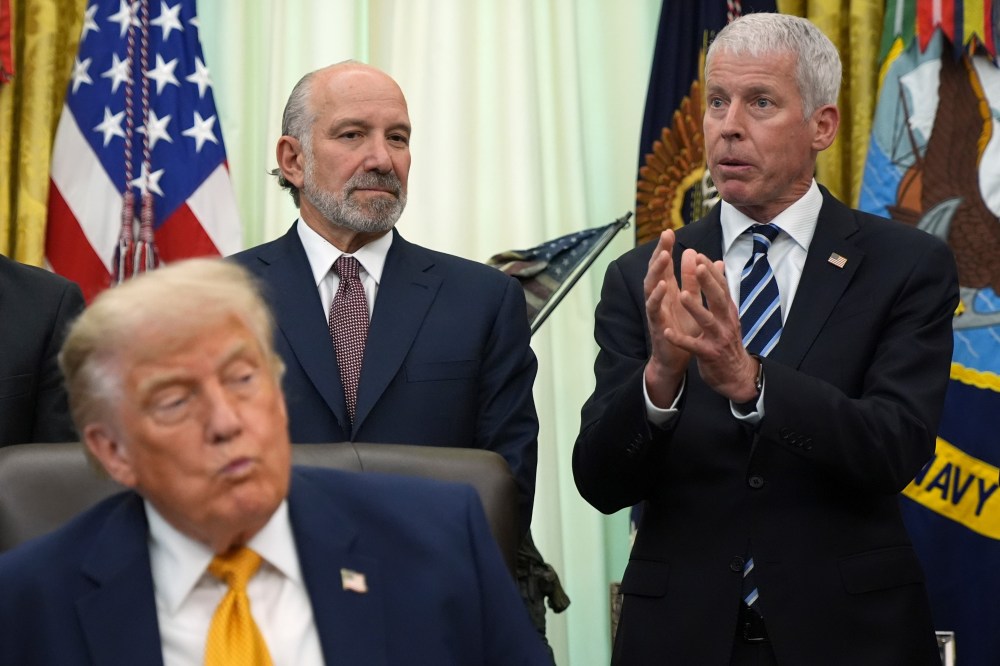
Energy Secretary Chris Wright, from right, speaks as Commerce Secretary Howard Lutnick and President Donald Trump listen in the Oval Office of the White House during an executive order signing about quantum computing, Monday, June 22, 2026, in Washington. (AP Photo/Jacquelyn Martin)

Most U.S. nuclear power plants were built between 1970 and 1990. Only two new large reactors have been built from scratch in the United States in recent decades. Those two reactors, at Georgia Power Co.’s Plant Vogtle, were completed years late and billions of dollars over budget. The 10 new reactors will use the same design, Westinghouse’s AP1000.

Wright said the Plant Vogtle project struggled because of bad planning, supply chain problems and the COVID-19 pandemic. But, he said, the reactor design is “robust and sound.”

“By building in volume and at multiple locations, we think we will create and stand up a large supply chain and build a lot of construction expertise,” Wright said. “We expect the timing and cost of these plants to well outperform what was done on Vogtle.”

Seven utilities and energy companies signed letters of intent that identified sites, the Energy Department said. The agency plans to pick five, which would host two reactors at each site. The federal financing would be used to purchase nuclear components with long lead times, and are not construction loans.

The department declined to name the utilities involved or the states they are in, calling it premature until the selections are made. It did not give a timeline for making those selections.

President Donald Trump set a goal of quadrupling domestic production of nuclear power within the next 25 years, and he has signed executive orders to speed development. The administration is working to advance new nuclear technologies, such as small modular nuclear reactors.

Dan Sumner, president and chief executive officer of Westinghouse, said industrialized nuclear power needs to be built at fleet scale, in order for the United States to lead in artificial intelligence, advanced manufacturing and the industries that will define the next century.

Critics of building more nuclear reactors say they’re too expensive and riskier than other low-carbon energy sources. Several states restrict or ban new nuclear power plant construction.

Travis Fisher, director of energy and environmental policy studies at the libertarian Cato Institute think tank, said the Energy Department has the authority to issue these loan guarantees, but he doesn’t think the executive branch should be so heavily involved in the electricity sector.

If the past is any indication, the next administration will use similar authorities to favor a different set of energy resources, he added. “Remove the state barriers and the federal favoritism and let companies build the power plants that pass the market test,” Fisher wrote in an e-mail Tuesday.
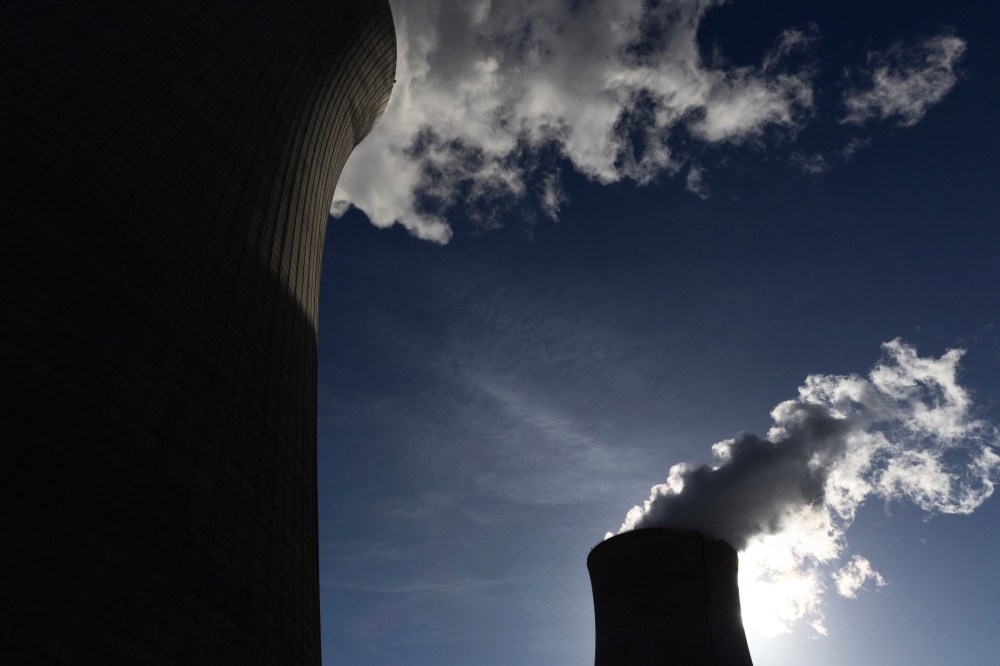
FILE - The cooling towers for units 4, left, and 3, right, are seen at Plant Vogtle, operated by Georgia Power Co., in east Georgia's Burke County near Waynesboro, Ga., on May 29, 2024. (Arvin Temkar/Atlanta Journal-Constitution via AP, File)

Data centers used 4% to 5% of the nation’s total electricity in 2024, a share that could nearly triple by 2028, according to government estimates. Some analysts predict nationwide electricity use to rise as much as 20% in the next decade, with data centers a big reason.

The Energy Department said the loans could speed up the development of these 10 reactors by up to three years and lower construction costs. Its goal is for all 10 to be under construction by 2030, to start providing power in the mid-2030s.

The utilities and Westinghouse will be expected to contribute up to $5 billion in equity in total across the five, two-reactors projects. Wright said his department provides up to $17.5 billion in loans, or $3.5 billion per project, in debt to pair with the equity. He said it’s “very, very low risk to the American taxpayers.”

___

McDermott reported from Providence, R.I.

___

The Associated Press’ climate and environmental coverage receives financial support from multiple private foundations. AP is solely responsible for all content. Find AP’s standards for working with philanthropies, a list of supporters and funded coverage areas at AP.org.


Report Error Submit a Tip

More Stories

‘She was looking to destroy me’: convicted harasser faces new charges

Dean Pritchard 6 minute read Preview

‘She was looking to destroy me’: convicted harasser faces new charges

Dean Pritchard 6 minute read Thursday, Sep. 17, 2026

When Agnieszka Ciochon-Newton moved into the 55-plus apartment building on Stradbrook Avenue last year, she came across as “timid, soft-spoken and sensitive,” said building manager Tanya Owen.

Little did Owen know the meek-looking 58-year-old woman would soon turn her life and the lives of many of her tenants upside down and threaten her career and family.

“She was looking to destroy me for a simple tenant disagreement,” Owen said Thursday.

Court records show Ciochon-Newton was arrested earlier this month and charged with seven counts of criminal harassment, two counts of uttering threats and one count each of fraud, breaking and entering, attempting to obstruct justice, intimidation of a justice official, mischief and defamatory libel.

Read
Thursday, Sep. 17, 2026

Day 1 of Jets training camp in the books with pairings essentially cemented

Ken Wiebe 7 minute read Preview

Day 1 of Jets training camp in the books with pairings essentially cemented

Ken Wiebe 7 minute read Thursday, Sep. 17, 2026

Nearly six minutes into his question-and-answer session, Scott Arniel took a welcome detour from the news of the day.

After exhausting the discussion around the goalie who wasn’t in training camp, the head coach of the Winnipeg Jets finally got a query about the line combinations and defensive pairings that were unveiled in training camp.

And unlike past years, when exhibition games were more frequent and the training camp wasn’t this condensed, Arniel conceded these groupings were intentional and were likely staying together for some time.

The expansion to an 84-game regular season brings with it a reduction to four pre-season games and a much shorter training camp, which could limit the amount of experimentation that Arniel can do during the next two weeks.

Read
Thursday, Sep. 17, 2026

Gillingham in lead with decided voters

Nicole Buffie 6 minute read Preview

Gillingham in lead with decided voters

Nicole Buffie 6 minute read Yesterday at 6:55 PM CDT

A cloud of uncertainty is hanging over Winnipeg as October’s municipal election nears.

Three months after a poll showed more than 40 per cent of Winnipeggers wanted to see someone other than current mayor Scott Gillingham elected, a new Abacus Data poll indicates more than half of Winnipeg voters are undecided heading into next month’s civic election.

Of decided voters, 55 per cent favour Gillingham compared to 23 per cent for former councillor and provincial cabinet minister Kevin Klein and 11 per cent for funeral director Mike Vogiatzakis.

Of all respondents, just over 50 per cent said they were unsure while 13 per cent said they will not vote.

Read
Yesterday at 6:55 PM CDT

Puzzles Palace

1 minute read Monday, Jul. 27, 2026

To solve our puzzles, please subscribe with this special offer: |

United Way, other charities fight for dollars as donor base shrinks

Scott Billeck 7 minute read Preview

United Way, other charities fight for dollars as donor base shrinks

Scott Billeck 7 minute read Yesterday at 2:00 AM CDT

Winnipeg’s charitable sector is being squeezed from both sides: demand for help is growing while the pool of donors to meet that need is shrinking.

The imbalance is increasingly being carried by a relatively small group of deep-pocketed donors. Last year, 600 people — about three per cent of United Way Winnipeg’s individual donors — accounted for roughly $8 million, or 55 per cent of individual donations.

The fundraising pitch isn’t getting any easier.

Homelessness and public drug use have become increasingly visible, household budgets remain strained and the problems charities are trying to address can seem so entrenched that donors may reasonably wonder what difference another contribution can make.

Read
Yesterday at 2:00 AM CDT

Not falling back means time loop remains unclosed

Jen Zoratti 4 minute read 2:01 AM CDT

I demand restitution. Where’s my hour?

In the traditional fall-back, spring-forward time change set up — you know, ol’ trusty that’s been effect for lo these 63 years — we lost an hour in the spring that we got back in the fall.

That was the social contract: you commit to feeling like you’re on cold medication for a week in March because you know a glorious extra hour of sleep will be returned to you in November. (Unless, of course, you have little kids, but look: we all make our choices.)

Well, that transaction, flawed as it was, isn’t happening this year. That hour you sacrificed to the sun gods in the spring? Gone. Not coming back. We’ve sprung forward and we shan’t be falling back — not in November, and (possibly) not ever. The scale shall remain unbalanced and the loop shall remain unclosed as Manitoba has adopted permanent daylight time.