Europe’s extreme heat would be impossible without climate change, scientists say

Advertisement

Advertise with us

The record-breaking heat that's scorching Europe day and night this month would not have been possible without climate change, according to a new study.

Read this article for free:


or

Already have an account? Log in here »

To continue reading, please subscribe:

Subscribe and receive a limited-edition Free Press branded hat or tote.

Digital Subscription

One year of digital access for only $205*

  • Enjoy unlimited reading on winnipegfreepress.com
  • Read the E-Edition, our digital replica newspaper
  • Access News Break, our award-winning app
  • Play interactive puzzles

*First annual payment billed as $205.00 + GST for one year. This annual subscription will automatically renew at $233.00 + GST every 52 weeks (10% off the regular annual price of $259.35). Offer available to new and qualified returning subscribers only. Cancel any time.

To continue reading, please subscribe:

Add Free Press access to your Brandon Sun subscription for only an additional

$1 for the first 4 weeks*

  • Enjoy unlimited reading on winnipegfreepress.com
  • Read the E-Edition, our digital replica newspaper
  • Access News Break, our award-winning app
  • Play interactive puzzles
Start now

*Your next Brandon Sun subscription payment will increase by $1.00 and you will be charged $17.95 plus GST for four weeks. After four weeks, your payment will increase to $24.95 plus GST every four weeks.

The record-breaking heat that’s scorching Europe day and night this month would not have been possible without climate change, according to a new study.

The World Weather Attribution rapid study released Friday found that the heat would have been virtually impossible just five decades ago, and is 200 times more likely today than it would have been 20 years ago.

Millions in France, Italy, Spain, the United Kingdom and elsewhere in Europe are experiencing extreme temperatures and humidity this week associated with a heat dome. Daytime temperatures have topped 40 degrees Celsius (104 Fahrenheit) in many places, while high nighttime temperatures have also made it harder to cool down and recover.
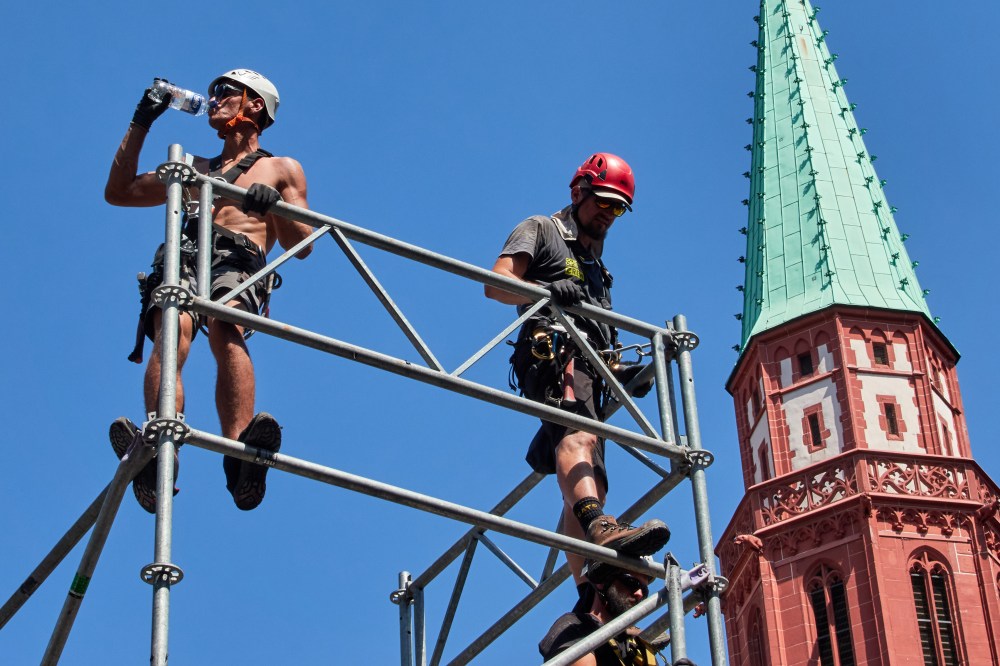
A worker drinks water as he sets up a stage for the upcoming Ironman triathlon, Frankfurt, Germany, Thursday, June 25, 2026. (AP Photo/Michael Probst)

The scientists estimated that a heat wave with similar characteristics occurring in the climate of June 1976 would have been about 3.5 degrees Celsius (6.3 Fahrenheit) cooler during the day and about 2 degrees Celsius cooler (3.6 Fahrenheit) in 2003. The nighttime temperatures would have been about 2.4 degrees Celsius (4.3 Fahrenheit) cooler in June 1976 and about 1.3 degrees Celsius (2.3 Fahrenheit) cooler in 2003.

They chose 1976 and 2003 for comparison because those years saw extreme heat in Europe.

“The increase in temperatures was so dramatic that we would have expected to have never seen this event in the 1976 climate,” said the study’s lead author Theodore Keeping, also a climate scientist at the Centre for Environmental Policy at Imperial College London. “And it would also still have been very, very rare, even 23 years ago in 2003.”

Climate change is the driving force behind the heat

World Weather Attribution, a Europe-based collaborative of scientists who study the causes of global extreme weather events, began assessing in 2015 the extent to which those could be attributed to climate change caused by the burning of fossil fuels such as coal, oil and gas. The organization’s rapid attribution studies, including this one, aren’t peer-reviewed but use peer-reviewed methodology.

The current study used observed temperature data and forecasts for an analysis of the heat wave that started on June 18.

It also found that 45% of the 850 cities analyzed across 30 European countries have broken, or are expected to hit, records for heat stress levels, a measure that includes humidity and temperature.

“It directly relates to the heat stress on the human body and our ability to cool ourselves down, and it’s a really good metric for the expected health impacts we expect to see from this heat wave,” Keeping said. Heat and humidity make for a dangerous combination for humans.

Ultimately, this marks the most severe heat wave to have ever been recorded in this region of Europe and most severe humid heat event, WWA researchers said.

Europe is especially unequipped for these extreme temperatures

Europe is the world’s fastest-warming continent, with temperatures increasing at twice the speed as the global average since the 1980s, according to the European Union’s Copernicus Climate Change Service. In a separate study last year, WWA researchers found there were about 1,500 climate change-caused deaths during a European heat wave last summer.

This week, weather agencies across Europe have issued red alerts about heat risks, and sporting events, schools, public transportation and attractions have been limited as a result. Many of these countries do not have widespread air conditioning or other infrastructure to account for warmer climates. France, which has been bearing much of the brunt of the heat wave, recorded its hottest day ever this week, and has also reported 40 deaths from drownings as people seek cooling relief.

The WWA scientists said the current El Nino warming cycle did not influence this heat.

Europe also experienced record-shattering high temperatures in May. Typically, Europe does not see dramatically warmer weather until July and August.

The findings of the study released Friday are reasonable, but may downplay climate change’s role in the heat, said Michael Mann, a climate scientist at the University of Pennsylvania who was not involved in the research.

“If anything, this latest assessment — and all similar assessments — are actually underestimating the role that climate change is playing here,” said Mann, who has separately studied how climate change is increasing heat stress in North America.

Keeping, the study author, said the Europe heat wave shows the need to adapt infrastructure and behavior to extreme temperatures.

“We need to expect them to happen. They’re only going to become more frequent in the near term,” Keeping said. “We also need to address the source of climate change as well. And that is very simply carbon emissions from burning fossil fuels.”

___

Alexa St. John is an Associated Press climate reporter. Follow her on X: @alexa_stjohn. Reach her at ast.john@ap.org.

___

Read more of AP’s climate coverage.

___

The Associated Press’ climate and environmental coverage receives financial support from multiple private foundations. AP is solely responsible for all content. Find AP’s standards for working with philanthropies, a list of supporters and funded coverage areas at AP.org.

Report Error Submit a Tip

More Stories

Tory health critic livid after being rebuffed by health officials

Carol Sanders 4 minute read Preview

Tory health critic livid after being rebuffed by health officials

Carol Sanders 4 minute read 11:53 AM CDT

The health critic for the Progressive Conservative party says her ability to get information about the accelerated reopening of Dauphin’s emergency department was stymied by Prairie Mountain Health officials because they refused to meet with her.

“I wanted to meet with PMH staff to discuss the status of the facility and the challenges they’re facing and getting services back online,” Kathleen Cook said Friday.

“I was very disappointed that Prairie Mountain Health declined me that opportunity.”

Cook said she asked for a meeting a few days after the Sept. 7 reopening of a temporary ER at the hospital, that was severely damaged by flooding.

Read
11:53 AM CDT

A life's story: ‘Ivor the Driver’ found his calling in the ranching life

Aaron Epp 7 minute read Preview

A life's story: ‘Ivor the Driver’ found his calling in the ranching life

Aaron Epp 7 minute read Updated: 9:59 AM CDT

Ivor Asham’s family couldn’t have picked a better image to accompany his obituary. There he is, riding Flash, his beloved brown and white quarter horse, a black cowboy hat on his head and a drink in his hand.

Asham owned and operated Birds Hill Park Ranch for nearly 35 years, where he shared his lifelong passion for horses with thousands of visitors. He moved hay, harnessed horses and drove the wagons, introducing himself as “Ivor the Driver.”

Over the years, Asham built a reputation as the quintessential cowboy.

There’s a restaurant at the ranch filled with memorabilia that he collected over the years. Calgary Stampede posters, cowboy boot-shaped shot glasses, a child’s rocking horse, a wagon wheel and numerous photos of legendary actor John Wayne are just some of the items that line the walls.

Read
Updated: 9:59 AM CDT

Goodness alive, well in N.L.-set musical

Jen Zoratti 4 minute read Preview

Goodness alive, well in N.L.-set musical

Jen Zoratti 4 minute read 2:01 AM CDT

I first saw Come From Away — the true-story musical about the incredible efforts of the residents of Gander, N.L. on Sept. 11, 2001, who welcomed nearly 7,000 travellers diverted to their remote town after the attacks on the World Trade Center and the Pentagon — in 2022, when Broadway Across Canada brought it to the Centennial Concert Hall.

I went in cold, but with blunted expectations; it seemed, on premise alone, like it could tilt too far into shmaltzy sentimentality, that it would be too earnest in its goodness.

So, when I wept until my face was as wet and salty as though it had been slapped by the waves of the North Atlantic, I was pleasantly surprised. I loved it. It’s emotional, yes. It’s sentimental, yes. But you can’t help but feel both buoyed — and, dare I say, patriotic — by the end of it.

Written by Canadians Irene Sankoff and David Hein, Come From Away seemed an unlikely hit when it opened on Broadway in 2017. But there was, by then, an appetite for it.

Read
2:01 AM CDT

Closure of Nomads field massive upset for North End

Joshua Frey-Sam 4 minute read Preview

Closure of Nomads field massive upset for North End

Joshua Frey-Sam 4 minute read Updated: Yesterday at 8:49 AM CDT

The North Winnipeg Nomads have a flag on the field.

The long-standing minor football club was recently informed that its field is unfit to host games and that it would need to find a new home for its five youth and adult teams until repairs are made to the playing surface.

“Our board has made every effort to address the condition of our home field,” the club wrote in a statement. “Unfortunately, following a professional assessment, the field has been determined to be unsafe and unstable for our athletes.”

All five of the club’s teams will play their 2026 season at Frank Whyte Field, part of the Northwood Community Centre, with no confirmed date for when they can play on their home field again.

Read
Updated: Yesterday at 8:49 AM CDT

Letters, Sept. 12

7 minute read 2:00 AM CDT

An overreactionRe: Winnipeg teacher disciplined for ‘liking’ student’s post, Sept. 1.

I’ve been stewing about the article for a few days and trying to decide what’s been bothering me.

I feel that the school division overreacted with its disciplinary measures, and that a public servant has been publicly shamed on the front page for what I can only describe as a questionable act.

The named teacher seems to be a responsible and law-abiding person who has committed no crime whatsoever.

Europe’s extreme heat would be impossible without climate change, scientists say

Alexa St. John, The Associated Press 5 minute read Preview

Europe’s extreme heat would be impossible without climate change, scientists say

Alexa St. John, The Associated Press 5 minute read Sunday, Jun. 28, 2026

The record-breaking heat that's scorching Europe day and night this month would not have been possible without climate change, according to a new study.

The World Weather Attribution rapid study released Friday found that the heat would have been virtually impossible just five decades ago, and is 200 times more likely today than it would have been 20 years ago.

Millions in France, Italy, Spain, the United Kingdom and elsewhere in Europe are experiencing extreme temperatures and humidity this week associated with a heat dome. Daytime temperatures have topped 40 degrees Celsius (104 Fahrenheit) in many places, while high nighttime temperatures have also made it harder to cool down and recover.

The scientists estimated that a heat wave with similar characteristics occurring in the climate of June 1976 would have been about 3.5 degrees Celsius (6.3 Fahrenheit) cooler during the day and about 2 degrees Celsius cooler (3.6 Fahrenheit) in 2003. The nighttime temperatures would have been about 2.4 degrees Celsius (4.3 Fahrenheit) cooler in June 1976 and about 1.3 degrees Celsius (2.3 Fahrenheit) cooler in 2003.

Read
Sunday, Jun. 28, 2026