A Brazilian bay’s surprise shark nursery sparks conservation project
Advertisement
Read this article for free:
or
Already have an account? Log in here »
To continue reading, please subscribe:

Digital Subscription
One year of digital access for only $205*
- Enjoy unlimited reading on winnipegfreepress.com
- Read the E-Edition, our digital replica newspaper
- Access News Break, our award-winning app
- Play interactive puzzles
*First annual payment billed as $205.00 + GST for one year. This annual subscription will automatically renew at $233.00 + GST every 52 weeks (10% off the regular annual price of $259.35). Offer available to new and qualified returning subscribers only. Cancel any time.
To continue reading, please subscribe:
Add Free Press access to your Brandon Sun subscription for only an additional
$1 for the first 4 weeks*
- Enjoy unlimited reading on winnipegfreepress.com
- Read the E-Edition, our digital replica newspaper
- Access News Break, our award-winning app
- Play interactive puzzles
*Your next Brandon Sun subscription payment will increase by $1.00 and you will be charged $17.95 plus GST for four weeks. After four weeks, your payment will increase to $24.95 plus GST every four weeks.
Read unlimited articles for free today:
or
Already have an account? Log in here »
ANGRA DOS REIS, Brazil (AP) — A fishing community in Brazil’s southeastern Ilha Grande bay once saw the blacktip sharks navigating the sparkling, emerald green water as potential food.
That perception has shifted, at least in part thanks to scientists who discovered that a nearby cove is frequented by dozens of pregnant blacktip sharks, prompting efforts to protect the area.
Recent studies describe Brazil as the largest consumer of shark meat. Yet sharks are among the most threatened group of vertebrates on Earth, with more than one-third of species at risk of extinction due to overfishing, habitat degradation and climate change, according to the International Union for Conservation of Nature (IUCN).
Brazil’s coastline harbors a large diversity of shark species and includes critical habitats for many threatened populations, making their protection an important part of global ocean conservation.
Key to those efforts is the identification of nurseries such as the one in Piraquara de Fora cove, according to experts who are part of the Brazilian Institute for Nature Conservation’s Sharks of Ilha Grande Bay project.
“We used to fish and eat them,” said Marlene Fernanda do Nascimento Martins, a 35-year-old community leader. Conservationists “explained that we shouldn’t do that anymore because of the animals themselves and the need to protect them.”
Tracking sharks to promote conservation
Sharks reproduce slowly, with fewer offspring than many bony fishes, which increases their vulnerability.
“Breeding areas are fundamental to ensuring the species survives throughout this Atlantic ecoregion,” said Leonardo Mitrano Neves, who heads the scientific branch of the project.
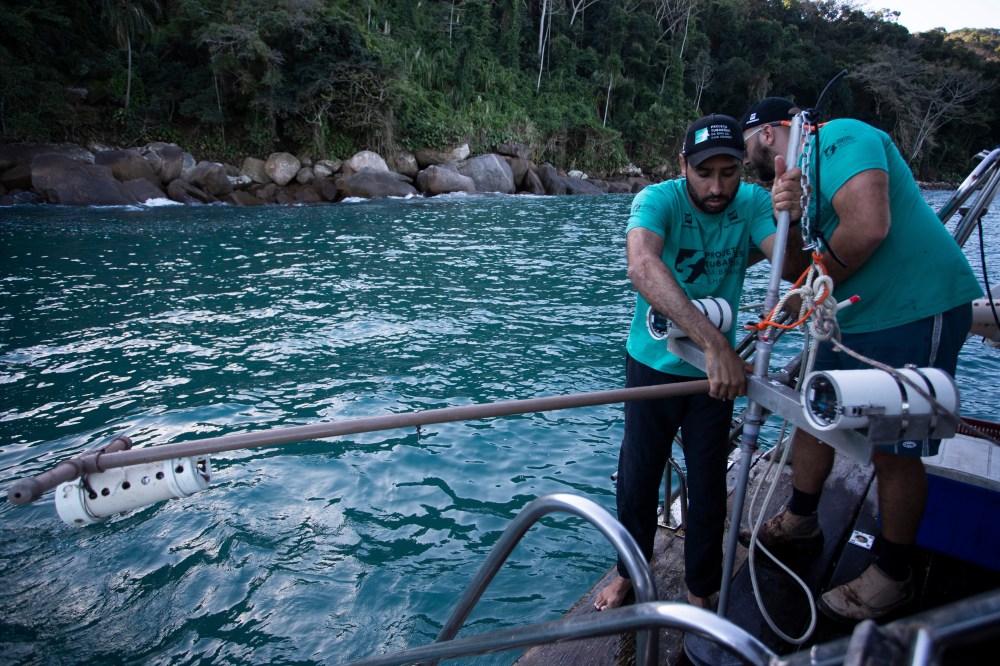
On a recent weekday, Mitrano Neves and his team lowered monitoring equipment loaded with cameras into different parts of the cove, leaving them submerged for an hour alongside bait to attract the sharks.
That footage and drone images will later be analyzed in a laboratory, producing data that will be used to advocate for greater conservation efforts.
While blacktip sharks are most common in the region, the project also focuses on sand tiger sharks and hammerhead sharks.
The scheme also aims to start environmental education activities in schools so that sharks will come to be seen as part of the region’s natural heritage.
Communication materials highlight that the sharks do not represent a threat to humans and that there are no known shark incidents in the region.
Teaching to protect sharks and health risks of shark meat consumption
Brazil prohibits targeted shark fishing, but nonprotected sharks may still be landed when caught incidentally as bycatch, whereas threatened species are protected from capture and commercialization and must be released if caught.
Identification can be imprecise, with shark meat often sold under the generic term “cação.”
José Truda Palazzo, the coordinator of the project in Ilha Grande bay, said their work to discourage local communities from eating shark meat is starting to have an impact.
During meetings with nearby populations, representatives of the project talked about the importance of the sharks for the ocean’s ecosystem and the health risks associated with eating shark meat, he said.
Research indicates that, as apex predators, sharks accumulate high levels of heavy metals — including arsenic, mercury and lead — in their blood and tissues. A 2024 study also found that some Brazilian sharpnose sharks tested positive for cocaine.
“We hope that more and more people come to understand that cação is shark, and shark meat is toxic, in addition to the fact that sharks are endangered animals,” said Palazzo.
Opportunity for ecotourism
As long as the sky and water are clear, local residents sometimes spot the sharks from the low-level, forest-covered mountains, above the sand-colored rocks that meet the ocean.
In time, observation of the sharks — on land, from boats and even underwater — could develop into an additional source of income thanks to ecotourism, Palazzo said.
Nascimento Martins fishes and sells ice on the beach to supplement her monthly income, which supports her and her three children. She said ecotourism would offer a big assist to the area.
“We’re a remote community with very limited resources. So anything that comes along that can help us preserve our village is a good thing,” she said.
Reinaldo Dias da Rocha, who is from the same community, said his father had already encouraged him not to hunt sharks, but the project had reinforced the importance of preserving the animals.
“We pass the information on to our nephews, to tourists who come to discover this place and enjoy our beautiful beaches, and further labor the point that what we call cação isn’t to be eaten.”
___
Follow AP’s coverage of Latin America and the Caribbean at https://apnews.com/hub/latin-america