Fact File: Trump blames Canada, but experts say countries tackle wildfires similarly
Advertisement
Read this article for free:
or
Already have an account? Log in here »
To continue reading, please subscribe:

Digital Subscription
One year of digital access for only $205*
- Enjoy unlimited reading on winnipegfreepress.com
- Read the E-Edition, our digital replica newspaper
- Access News Break, our award-winning app
- Play interactive puzzles
*First annual payment billed as $205.00 + GST for one year. This annual subscription will automatically renew at $233.00 + GST every 52 weeks (10% off the regular annual price of $259.35). Offer available to new and qualified returning subscribers only. Cancel any time.
To continue reading, please subscribe:
Add Free Press access to your Brandon Sun subscription for only an additional
$1 for the first 4 weeks*
- Enjoy unlimited reading on winnipegfreepress.com
- Read the E-Edition, our digital replica newspaper
- Access News Break, our award-winning app
- Play interactive puzzles
*Your next Brandon Sun subscription payment will increase by $1.00 and you will be charged $17.95 plus GST for four weeks. After four weeks, your payment will increase to $24.95 plus GST every four weeks.
Read unlimited articles for free today:
or
Already have an account? Log in here »
OTTAWA – U.S. President Donald Trump accused Canada on Friday of not properly maintaining its forests, leading to heavy smoke from wildfires hovering over American cities. Experts who study wildfires say Canada’s approach to forest management is similar to that of the United States and that in more remote areas of the boreal forest, sometimes it’s better to just let things burn.
THE CLAIM
“We are holding Canada responsible for the fact that they are not properly maintaining their Forests, and Brush therein, and the United States is being unnecessarily invaded by filthy, polluted, and unhealthy air, the quality of which is dangerous, and totally unacceptable!” Trump said in a post to his Truth Social account that has generated more than 3,000 replies and 24,000 likes.
“Canada has refused to engage in basic Forest Management and Debris Removal, knowing that such refusal will lead to exactly this result. This is Willful Negligence, and becoming a yearly occurrence, costing the United States Billions of Dollars, which cost of this pollution must of necessity be added to the TARIFFS Canada is currently paying.”
An identical post from an account on X, which reposts all of Trump’s Truth Social posts, has nearly 400,000 views.
In another post on X, Republican John James, a U.S. member of Congress from Michigan, said Canada has failed to meet its “responsibility to prevent a foreseeable disaster from crossing into another country’s airspace.” That post has been viewed more than one million times.
THE FACTS
In Canada, wildfire management is largely handled at the provincial and territorial level. Federal agencies like Parks Canada and the Department of National Defence do conduct fire management, but most of the responsibility lies with provinces and territories.
Canadians researchers say there are similarities in how Canada and the United States approach wildfires.
Eric Kennedy, an associate professor at York University who studies wildfire management, said there are cases where it’s better to simply let the forest burn if it poses no threat to communities or infrastructure.
“Those fires might also be beneficial from an ecological perspective, as well as from a risk reduction perspective,” Kennedy said in an interview.
“When you talk with fire managers, they often talk about how ‘a fire put out is a fire put off,’ because you’re leaving all of that material there unburnt. So if you’re putting out a fire in more favourable conditions, like less aggressively burning, you are leaving that fuel for a day when you can’t control it later on and you don’t have any choice in the matter.
“And so we might decide that a fire should burn for ecological reasons, like because the ecosystem requires it for its health.”
Kennedy said that in Alaska, American fire management officials have let some fires burn themselves out to achieve an ecological benefit or reduce the risk of more severe fires in the future.
“This is a common practice on both sides of the border,” he said.
Jed Kaplan, a professor at the University of Calgary, said fires in remote parts of the boreal forest are part of a “natural process.”
“Fire management activities are very similar between the U.S. and Canada close to roads, close to populated areas, close to areas that are under active forestry management,” he said in an interview.
“But when we think about the boreal in general, there are huge parts of the northern part of the provinces and into the territories that are not managed at all. They’re not commercially managed forests and they are simply left to follow their own natural ecosystem processes.”
Kaplan said there is often no way to detect a fire in a remote area until it’s too late.
“If you can’t detect them in within the first hour or two of them starting to burn, they get too big to put out. And so we’re just going have to let them burn in some ways,” he said.
“When a fire burns close to a town or city, that’s when we’re going to try to put resources onto putting it out. But when it’s burning out in those remote parts of the Far North, we just don’t have the resources, and never will quite frankly, to be able to control all those fires.”
Kennedy said there’s also the cost to consider.
“When fires are further away from our infrastructure, from roads, and from where our aircraft are based, it just becomes much more expensive to fight these fires,” he said.
“And so you may well say, ‘OK, it’s worth spending $1 million fighting a fire that threatens a community for $10 million or more.’ But could we really justify spending $1 million fighting a fire that probably the impact is actually ecologically beneficial and it’s not putting anything at risk?”
It’s not clear what authority Trump would use to impose new tariffs on Canada in response to the pollution. Earlier this year, the U.S. Supreme Court struck down Trump’s attempt to use the International Emergency Economic Powers Act, better known as IEEPA, for his sweeping and erratic “Liberation Day” tariffs and fentanyl-related duties on Canada, Mexico and China.
Ryan Majerus, a Washington-based partner in the international trade team at the law firm King & Spalding, said that while the Supreme Court stated definitively that IEEPA cannot be used for tariffs in response to an emergency, it left open a range of other actions that could still substantially affect trade.
He added the Trump administration could in theory bring the impact of wildfires into negotiations on the Canada-U.S.-Mexico-Agreement on trade.
Both Kaplan and Kennedy point out that smoke needs no passport — it travels freely back and forth across borders.

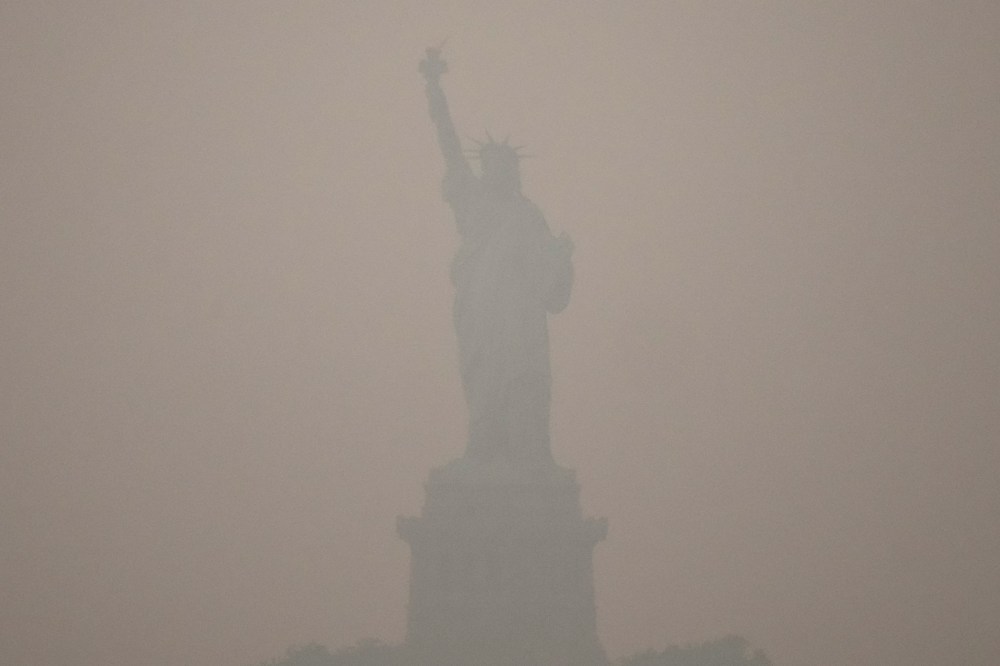
Monday saw smoke from fires in the United States blanket southern British Columbia., while wildfires in Minnesota contributed to smoky skies in Washington, D.C.
“I mean, I’m looking outside my window, I’m seeing hazy skies and I actually know that that smoke is coming from the U.S.,” Kaplan said from southeastern B.C.
“Fires don’t know borders,” added Kennedy. “That’s the reality of having an unfathomably large shared border, including the border with Alaska.”
— With files from Kelly Geraldine Malone in Washington.
This report by The Canadian Press was first published July 20, 2026.