New rules could double size of private docks in Coastal Georgia
Advertisement
Read this article for free:
or
Already have an account? Log in here »
To continue reading, please subscribe:

Digital Subscription
One year of digital access for only $205*
- Enjoy unlimited reading on winnipegfreepress.com
- Read the E-Edition, our digital replica newspaper
- Access News Break, our award-winning app
- Play interactive puzzles
*First annual payment billed as $205.00 + GST for one year. This annual subscription will automatically renew at $233.00 + GST every 52 weeks (10% off the regular annual price of $259.35). Offer available to new and qualified returning subscribers only. Cancel any time.
To continue reading, please subscribe:
Add Free Press access to your Brandon Sun subscription for only an additional
$1 for the first 4 weeks*
- Enjoy unlimited reading on winnipegfreepress.com
- Read the E-Edition, our digital replica newspaper
- Access News Break, our award-winning app
- Play interactive puzzles
*Your next Brandon Sun subscription payment will increase by $1.00 and you will be charged $17.95 plus GST for four weeks. After four weeks, your payment will increase to $24.95 plus GST every four weeks.
Read unlimited articles for free today:
or
Already have an account? Log in here »
Margaret and William Sovey bought their marshfront property on Sea Island more than a quarter century ago, enthralled by its view of unspoiled saltmarsh.
These days, they have to crane their necks just so to preserve that vista. On a recent hot, sunny morning, Margaret Sovey, 84, stood near a bank of windows to demonstrate.
“I sit at the kitchen table, and I just look straight out. I don’t look this way anymore,” Margaret said, pointing south toward half a dozen over-700-foot-long dock walkways that slice through a raft of green marsh grass to Village Creek.
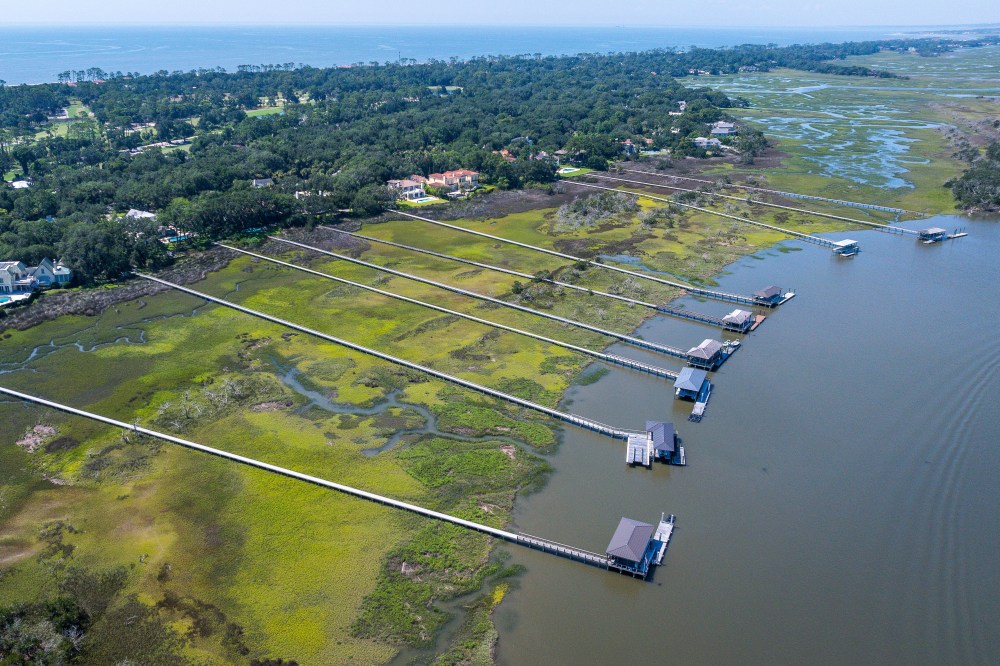
“And you know, my blood pressure goes up every morning when I look out that window, and I see these docks and boat houses. It just galls me to have to look at this, and have this little bit of waterway left,” said the German-born Margaret, who along with her husband, a native of Hartwell and a Georgia Tech alumnus, moved into their custom-built house in 1996.
“And then these people contacted us and wanted to build a dock as well,’ she said, referring to her next-door neighbors. “Now that would go right smack in the middle of that little bit of water that we can still look at and see little boats go by and all of that.”
That next dock could be even more obtrusive than the existing ones. Georgia officials have proposed new regulations for private recreational docks in Coastal Georgia that, if approved, could double the size of dock walkways, by allowing them to be 6 feet wide and cover more than a tenth of an acre of marsh.
And that’s just one of the changes the new regulations would allow. The public can comment on those regulations until July 24. The DNR Board of Directors is expected to vote on the regulations at its August 25 meeting.
How we got here
The Coastal Resources Division of DNR regulates private recreational docks via a revocable license for use of state-owned tidal water bottoms. Property owners with enough marsh-front property qualify to apply.
Still, it’s unclear exactly how many docks exist in Coastal Georgia, how big they are and how they affect the marsh and its plant and animal species.
The DNR’s online dock permit database doesn’t reflect actual structures, only relatively recent permits. Between the Isle of Hope and the mainland in Chatham County, gray pins mark known permits. Some properties may have multiple permits, some permits may exist but aren’t in the database.
The DNR has tried to inventory coastal docks, but its list of about 4,100 dock permits is not a reliable guide to where docks actually exist or how much of the marsh private docks cover. Records are patchy for docks permitted before 2013, the year the agency modernized its recordkeeping in a new database. Permits from before that year usually haven’t made it into the new system unless an owner has since requested a modification that triggered updated record-keeping. Even for post-2013 permits, the database doesn’t reflect events on the ground, like docks swept away in storms and never replaced, or homeowners who got a permit but never actually built the dock. Homes old enough to have had several owners can have multiple dock permits in the system, one for each owner there who’s ever gotten one.
And some of the records that do exist are incomplete or ambiguous: About 12% of the records don’t list a maximum allowed dock length.
The agency itself cautions database users that due to the way records were kept in the past, land use and marsh impacts from docks are “ nearly impossible to quantify. ”
The process of obtaining a license has evolved over time. The U.S. Army Corps of Engineers used to have size and location standards for these docks. As of 2022, however, the Corps requires only that these docks do not impede navigation. In the absence of specific standards from the Corps, the Coastal Resources Division adopted a written policy to guide how it would continue to issue or deny revocable licenses for private docks based on former Corps standards and a decades-long practice. If adopted, the proposed regulations will formalize these guidance policies about the size, placement, and approval of private recreational docks in the coastal marshland.
Golf cart access, bigger impacts
The draft regulations allow dock walkways to be up to 1,000 feet long, or up to 1,100 with a variance. That’s in line with the current practice of 1,000 feet. But current practice also limits total area to 3,000 square feet, meaning longer docks have had to be narrower. With the draft proposal, the total area limit is gone and walkways can be up to 6 feet wide. That expands the allowable footprint of the walkway from 3,000 square feet to 6,600 square feet.
Some dock owners argue the added width is needed to provide access to golf carts. Conservation leaders, including two who participated in stakeholder meetings to hash out the regulations, oppose the wider docks as harmful to the local environment, and an unnecessary further privatization of the publicly owned saltmarsh.
When the draft regulations were presented at the June DNR meeting, Mike McMillan, a coastal dock owner, told commissioners that the typical four-foot or less wide dock was not enough. His elderly parents couldn’t walk the length of the dock and it’s too narrow for a golf cart. Children and dogs have slipped off the walkway into the marsh.
“My parents were not able to get out to the boat,” said McMillan, a member of the stakeholder committee that helped formulate the proposed regulations. “(They) were not able to enjoy the grandkids.”
“So at the end of the day, I think being able to go six feet, being able to allow us to have a golf cart to get people out there, to get people off the bikes and crazy ways to get out there is helpful for everybody,” he said.
DNR Board Member Bill Jones, who lives on St. Simons, made a similar point at a DNR coastal committee meeting in May.
“If it’s six feet wide, that allows a golf cart plus one foot on either side for safety, and that allows the mobility-impaired to access the end of the dock,” he said.
Because the docks under consideration are private, only the mobility impaired who own the dock or are invited by the owners can access them. Public docks are more likely to be accessible by design. But even those aren’t required to have walkways that accommodate golf carts. Accessible boating standards of the Americans with Disabilities Act specify walkways be at least 3 feet wide to accommodate wheelchairs.
Conservationists point to the negative effects of bigger docks over the state-owned marsh.
“This represents more than a doubling of shading impacts despite the known science, commissioned by DNR, which demonstrated that shading of marsh grass by dock walkways directly reduces marsh productivity,” Courtney Reich, Coastal Director of the Georgia Conservancy, wrote in a July 13 comment letter to the state.
Reich was referring to a series of studies undertaken by Clark Alexander at the UGA Skidaway Institute of Oceanography beginning in 2004. His research, which he presented to the stakeholder group, included findings of 56% sparser vegetation under docks compared to adjacent areas. The researchers noted that this “density reduction represents a potentially important and previously unquantified term in the carbon budget of the marsh, which provides food and critical habitat for many commercially important species.”
Alexander and his team also found that docks affect how dead marsh grass – wrack – accumulates in the marsh. “…(D)ock-associated wrack accumulation on the marsh may be equal to, if not more, significant than that of private recreational dock shading,” they wrote in a 2008 report.
In June, Alton Brown, senior principal with Resource + Land Consultants, presented to the DNR board what he sees as the minimal impact of docks on the marsh as a whole. His company used GIS systems to estimate the number of docks on the coast and how much marsh they cover.
In total, he estimated the coastal counties’ docks cover about 91 acres, or less than 0.02% of the state’s 368,000 acres of coastal marshland.
“So then I looked at what would it be if every remaining parcel builds a private dock? Of course, we don’t know the length that those docks will be, so I just arbitrarily picked an average of 500 feet, and it would be about 0.1%.”
Brown, whose business helps guide land owners through the process with CRD, emphasized the positives. Docks aren’t causeways, after all, he said.
“Underneath these elevated walkways, you know, you still have the functions,” he said. “You have the semi-diurnal tides. You still have all of the fish and macro species occurring. You do have, as some science studies have shown, some loss of vegetation, but it’s only about a small percentage.”
Research findings
Alice Keyes, senior conservation strategist at the advocacy nonprofit One Hundred Miles and a member of the stakeholder committee, points to docks’ impact on biodiversity and aesthetics, especially in localized areas.
“What the Coastal Resources Division has incorporated is enabling ultimately a small group of people to have a major impact on our public marshlands at the public’s expense for their own private benefit. So these big six-foot (wide) docks that could be 1,000 feet long are going to fragment our marsh,” Keyes told The Current GA. “They’re going to reduce the biodiversity in our marshlands. They’re going to affect the health of the marsh, and they’re going to affect the neighbors’ viewshed and quality of the experience in the place, all for their own individual benefit, and so those are public assets that the CRD needs to consider.”
A 2009 study in Maryland looked at the effect of docks longer than about 100 feet on the abundance and diversity of marsh birds as a way to assess ecological integrity. They found a drop in both the abundance and diversity of bird species that rely exclusively on the saltmarsh.
“Reducing or eliminating long piers would reduce human disturbance and contribute to less fragmented, more expansive marsh habitat,” the authors wrote in The Journal of Wildlife Management.
Wildlife managers at DNR agreed that bird species in Georgia that depend on intact expanses of saltmarsh, including saltmarsh sparrows, clapper rails and whimbrels, are likely to be driven from an area with many docks.
“It is clear that beyond a certain limit of docks in a given saltmarsh area, the effects of fragmentation reduce habitat quality and likely extirpate species locally,” then-program manager Jason Lee wrote to Keyes in 2024.
Acreage limit surpassed
The Georgia Conservancy also notes as a major concern that the new standard will allow docks to impact over 0.1 acres of marsh, a threshold that requires mitigation for other wetlands.
“This exceeds the 1/10th acre threshold that the U.S. Army Corps of Engineers uses to trigger compensatory mitigation requirements for jurisdictional wetland impacts,” their comment letter reads. “If this level of impact is significant for freshwater wetlands, then why would the same not be true for salt marshes?”
That 0.1 acres of impact also exceeds the legal definition of “minor alteration” of marshlands written into Georgia’s Coastal Marshlands Protection Act, setting up a conflict between the law and the regulations.
Jeff Beauvais, of One Hundred Miles, warns about possible loopholes in the regulation’s use of the terms “serviceable” and “reconstruction.” North Coast Advocate Beauvais is not an attorney, but found the regulation’s language “sloppy.”
The proposed regulations state: “If the department deems the private dock or its parts are unserviceable, it cannot be maintained; however, it may be reconstructed or modified according to Rule 391-2-1-.05.”
Beauvais worries about what will qualify as “unserviceable.”

“If I want to drive a golf cart down my dock and I can’t currently because it’s too narrow, is that not usable?” he told The Current. “Is DNR going to argue that that counts as not usable and therefore not serviceable?”
Back on Sea Island, the possibility of even larger docks blocking her view disheartens Margaret Sovey.
“I’m almost glad I’m as old as I am because I don’t have that much time left. But if I had another 20-30 years that I would want to be here, I don’t know if I would stay,” she said. “I’m so aggravated about what has happened and how this area has been changed, and certainly not for the better.”
___
This story was originally published by The Current and distributed through a partnership with The Associated Press.