Quebec and Newfoundland and Labrador reach tentative energy agreement worth billions
Advertisement
Read this article for free:
or
Already have an account? Log in here »
To continue reading, please subscribe:

Digital Subscription
One year of digital access for only $205*
- Enjoy unlimited reading on winnipegfreepress.com
- Read the E-Edition, our digital replica newspaper
- Access News Break, our award-winning app
- Play interactive puzzles
*First annual payment billed as $205.00 + GST for one year. This annual subscription will automatically renew at $233.00 + GST every 52 weeks (10% off the regular annual price of $259.35). Offer available to new and qualified returning subscribers only. Cancel any time.
To continue reading, please subscribe:
Add Free Press access to your Brandon Sun subscription for only an additional
$1 for the first 4 weeks*
- Enjoy unlimited reading on winnipegfreepress.com
- Read the E-Edition, our digital replica newspaper
- Access News Break, our award-winning app
- Play interactive puzzles
*Your next Brandon Sun subscription payment will increase by $1.00 and you will be charged $17.95 plus GST for four weeks. After four weeks, your payment will increase to $24.95 plus GST every four weeks.
Read unlimited articles for free today:
or
Already have an account? Log in here »
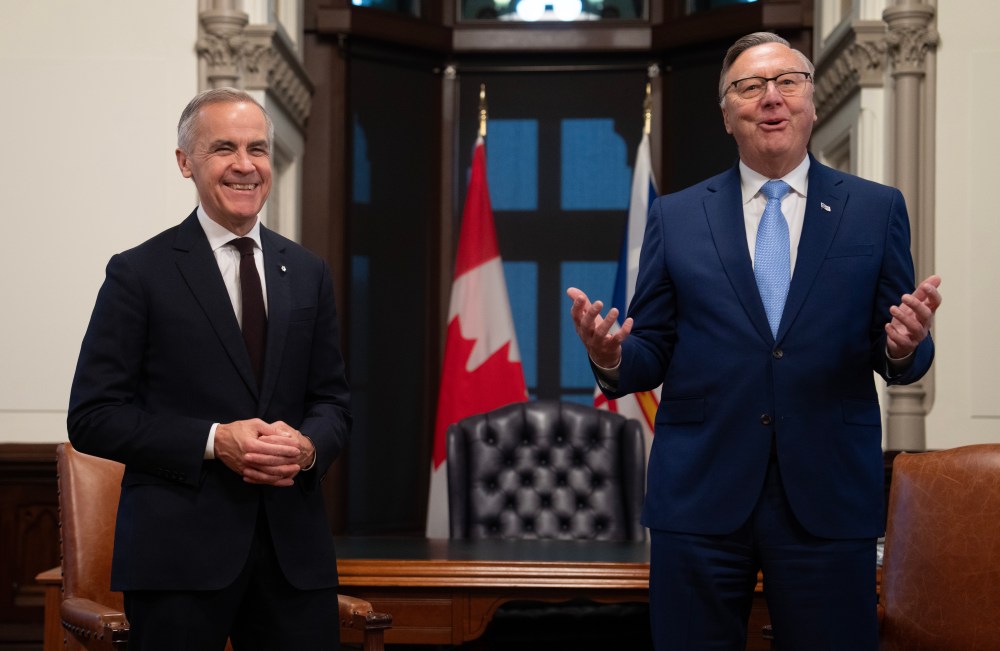
ST. JOHN’S – Leaders in Quebec and Newfoundland and Labrador unveiled details of an ambitious new energy plan on Monday, which Prime Minister Mark Carney described as the largest clean energy investment in North America.
The province’s utilities are eyeing up to 14,000 megawatts of new and existing hydroelectric developments in Labrador and along the Churchill River. The federal government is also pitching in, and Carney was on hand for the announcement on a pier at the St. John’s Port Authority.
“Today’s announcement will produce enough clean electricity to power every car, truck, motorcycle and bus in Canada,” the prime minister said. “It will generate enough power to light, heat and cool the homes in Toronto, Montreal and Vancouver combined.”
It may also end decades of tension between Newfoundland and Labrador and Quebec — if negotiators can hammer out final, binding agreements amid an election campaign in Quebec and the possible installation of a new provincial government.
The framework agreement outlines plans for Hydro-Québec and Newfoundland and Labrador Hydro to divvy up power from the Churchill Falls generating station and launch new hydro, wind and transmission projects worth more than $50 billion, officials said during a media briefing preceding the political announcement.
They did not provide reporters with a copy of the agreement.
The draft agreement proposes a new, 2,700-megawatt generating station at Gull Island on the Churchill River and upgrades to the existing 5,428-megawatt power plant at Churchill Falls, which is jointly owned and operated by provincial utilities.
It includes plans for transmission lines and feasibility studies for a second powerhouse at Churchill Falls and a 2,000-megawatt wind development in the Churchill River area, which could be partially owned by a private partner, officials said.
If finalized, the deal also would allow Newfoundland and Labrador to transmit power from Labrador — up to 985 megawatts — through Quebec to markets in the United States.
The arrangement would earmark about 2,750 megawatts of power for Newfoundland and Labrador Hydro and 8,515 megawatts for Hydro-Québec, though the figures could increase if the partners proceed with the expansion of the Churchill Falls plant.
The expected return for Newfoundland and Labrador over the 50-year agreement is an estimated $49 billion, officials said.
Negotiators hope to hammer out a final deal by the end of this year. However, Quebec Premier Christine Fréchette must call a provincial election by Oct. 5 and it’s not clear how the campaign, nor the installation of a new government, could affect those goals.
Polls suggest Fréchette’s Coalition Avenir Québec government is not favoured to form the next government, and trails behind the sovereigntist Parti Québécois and the Liberals.
“I see the Parti Québécois is interested in tearing up this agreement. They don’t want to implement it,” Fréchette said. “So what do they offer to Quebecers if it’s not this agreement? Where will they find the 10,000 megawatts we are bringing to Quebec?” However, Paul St-Pierre Plamondon, the PQ leader, shot back, saying on the X social media platform that it was not true that he would shred the proposal.
“The reality is that no one has read the agreement,” he wrote in a post. “If the agreement is positive for Quebec, then obviously it will be in a Parti Québécois government’s interest to maintain it.”
Newfoundland and Labrador Premier Tony Wakeham said he had no control over the election outcome in Quebec, and he trumpeted the non-binding agreement as a win for the two provinces and the federal government.
Newfoundland and Labrador is eager to turn the river’s hydroelectric potential into revenue, and Quebec is looking to secure a reliable power supply for decades to come. Negotiations began several years ago, and they resulted in another framework agreement signed in 2024.
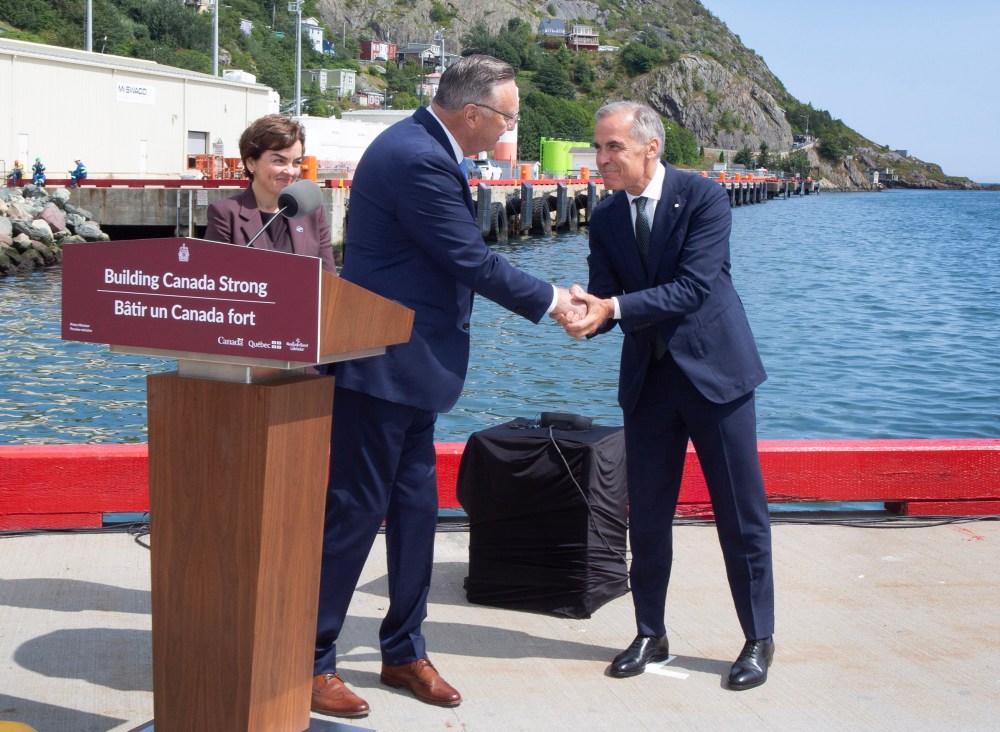
However, Wakeham sent a team back to the bargaining table after he and his Progressive Conservatives were elected last year. He was looking for more power, more value and transmission rights through Quebec, he said at the time.
Wakeham kicked off his election campaign last fall promising to hold a public referendum on any final deals. He walked back that promise on Monday, saying a referendum would not happen.
“I know there will be people in our province who will be disappointed in that, but I accept that,” Wakeham said in an interview. “The time was now. There was an opportunity right now.”
The federal government will kick in $10 billion in financing for several proposed projects including transmission lines and the Gull Island development, according to a news release.
Hydro-Québec would also pay more for power from the Churchill Falls plant, beginning at 1.8 cents per kilowatt hour in 2027, according to a graph provided to the media. That price would increase until 2077, averaging out to an effective price of 7.4 cents per kilowatt hour over the next 50 years.
The previous draft agreement signed in 2024 landed on an average effective price of 5.9 cents per kilowatt hour.

Hydro-Québec currently pays just 0.2 cents per kilowatt hour under a contract signed in 1969 which was set to expire in 2041.
Many in Newfoundland and Labrador have long viewed the current arrangement as unfair and even unjust and the province has tried unsuccessfully to have the deal quashed in court. Monday’s tentative agreement would terminate the 1969 deal and end what Wakeham described as one of the darkest chapters of Newfoundland and Labrador history.
“When we went into these negotiations, we made it clear there was one thing which we would not compromise: that Newfoundlanders and Labradorians must always be the primary beneficiaries of our own resources,” he told the crowd.
This report by The Canadian Press was first published Aug. 17, 2026.
Note to readers:This is a corrected story. A previous version said the price Hydro-Québec would pay for power would increase until 2027, averaging out to an effective price of 7.4 cents per kilowatt hour over the next 50 years. In fact, the price Hydro-Québec would pay would increase until 2077, according to a graph that was provided to news outlets.