Kenya triples its power target, aiming to expand use of nuclear and geothermal energy

Advertisement

Advertise with us

NAIROBI, Kenya (AP) — Kenya has tripled its long-term target for expanding its renewable energy capacity to meet surging demand and support its industrialization, but that might not result in more affordable power for consumers.

Read this article for free:


or

Already have an account? Log in here »

To continue reading, please subscribe:

Subscribe and receive a limited-edition Free Press branded hat or tote.

Digital Subscription

One year of digital access for only $205*

  • Enjoy unlimited reading on winnipegfreepress.com
  • Read the E-Edition, our digital replica newspaper
  • Access News Break, our award-winning app
  • Play interactive puzzles

*First annual payment billed as $205.00 + GST for one year. This annual subscription will automatically renew at $233.00 + GST every 52 weeks (10% off the regular annual price of $259.35). Offer available to new and qualified returning subscribers only. Cancel any time.

To continue reading, please subscribe:

Add Free Press access to your Brandon Sun subscription for only an additional

$1 for the first 4 weeks*

  • Enjoy unlimited reading on winnipegfreepress.com
  • Read the E-Edition, our digital replica newspaper
  • Access News Break, our award-winning app
  • Play interactive puzzles
Start now

*Your next Brandon Sun subscription payment will increase by $1.00 and you will be charged $17.95 plus GST for four weeks. After four weeks, your payment will increase to $24.95 plus GST every four weeks.

NAIROBI, Kenya (AP) — Kenya has tripled its long-term target for expanding its renewable energy capacity to meet surging demand and support its industrialization, but that might not result in more affordable power for consumers.

The plan calls for renewable power generating capacity of 5,500 megawatts, up from about 1,500 MW now. That would include 2,000 MW of nuclear power alongside 700 MW of hydropower and new geothermal projects.

That will strengthen the country’s position as a global leader in renewable energy. Kenya already produces 93% of its electricity using renewable sources. But experts say that reforms for utility contracts, electricity grids, financing and pricing are needed to translate clean energy growth into lower cost power for consumers.
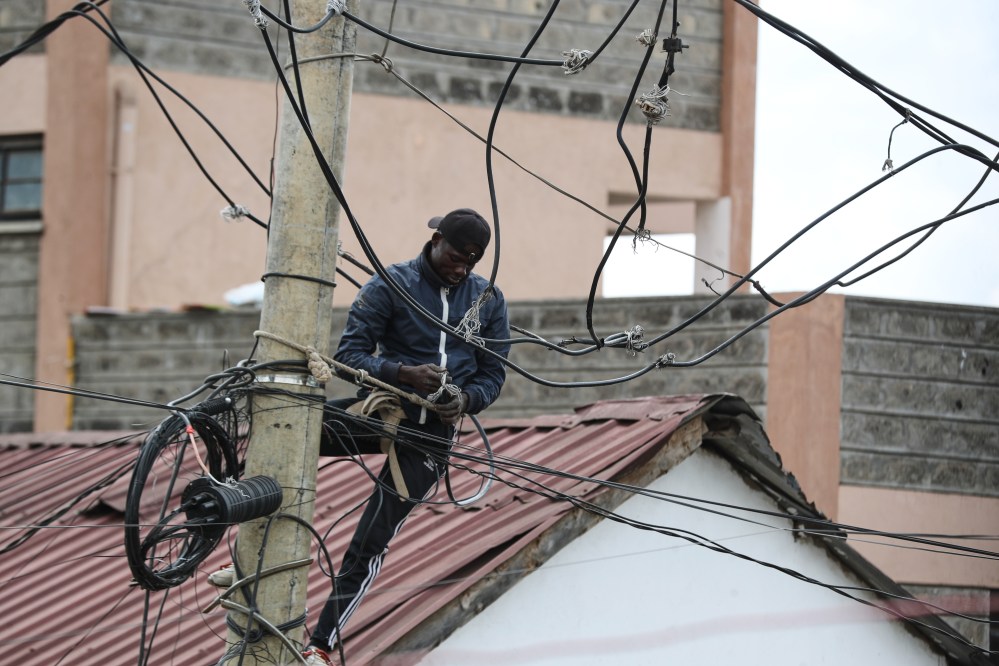
FILE -A man connects electric cables on a pole above the Kibera informal settlement in Nairobi, Kenya, March 31, 2026. (AP Photo/Henry Naminde, File)

“We have recalibrated our long-term growth trajectory from 1,500MW to a 5,500MW renewable energy development pipeline,” said Peter Njenga, CEO of KenGen, the state-owned utility that produces about 60% of Kenya’s power.

Cheaper electricity is needed

Lawmakers have been pushing the government to reduce electricity rates. In July, the parliament directed Energy Minister Opiyo Wandayi to develop a policy for renegotiating electricity supply agreements with major power producers. Lawmakers said lower wholesale prices could create more leeway for Kenya Power to cut consumer rates without damaging its finances.

Energy experts say Kenya needs to focus less on building new generation capacity than on making electricity cheaper.

“The answer to this conundrum is not as straightforward as it may seem,” said Mugwe Manga, climate finance lead at the nonprofit FSD Kenya. “One must look at the entire energy system holistically to understand the drivers of the end cost of power.”

Unlike countries like Morocco, Egypt and China, Kenya provides limited direct subsidies to cushion electricity prices. While renewable generation costs are broadly competitive, consumers ultimately bear the burden of financing costs, transmission and distribution losses, taxes, and foreign exchange movements.

Latest data show that industrial consumers in Kenya pay between $0.18 and $0.23 per kilowatt-hour, compared with about $0.03 in South Africa and Egypt, and $0.05 in Morocco and Ethiopia.

“The perception that electricity is expensive is subjective,” Kenya Power CEO Joseph Siror said in an earlier interview. “The consumer prices are dependent on infrastructure costs, electricity tariff structures, and outstanding bill recoveries.”

Kenya’s heavy reliance on green energy sources adds to costs since the infrastructure required to generate such power is expensive to install and maintain, he said.

Power grids and financing add to costs

One of the biggest inefficiencies keeping electricity costs high lies in the distribution network itself, Manga said.

More than 20% of electricity is lost to technical failures and illegal connections, compared with a global average of 8%-10%,” he said “That offers a great low-hanging fruit to improve efficiency and pass that efficiency dividend to end consumers through reduced tariffs.”

High financing costs are another problem. Renewable energy developers across Africa borrow at significantly higher interest rates than their counterparts in wealthier economies because investors perceive view projects as having greater risks. Those extra borrowing costs ultimately are passed on to consumers.

Kenya’s power purchase agreements have also come under renewed scrutiny. Independent power producers supply about 40% of total capacity under long-term contracts signed after electricity generation was liberalized in the late 1990s.

In the end, consumers pay more

Some contracts include “take-or-pay” clauses that require Kenya to make agreed-upon payments even when contracted electricity is not fully consumed. Critics argue such arrangements force consumers to pay for surplus electricity, although Manga said such guarantees were necessary to secure financing for capital-intensive projects.

“Kenya’s renewable resource base is a major advantage, but electricity prices are determined by the whole system, not only by the cost of power generation,” said Albert Nganga, senior regulatory manager at CrossBoundary Energy. “They also reflect how power is contracted, transmitted, distributed and recovered.”

Recently proposed open-access electricity market reforms could increase competition by allowing large consumers to purchase electricity directly from power generators, he said.

The ambitious targets for expanding power generation require predictable investment policies and reforms, said Cynthia Angweya-Muhati, CEO of the Kenya Renewable Energy Association.

“The real test will be whether that additional clean generation is matched by reforms that lower electricity costs for consumers,” Angweya-Muhati said.

——-

The Associated Press’ climate and environmental coverage receives financial support from multiple private foundations. AP is solely responsible for all content. Find AP’s standards for working with philanthropies, a list of supporters and funded coverage areas at AP.org.


Report Error Submit a Tip

More Stories

Mayoral candidate Vogiatzakis criticized for living outside Winnipeg

Malak Abas 4 minute read Preview

Mayoral candidate Vogiatzakis criticized for living outside Winnipeg

Malak Abas 4 minute read Friday, Oct. 2, 2026

A mayoral hopeful took heat from other candidates Friday for living outside Winnipeg while running in the civic election.

Mike Vogiatzakis’s primary residence is in the Rural Municipality of St. Andrews, about 25 kilometres north of Winnipeg — a community with its own mayor and councillors.

But the funeral director said he owns a home in Winnipeg where he divides his time, and he would move to the city full-time if elected mayor.

“It doesn’t matter where a person lives. Why are we dividing St. Andrews and Manitoba and Winnipeg? I’ve met the criteria to run for mayor,” Vogiatzakis said Friday morning.

Read
Friday, Oct. 2, 2026

Today’s horoscope

Georgia Nicols 4 minute read Preview

Today’s horoscope

Georgia Nicols 4 minute read 2:00 AM CDT

MOON ALERT: Caution! Avoid shopping (except food and gas) and important decisions until after 6:30 p.m. today. After that, the moon moves from Cancer into Leo.

ARIES (March 21-April 19)

Don’t expect much co-operation from partners, spouses and close friends. This is why you might feel cut off from others or a bit lonely. There’s the sense a gulf exists between you and everyone else. But this is temporary. Courage!

TAURUS (April 20-May 20)

Read
2:00 AM CDT

Moving drama at MTYP gives voice to boy who changed law

Holly Harris 4 minute read Preview

Moving drama at MTYP gives voice to boy who changed law

Holly Harris 4 minute read Yesterday at 2:37 PM CDT

The heroic true tale of Norway House Cree Nation-born Jordan River Anderson came home Friday night, as Manitoba Theatre for Young People presented Yvette Nolan’s Jordan.

The touring production, a collaboration with Geordie Theatre, runs weekends through Oct. 11, with additional stops in Toronto, Vancouver and Ottawa’s National Arts Centre.

Having several of Anderson’s family members witness the local première underscored the evening with poignancy. Elder and Pine Creek First Nation member Barbara Nepinak added her own dignified presence and prayers following MTYP artistic director Pablo Felices-Luna’s welcoming remarks.

The season-opener also marks the Winnipeg-raised playwright’s homecoming; the Algonquin playwright, director, dramaturg, actor and educator was a fixture in our local theatre community for many years before going on to serve as artistic director for Native Earth Performing Arts from 2003 to ‘11, among other contributions.

Read
Yesterday at 2:37 PM CDT

Province looks to seize notorious drug den

Erik Pindera 5 minute read Preview

Province looks to seize notorious drug den

Erik Pindera 5 minute read Yesterday at 12:00 PM CDT

Provincial justice officials are trying to seize a Dominion Street drug den that has been the source of trouble in the West End for years.

The owner of 982 Dominion St., 45-year-old Robert Edward Johnson, was most recently arrested in June along with several others after a lengthy Winnipeg Police investigation into thefts and illicit drug sales connected to the house.

“The residence has a reputation within the neighbourhood as being a location where individuals habitually attend for the purpose of purchasing and/or consuming controlled substances,” reads a statement of claim filed by the province’s director of civil forfeiture in the Court of King’s Bench last week.

“For several years, the residence has been associated with criminal activity, violence, and disorder, resulting in numerous police attendances and complaints from members of the surrounding community.”

Read
Yesterday at 12:00 PM CDT

Manitoba’s own Summer Howell takes on biggest role yet as Stephen King’s telekinetic teen Carrie

Randall King 7 minute read Preview

Manitoba’s own Summer Howell takes on biggest role yet as Stephen King’s telekinetic teen Carrie

Randall King 7 minute read Friday, Oct. 2, 2026

From the tender age of eight, actress Summer Howell has made her presence known in a series of horror films shot in her home province of Manitoba.

Her first film was Curse of Chucky (2013), director Don Mancini’s continuation of the venerable killer doll series he started (as a screenwriter) in 1988 with Child’s Play.

“Even then, it was obvious she was very talented, intelligent and delightful,” Mancini said of Howell.

Though she has worked in other genres, Howell gravitated to horror repeatedly, with credits in Shawn Linden’s harrowing Hunter Hunter (2020) and the 2023 possession thriller All Fun and Games. Earlier this year, she shot the horror film Sundown in Winnipeg with director Rebekah McKendry, which premièred last week at Beyond Fest in Los Angeles and is headed for a streaming berth on Shudder.

Read
Friday, Oct. 2, 2026

Brandonmeat packer thriving on its own

Abiola Odutola 3 minute read Preview

Brandonmeat packer thriving on its own

Abiola Odutola 3 minute read Yesterday at 2:01 AM CDT

BRANDON — Canada Packers has strengthened its business and laid the foundation for future growth during its first year as an independent company, its president says.

The Brandon-based pork producer, separated from Maple Leaf Foods in October 2025, established its own leadership, strategy, systems, culture and identity while continuing operations across its hog production farms and regional hog barns in southern and eastern Manitoba.

The company’s first year was focused on building a successful standalone business while continuing to serve customers, communities and shareholders, president Dennis Organ said.

“Market conditions over the past year have been more challenging than we anticipated when we became a separate entity,” he said in an email. “Despite that, we continued to execute against our priorities, including increasing processing volumes, maintaining disciplined operations and strengthening the business.”

Read
Yesterday at 2:01 AM CDT