With no time to spare, Michigan hatches a Great Lakes whitefish rescue plan

Advertisement

Advertise with us

With time running out to save the Great Lakes’ whitefish from a deadly mussel invasion, Michigan officials have a moonshot plan to pluck fish from Lake Michigan and breed them in captivity.

Read this article for free:


or

Already have an account? Log in here »

To continue reading, please subscribe:

Subscribe and receive a limited-edition Free Press branded hat or tote.

Digital Subscription

One year of digital access for only $205*

  • Enjoy unlimited reading on winnipegfreepress.com
  • Read the E-Edition, our digital replica newspaper
  • Access News Break, our award-winning app
  • Play interactive puzzles

*First annual payment billed as $205.00 + GST for one year. This annual subscription will automatically renew at $233.00 + GST every 52 weeks (10% off the regular annual price of $259.35). Offer available to new and qualified returning subscribers only. Cancel any time.

To continue reading, please subscribe:

Add Free Press access to your Brandon Sun subscription for only an additional

$1 for the first 4 weeks*

  • Enjoy unlimited reading on winnipegfreepress.com
  • Read the E-Edition, our digital replica newspaper
  • Access News Break, our award-winning app
  • Play interactive puzzles
Start now

*Your next Brandon Sun subscription payment will increase by $1.00 and you will be charged $17.95 plus GST for four weeks. After four weeks, your payment will increase to $24.95 plus GST every four weeks.

With time running out to save the Great Lakes’ whitefish from a deadly mussel invasion, Michigan officials have a moonshot plan to pluck fish from Lake Michigan and breed them in captivity.

With sustained money, effort and luck, the fish’s offspring could one day help repopulate the lake after humans quell the mussels that have pushed the lake’s wild whitefish to near-collapse.

“It’s really about saving those genetic stocks right now,” said Doug Craven, natural resources director for the Little Traverse Bay Band of Odawa Indians. “If we don’t do it this year, there may not be enough wild fish in those stocks” to do it in the future.
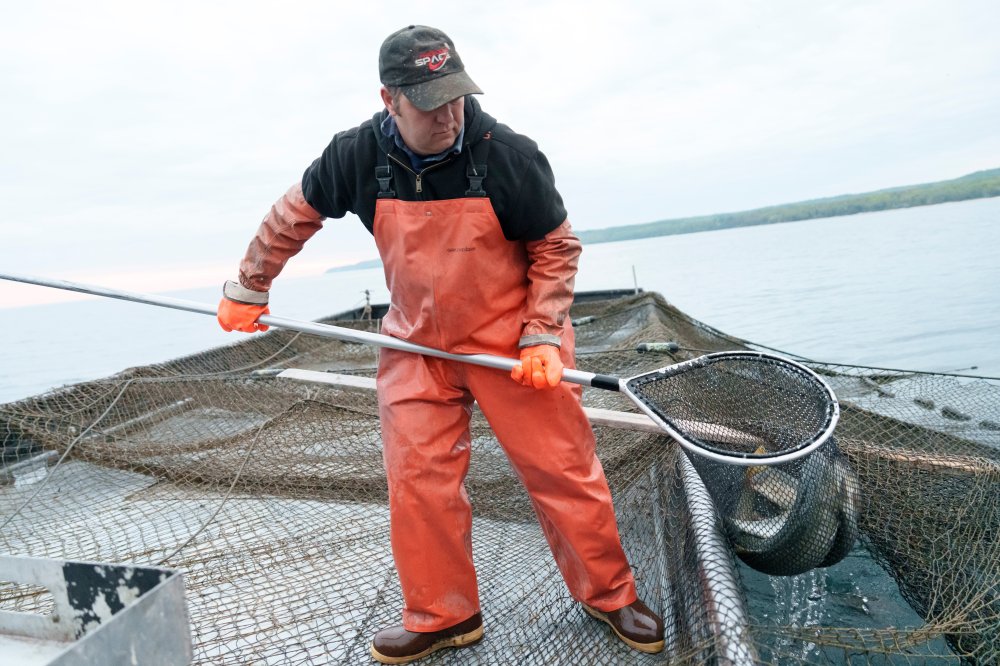
Joel Petersen carries a net of whitefish aboard a boat near Leland, Mich., 2025. (Josh Boland/Bridge Michigan via AP)

Armed with $350,000 from the recently passed state budget and nearly $900,000 from the Great Lakes Fishery Trust, state and tribal scientists will fan out from Naubinway to Saugatuck this fall to collect the spawning fish.

For now, the mission is limited in scale, targeting the bloodlines most in danger of disappearing. But those involved in the “genetic rescue” mission told Bridge Michigan they hope it sets the stage for a major whitefish recovery program.

That’s a marked change from just a year ago, when beyond some small-scale experiments led by Native American tribes, there was no coordinated plan to intervene as zebra and quagga mussels from Europe steadily eradicate whitefish from the lower Great Lakes.

The filter-feeding mussels now dominate the food web in every Great Lake except Superior. They strip away the plankton baby whitefish eat and leave behind water so clear the hatchlings risk deadly sunburns if starvation doesn’t kill them first.

So far, nobody has found an effective mussel control strategy — and whitefish don’t have long to wait.

In some areas of lakes Michigan and Huron, almost no hatchlings have survived to adulthood for two decades. Commercial harvests have plummeted from 6.9 million pounds in 2009 to less than 2 million pounds last year, and the geriatric fish that remain will soon die of old age.

Michigan’s collapsing whitefish

For now, rescue efforts led by the Michigan Department of Natural Resources and Little Traverse Bay Bands of Odawa Indians will be focused on Lake Michigan, where the crisis is particularly dire.

“For the southern Lake Michigan stocks, the only fear I have is, I hope we’re not too late,” said DNR Fisheries Chief Randy Claramunt.

After retrieving wild adults from several distinct bloodlines, scientists will attempt to incubate their eggs at the Wolf Lake State Fish Hatchery and then transfer the survivors to hatcheries across the state.

Ideally, those refugees would remain in human care for years or even decades until the mussel invasion subsides.

But money remains a barrier.

There are 18 unique whitefish populations in lakes Michigan and Huron, and most of them are imperiled. Current funding will cover only a couple of years of hatchery space, fish food and other expenses for only some of those populations.

Great Lakes Fishery Trust Manager Dan Lord said leaders of the effort hope to recruit deeper-pocketed partners, such as neighboring states and the US and Canadian governments.

For context, the federally funded recovery of Great Lakes lake trout has taken decades and hundreds of millions of dollars — and the work is not yet done.

Hoping to be prepared if the money materializes, state, federal, tribal and nonprofit scientists are developing a menu of options for broader rescue efforts that could involve hatcheries, inland ponds and lakes or new attempts to spawn whitefish in rivers.

“We’re looking comprehensively at all the places where we could possibly create (a refuge) for fish,” said Matt Herbert, a senior conservation scientist with the Nature Conservancy in Michigan.

The species’ long-term survival in the Great Lakes depends upon efforts to curb the mussel invasion.

A Bridge Michigan analysis found those efforts are so meagerly funded that scientists build research equipment out of scrap metal while worrying whether their work can continue another year.

In the wake of that reporting, US Reps. Debbie Dingell and Tim Walberg, both of Michigan, cosponsored legislation that would devote $500 million to mussel control research over the next decade. So far, the bill has shown no sign of momentum, prompting mounting calls for Congress to act.

“Whitefish are the canary in the coal mine,” Craven said. “They’re not the only species being affected by quagga mussels. So it’s important to address this for the sake of those ecosystems and those other fisheries, too.”

___

This story was originally published by Bridge Michigan and distributed through a partnership with The Associated Press.

Report Error Submit a Tip

More Stories

’Disgusting’ posters being investigated by police

Morgan Modjeski 4 minute read Yesterday at 2:22 PM CDT

The Winnipeg Police Service major crimes unit is investigating what some have labelled offensive and hateful posters on full-display at a Winnipeg home.

One of the people irked by the display is Gracie Garrett. She’s has lived on Ashburn Street in Winnipeg’s Minto neighbourhood for almost ten years. She’s never felt unsafe in the neighbourhood before, but now, a set of posters plastered on a nearby house are making her feel uneasy.

The five signs, posted facing the street prominently on a front window, contain a slur, refer to Nazis as “heroes” and call Muslims, Christians and other groups “evil.”

Learning of the signs Friday, Garrett said she’ll be reporting the posters to police, as she worries they incite and promote violence.

Volunteer pop-up library axed from Manitoba Youth Centre

Matthew Frank 4 minute read Preview

Volunteer pop-up library axed from Manitoba Youth Centre

Matthew Frank 4 minute read Updated: Yesterday at 11:25 AM CDT

Manitoba Corrections has cancelled a pop-up library program at the Manitoba Youth Centre, leaving inmates without librarian services and fewer options to borrow certain books.

The Prison Libraries Committee, part of the non-profit Manitoba Library Association, operated and funded the volunteer program since 2024 before it was shut down by the province last month. The group previously partnered with the province to offer the service because the facility has no dedicated library of its own.

“It is concerning that community members who are incarcerated, especially youth, are losing out on meaningful programming, access to information and rehabilitation efforts, which are offered at no cost to (Manitoba) Corrections. We urge Manitoba Justice to promote more library services and programming, not less,” said a Sept. 24 letter from the non-profit addressed to the justice minister.

Ashley Huot, chair of the Prison Libraries Committee, said she was puzzled when she received an email last month from Manitoba Corrections stating that the pop-up library was no longer needed.

Read
Updated: Yesterday at 11:25 AM CDT

Province looks to seize notorious drug den

Erik Pindera 5 minute read Preview

Province looks to seize notorious drug den

Erik Pindera 5 minute read Yesterday at 12:00 PM CDT

Provincial justice officials are trying to seize a Dominion Street drug den that has been the source of trouble in the West End for years.

The owner of 982 Dominion St., 45-year-old Robert Edward Johnson, was most recently arrested in June along with several others after a lengthy Winnipeg Police investigation into thefts and illicit drug sales connected to the house.

“The residence has a reputation within the neighbourhood as being a location where individuals habitually attend for the purpose of purchasing and/or consuming controlled substances,” reads a statement of claim filed by the province’s director of civil forfeiture in the Court of King’s Bench last week.

“For several years, the residence has been associated with criminal activity, violence, and disorder, resulting in numerous police attendances and complaints from members of the surrounding community.”

Read
Yesterday at 12:00 PM CDT

Bombers get ‘whooped’ in Montreal

Taylor Allen 5 minute read Preview

Bombers get ‘whooped’ in Montreal

Taylor Allen 5 minute read Yesterday at 11:32 PM CDT

MONTREAL — It’s hard to fathom that the Winnipeg Blue Bombers smacked these Montreal Alouettes five weeks ago.

The team that pulled off that 44-28 upset at Princess Auto Stadium was nowhere to be found in La Belle Province on Saturday night.

You can, however, now find them in the basement of the West Division at 7-8 after getting completely outmatched and outclassed by the Als in a 37-10 beatdown.

“This was bad,” left tackle Stanley Bryant told the Free Press postgame. “They basically had their way all around. They whooped our ass.”

Read
Yesterday at 11:32 PM CDT

Winnipeggers witness unveiling of Japanese Canadian monument in B.C.

Morgan Modjeski 6 minute read Preview

Winnipeggers witness unveiling of Japanese Canadian monument in B.C.

Morgan Modjeski 6 minute read Yesterday at 8:39 PM CDT

As Miki Stewart gathered with her family at the Japanese Cultural Association of Manitoba on Saturday afternoon, she was thinking of her parents, Yoshimaru and Yoshi Abe.

Both Stewart, 80, and her sister Yumi Falk, 81, alongside an older brother, were born in the Tashme internment camp in British Columbia. They were among more than 2,600 Japanese Canadians who were forcefully removed and interred at the camp following the bombing of Pearl Harbour and Canada’s declaration of war on Japan in 1941.

“They didn’t talk much about how they suffered,” Stewart said of her parents. “But they did.”

She was amongst a group of more than 150 people who gathered at the association’s McPhillips headquarters on Saturday afternoon to watch the unveiling of the Japanese Canadian Monument in Victoria B.C.

Read
Yesterday at 8:39 PM CDT

Moving drama at MTYP gives voice to boy who changed law

Holly Harris 4 minute read Preview

Moving drama at MTYP gives voice to boy who changed law

Holly Harris 4 minute read Yesterday at 2:37 PM CDT

The heroic true tale of Norway House Cree Nation-born Jordan River Anderson came home Friday night, as Manitoba Theatre for Young People presented Yvette Nolan’s Jordan.

The touring production, a collaboration with Geordie Theatre, runs weekends through Oct. 11, with additional stops in Toronto, Vancouver and Ottawa’s National Arts Centre.

Having several of Anderson’s family members witness the local première underscored the evening with poignancy. Elder and Pine Creek First Nation member Barbara Nepinak added her own dignified presence and prayers following MTYP artistic director Pablo Felices-Luna’s welcoming remarks.

The season-opener also marks the Winnipeg-raised playwright’s homecoming; the Algonquin playwright, director, dramaturg, actor and educator was a fixture in our local theatre community for many years before going on to serve as artistic director for Native Earth Performing Arts from 2003 to ‘11, among other contributions.

Read
Yesterday at 2:37 PM CDT