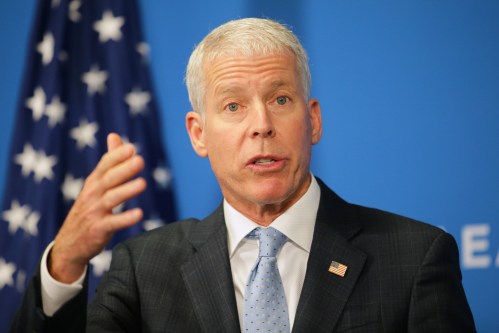
Energy Department will spend $2 billion to squeeze more electricity from the aging power grid

Advertisement

Advertise with us

ALLENTOWN, Pa. (AP) — The Energy Department said Thursday that it will spend almost $2 billion to try to squeeze more electricity out of the nation's aging and stressed power grid, as President Donald Trump's administration steps up efforts to avoid blackouts amid skyrocketing energy demand spurred by artificial intelligence.

Read this article for free:


or

Already have an account? Log in here »

To continue reading, please subscribe:

Subscribe and receive a limited-edition Free Press branded hat or tote.

Digital Subscription

One year of digital access for only $205*

  • Enjoy unlimited reading on winnipegfreepress.com
  • Read the E-Edition, our digital replica newspaper
  • Access News Break, our award-winning app
  • Play interactive puzzles

*First annual payment billed as $205.00 + GST for one year. This annual subscription will automatically renew at $233.00 + GST every 52 weeks (10% off the regular annual price of $259.35). Offer available to new and qualified returning subscribers only. Cancel any time.

To continue reading, please subscribe:

Add Free Press access to your Brandon Sun subscription for only an additional

$1 for the first 4 weeks*

  • Enjoy unlimited reading on winnipegfreepress.com
  • Read the E-Edition, our digital replica newspaper
  • Access News Break, our award-winning app
  • Play interactive puzzles
Start now

*Your next Brandon Sun subscription payment will increase by $1.00 and you will be charged $17.95 plus GST for four weeks. After four weeks, your payment will increase to $24.95 plus GST every four weeks.

ALLENTOWN, Pa. (AP) — The Energy Department said Thursday that it will spend almost $2 billion to try to squeeze more electricity out of the nation’s aging and stressed power grid, as President Donald Trump’s administration steps up efforts to avoid blackouts amid skyrocketing energy demand spurred by artificial intelligence.

The money will go toward 31 projects across 26 states that are expected to produce more than 23 gigawatts of additional electricity capacity — enough to power 16 million homes. The projects will use new technologies such as sensors to measure real-time weather conditions to ensure safe transmission or direct power away from congested paths, the department said.

The upgrades could improve power reliability and lower electricity costs for about 100 million Americans, officials said.
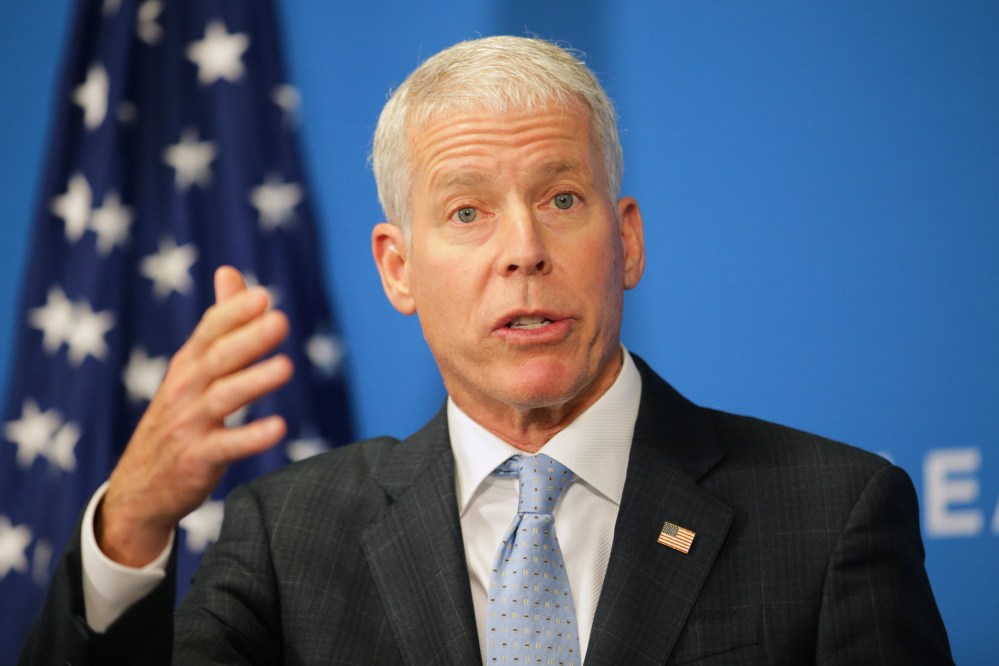
United States Secretary of Energy Chris Wright, talks to the media during a press conference on the sidelines of the annual General Conference of the International Atomic Energy Agency (IAEA) in Vienna, Austria, Monday, Sept. 14, 2026. (AP Photo/Heinz-Peter Bader)

“This is a quick way to lower electricity prices and increase reliability: using fibers that are already in the transmission lines to analyze what’s the temperature out, what’s the wind out, how can we use this transmission line to distribute more power, but safely and only in the right conditions,” Energy Secretary Chris Wright said in a news conference promoting the grants Thursday at a PPL Corp. facility in Allentown.

The eastern Pennsylvania electric utility says two data centers in its territory came online this year and six more are under construction, with enough other data centers in the advanced planning stages that its peak electric demand could quintuple by 2032.

PPL said it is receiving $71.5 million to modernize an existing high-voltage transmission line across roughly 30 miles in northern Pennsylvania.

The announcement comes amid warnings that AI’s voracious demand for power is threatening to overwhelm U.S. power supplies, as massive new data centers come online faster than new power plants can be built. It also comes as electricity bills rise faster than inflation in many parts of the U.S., blamed in some areas on demand from data centers.

The snowballing opposition to data centers in communities across the country has thrown a wrench into the plans of the world’s richest companies and transformed the midterm election landscape.

Trump continues to stick up for data centers, even as politicians from both major political parties criticize them and many communities try to block them.

In the meantime, Congress and some states are trying to push utilities to expand their use of new technologies to make grids more efficient and to lessen the need to build new power plants.

Julia Selker, the executive director of the WATT Coalition, a trade association for grid-enhancing technologies, said both the projects and the scale of the investment are significant. Utilities in the U.S. are lagging places like Europe in adopting the technologies, despite federal investment in the past to develop and test them, Selker said.

Still, Drew Maloney, CEO of the Edison Electric Institute, a trade association of for-profit utilities, said America’s electric utilities are making a “significant investment” every year in new technologies to strengthen the grid and reduce outages.

Wright said that work on the projects should begin right away and that he hoped some efficiencies are in place before this winter to tamp down price spikes when extreme weather sends demand skyrocketing.

Wright said he didn’t know whether the projects would have gotten done without federal funding. Many, he said, had been under consideration before the grants were offered, but the grant recipients hadn’t “quite pulled the trigger” on them.
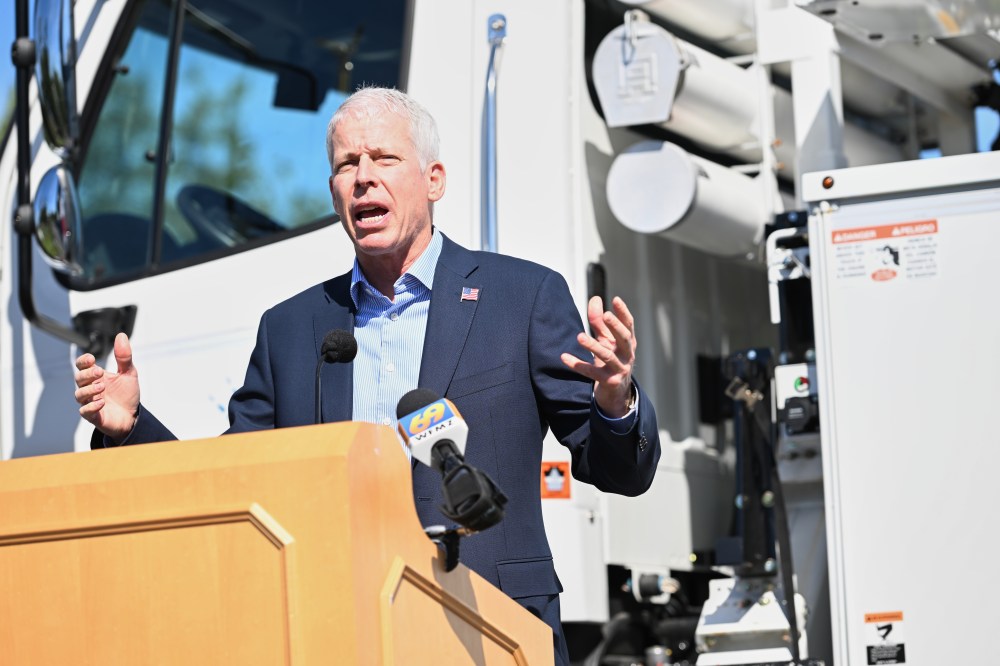
Energy Secretary Chris Wright speaks at a news conference at a PPL Corp. facility to announce that the Energy Department will spend almost $2 billion to try to squeeze more electricity out of the nation's aging and stressed power grid, Thursday, Sept. 24, 2026, in Allentown, Pa. (AP Photo/Marc Levy)

Projects being announced Thursday will involve component enhancements on more than 1,500 miles (2,400 kilometers) of transmission lines and technological enhancements across nearly 21,000 miles (34,000 kilometers), the department said.

Projects were prioritized based on those that can be put into operation quickly, officials said. Money for the grants comes from the bipartisan infrastructure law enacted by Congress under then-President Joe Biden, a Democrat. The government’s $1.9 billion in funding will be matched by $3.35 billion from the recipients, the department said.

Recipients include utilities, cooperatives and four state agencies. The state agencies — in Colorado, Indiana, Ohio and Oklahoma — were the biggest recipients, collectively drawing $810 million, with the Colorado and Oklahoma projects promising improvements to regional grids.

Trump has vowed to “unleash” the nation’s energy sector in his second term, aiming to drive up record-setting domestic oil and gas production, strip away pollution restrictions on power plants and keep expensive coal-fired power plants operating past their retirement dates.

The administration also has pledged nearly $4 billion to buy back offshore wind leases as Trump seeks to discourage the expansion of wind energy in favor of fossil fuels.

His administration meanwhile has pushed to help tech giants build and connect data centers to power plants and high-voltage power lines and convert Cold War-era uranium enrichment plants into data center and power plant complexes.

___

Daly reported from Washington.

Report Error Submit a Tip

More Stories

Minimum wage hikes set to begin across five provinces

The Canadian Press 2 minute read Preview

Minimum wage hikes set to begin across five provinces

The Canadian Press 2 minute read Updated: Yesterday at 3:12 PM CDT

The minimum wage is going up in five provinces.

The bumps of between 25 and 40 cents come in Ontario, Prince Edward Island, Nova Scotia, Manitoba and Saskatchewan.

Like other government announcements, Ontario has tied the increase to the rising cost of living.

It's moving its minimum wage up to $17.95 an hour, while P.E.I. is boosting it to $17.30 and Nova Scotia moves it to $17.

Read
Updated: Yesterday at 3:12 PM CDT

Energy Department will spend $2 billion to squeeze more electricity from the aging power grid

Marc Levy And Matthew Daly, The Associated Press 5 minute read Preview

Energy Department will spend $2 billion to squeeze more electricity from the aging power grid

Marc Levy And Matthew Daly, The Associated Press 5 minute read Thursday, Sep. 24, 2026

ALLENTOWN, Pa. (AP) — The Energy Department said Thursday that it will spend almost $2 billion to try to squeeze more electricity out of the nation's aging and stressed power grid, as President Donald Trump's administration steps up efforts to avoid blackouts amid skyrocketing energy demand spurred by artificial intelligence.

The money will go toward 31 projects across 26 states that are expected to produce more than 23 gigawatts of additional electricity capacity — enough to power 16 million homes. The projects will use new technologies such as sensors to measure real-time weather conditions to ensure safe transmission or direct power away from congested paths, the department said.

The upgrades could improve power reliability and lower electricity costs for about 100 million Americans, officials said.

“This is a quick way to lower electricity prices and increase reliability: using fibers that are already in the transmission lines to analyze what’s the temperature out, what’s the wind out, how can we use this transmission line to distribute more power, but safely and only in the right conditions," Energy Secretary Chris Wright said in a news conference promoting the grants Thursday at a PPL Corp. facility in Allentown.

Read
Thursday, Sep. 24, 2026

Face up to fact you blew it with ex-wife

Maureen Scurfield 4 minute read Yesterday at 2:01 AM CDT

DEAR MISS LONELYHEARTS: My ex-wife just moved back to town and looks like a changed woman. She spent years married to me, and our kids just graduated in a city where we once lived together. That was without help from me, other than minor financial stuff.

She has found a great new job back in Winnipeg and she’ll do very well. I admire her more than any other woman I ever met, but she’s not interested in me at all.

I once had a solid, responsible job and then got into drinking, and I cheated on her. That’s why she left town. Now I’ve been sober and sorry for many years.

I asked her last weekend if I could take her out to dinner and she said no and changed the subject.

Jets new backup Stevenson ‘stoked’ to be in tandem with Skinner

Mike McIntyre 6 minute read Preview

Jets new backup Stevenson ‘stoked’ to be in tandem with Skinner

Mike McIntyre 6 minute read Wednesday, Sep. 30, 2026

It didn’t take long to get the dirt on the newest member of the Winnipeg Jets.

Meet Clay Stevenson, who has no problem if you prefer to refer to him by his long-standing nickname of “Mud.”

“You know, Clay is in the mud, and there you go. That’s it, right there,” Stevenson said Wednesday with a laugh. “I got it in juniors when I was playing in Coquitlam, and kind of stuck ever since.”

Stevenson is now hoping to make a name for himself in a city that, quite fittingly, translates to “muddy water” in Cree. The 27-year-old from Alberta was placed on waivers by the Washington Capitals and claimed by the Jets, who were looking to clarify a goaltending situation which was as murky as the Red River.

Read
Wednesday, Sep. 30, 2026

Letters, Oct. 2

6 minute read 2:00 AM CDT

Are clinical psychologists next?

Re: Province hires 17 psychiatrists to work in Winnipeg, Selkirk (Sept. 25)

Manitoba’s government has shown that it knows how to solve a specialist staffing crisis in health care. Clinical psychologists are still left to wonder when it will be their turn.

The Manitoba Psychological Society (MPS) welcomes the recent announcement of 17 new psychiatrists in the public system. Any investment in mental health deserves to be celebrated, especially in light of the Canadian Alliance on Mental Illness and Mental Health’s report card that was released in August 2026. Manitoba received overall grades of F and D for mental health and substance use health, respectively. Although disappointing, this is not surprising given that Manitoba spends five to six per cent of its health budget on mental health and addictions, about half the recommended rate of 12 per cent.

Man who killed two Indigenous women, was accused of killing third, back in prison less than year after statutory release

Erik Pindera 4 minute read Preview

Man who killed two Indigenous women, was accused of killing third, back in prison less than year after statutory release

Erik Pindera 4 minute read Yesterday at 4:06 PM CDT

A Winnipeg man convicted of killing two First Nations women more than a decade ago — with charges stayed in a third slaying — has been sent back to prison less than a year after he left under conditions.

Parole Board of Canada officials revoked 67-year-old Shawn Lamb’s statutory release after a hearing last week.

“Your actions are not beyond your control, yet you continue to wilfully make poor decisions that place the public at risk,” board member Arun Kundu-Thomsen wrote in a decision released this week.

Lamb gained statutory release — a legislated conditional release most federal inmates automatically qualify for after serving two-thirds of their sentence — in November last year and lived in several Ontario facilities for federal offenders.

Read
Yesterday at 4:06 PM CDT