From climate-driven disasters to Rohingya refugee camps, solar kits help keep the lights on
Advertisement
Read this article for free:
or
Already have an account? Log in here »
To continue reading, please subscribe:

Digital Subscription
One year of digital access for only $205*
- Enjoy unlimited reading on winnipegfreepress.com
- Read the E-Edition, our digital replica newspaper
- Access News Break, our award-winning app
- Play interactive puzzles
*First annual payment billed as $205.00 + GST for one year. This annual subscription will automatically renew at $233.00 + GST every 52 weeks (10% off the regular annual price of $259.35). Offer available to new and qualified returning subscribers only. Cancel any time.
To continue reading, please subscribe:
Add Free Press access to your Brandon Sun subscription for only an additional
$1 for the first 4 weeks*
- Enjoy unlimited reading on winnipegfreepress.com
- Read the E-Edition, our digital replica newspaper
- Access News Break, our award-winning app
- Play interactive puzzles
*Your next Brandon Sun subscription payment will increase by $1.00 and you will be charged $17.95 plus GST for four weeks. After four weeks, your payment will increase to $24.95 plus GST every four weeks.
Read unlimited articles for free today:
or
Already have an account? Log in here »
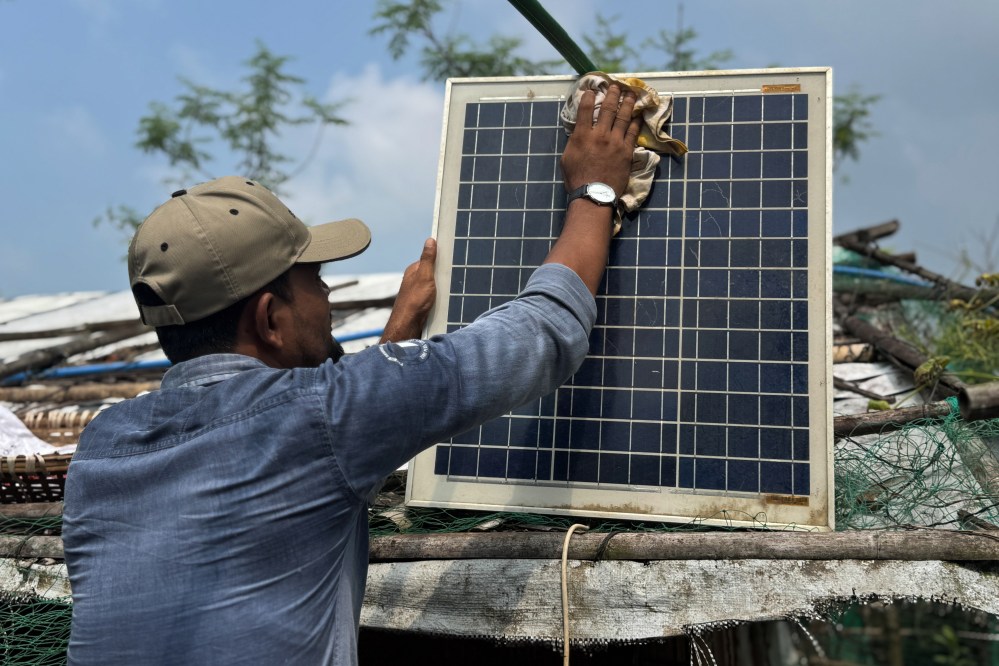
ISLAMABAD (AP) — Every day, Mohammed Saber places a single rectangular solar panel on the roof of the bamboo-and-tarpaulin shack that he and his family have called home for years, the last stop on their journey after fleeing the Myanmar military’s brutal crackdown on the Rohingya in 2017.
The panel is part of a portable solar kit given to the Rohingya refugee family as humanitarian aid six years ago. It’s been the family’s primary source of electricity, making daily life so much easier in the camp for the displaced in Teknaf, Bangladesh.
“We can now charge our phones, cook with light, children can study at night and use fans during the hot season,” said Saber, 35.
From the flood zones of Nepal to refugee camps in Africa, experts say that solar energy is increasingly becoming part of disaster relief as technology improves, costs fall and humanitarian organizations recognize that having access to electricity is a fundamental need.
Renewable energy solutions are needed more than ever, they say, as climate change drives and intensifies extreme weather while wars, sanctions and political upheavals keep fossil fuel prices volatile.
Solar energy kits are portable, rechargeable and grid-independent
When disasters strike and humanitarian needs surge, solar kits can become an invaluable resource, says Sarah Rosenberg-Jansen, a research fellow at the Stockholm Environment Institute, an independent research and policy institute specializing in sustainable development.
These solar kits — all-in-one, compact units that use solar panels and are not reliant on utility companies — are easy to move and recharge, according to Rosenberg-Jansen.
“In emergency situations, solar kits can be deployed immediately,” she said, adding that they are particularly useful in situations with rapidly rising floodwaters, changing front lines in a conflict, or for moving around in areas where damaged roads make it difficult to travel.
In terms of function, the kits can be “anything from solar lanterns to solar home systems, solar torches, solar heating pads, to electric cook stoves that use solar as their energy source,” she said.
Lower costs of solar energy helped its role in disaster relief
Rosenberg-Jansen also pointed out that solar panels are not prone to price shocks like fossil fuels, which can be difficult and costly to transport to a disaster zone.
Only a few decades ago, solar energy was a luxury, she added, but as technology evolved, mindsets and the price tag changed. Now it’s more affordable, thanks to the scaling up of mass manufacturing and technology advancement.
It’s also so much easier to use, said Yuriy Boyechko, CEO of Hope For Ukraine, a nonprofit based in the United States that provides solar kits to families living in war-torn Ukraine.
“We have grandmas and grandpas who are around 75-80 years old … receiving kits,” said Boyechko. “It’s just a matter of plug (in) and play.”
Solar panels are becoming more common now.
On the outskirts of Karachi, Pakistan’s economic hub, a tuberculosis clinic run by Doctors Without Borders uses solar energy. In South Sudan’s Renk county, the U.N. migration agency installed solar-powered water filtration systems for families displaced by the war in neighboring Sudan.
And after Nepal’s massive floods in August that killed 1,455 people and left 5,285 missing — including hundreds of foreign nationals — solar kits were distributed by local and international organizations, including Australia-based charity SolarBuddy.
Funding issues and bureaucracy are still an obstacle in disaster relief
Mark Gibson from Global Platform for Action, or GPA, which promotes affordable, reliable and clean energy access, said that integrating solar energy hasn’t come without difficulties.
Aid agencies have had time-tested systems in place, which often include diesel generators as part of long-term leases and agreements. Switching to solar means having to trust new systems and setting up new distribution chains, sometimes in risky environments.
Recent slashes in international donor funding have also undermined — or completely erased — new practices that were starting to take root, said Aimee Jenks, a program leader at GPA.
“Much of the technical expertise in the humanitarian sector on energy has been cut,” she said. “That’s now retracting a lot of progress.”
And while the cost of solar energy has decreased, it’s still prohibitive for many.
Boyechko, of Hope For Ukraine, said that by the end of 2026, his nonprofit will have distributed over 3,200 kits.
“But it took us two years to get to that number, because of funding needs,” he said. ”We have a waiting list of about 20,000 families. We just cannot keep up with demand.”
While no energy source is perfect, the move towards renewable energies is likely to decrease reliance on polluting fossil fuels.
For Saber, whose family is among more than 1 million refugees from Myanmar’s Rohingya ethnic and religious minority now living in Bangladesh, the kit means keeping the lights on.
“It’s improved my family’s life,” he said.
___
Freelancer photographer Ayub Khan Dkl in Teknaf, Bangaldesh, contributed to this report.
___
The Associated Press’ climate and environmental coverage receives financial support from multiple private foundations. AP is solely responsible for all content. Find AP’s standards for working with philanthropies, a list of supporters and funded coverage areas at AP.org.