Glaciers getting smaller, faster — especially in North America, study finds

Advertisement

Advertise with us

A new study has used millions of satellite images to generate the clearest picture yet of the world's glaciers and concludes they're getting smaller, faster.

Read this article for free:


or

Already have an account? Log in here »

To continue reading, please subscribe:

Subscribe and receive a limited-edition Free Press branded hat or tote.

Digital Subscription

One year of digital access for only $205*

  • Enjoy unlimited reading on winnipegfreepress.com
  • Read the E-Edition, our digital replica newspaper
  • Access News Break, our award-winning app
  • Play interactive puzzles

*First annual payment billed as $205.00 + GST for one year. This annual subscription will automatically renew at $233.00 + GST every 52 weeks (10% off the regular annual price of $259.35). Offer available to new and qualified returning subscribers only. Cancel any time.

To continue reading, please subscribe:

Add Free Press access to your Brandon Sun subscription for only an additional

$1 for the first 4 weeks*

  • Enjoy unlimited reading on winnipegfreepress.com
  • Read the E-Edition, our digital replica newspaper
  • Access News Break, our award-winning app
  • Play interactive puzzles
Start now

*Your next Brandon Sun subscription payment will increase by $1.00 and you will be charged $17.95 plus GST for four weeks. After four weeks, your payment will increase to $24.95 plus GST every four weeks.

Hey there, time traveller!
This article was published 28/04/2021 (1937 days ago), so information in it may no longer be current.

A new study has used millions of satellite images to generate the clearest picture yet of the world’s glaciers and concludes they’re getting smaller, faster.

And glaciers along the western edge of North America are thinning faster than almost anywhere else in the world, said co-author Brian Menounos of the University of Northern British Columbia, whose paper was published Wednesday in the journal Nature.

“I don’t think humans need more evidence the climate is changing,” Menounos said.
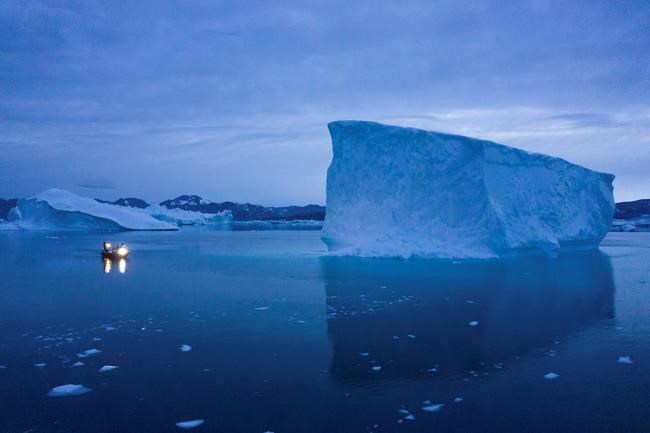
In this Aug. 15, 2019, photo, a boat navigates at night next to large icebergs in eastern Greenland. Greenland's ice has been melting for more than 20 years. THE CANADIAN PRESS/AP-Felipe Dana

“But I also think we can’t throw up our hands and say, ‘Oh, we can’t do anything.’ We have to understand the implications of climate change.”

Scientists have long known that the world’s 217,000 glaciers are in retreat.

That knowledge, however, was based on relatively infrequent satellite images and field monitoring that didn’t include all glaciers. Menounos and his colleagues turned to a previously unused trove of images that allowed them to estimate the falling elevation of precise spots with unprecedented accuracy.

“We had (a supercomputer) running for a solid year of compute time,” he said.

Once they knew how far the surface of the glaciers had fallen, they could calculate how much ice was lost. The results boggle the mind.

They found glaciers are now losing 267 billion tonnes of ice every year. Just one billion tonnes of ice — a gigatonne — is equal in mass to 10,000 fully loaded aircraft carriers.

Put another way, that’s enough ice melting every year to cover Canada’s entire land mass to a depth of 30 centimetres.

The pace is picking up. Between 2000 and 2004, when the study begins, glaciers “only” lost 227 gigatonnes per year.

But glaciers up the mountainous western spine of North America — including Canada — are melting even faster. Their thawing rate increased fourfold between 2000 and 2019.

Glaciers are now responsible for about 21 per cent of the roughly 22 centimetres that sea levels have risen since 1880.

That won’t stop. By the end of the century, about 200 million people will live on land likely to be submerged at high tide.

Glaciers are also a crucial source of fresh water, as they are in Western Canada. The paper quotes research suggesting more than one billion people could face water shortages by 2050.

That doesn’t include other benefits humans rely on glaciers for. They keep headwaters streams cool, for example.

“If you take that thermal buffering capacity of glaciers away, you’re left with a situation where these aquatic ecosystems are going to change,” Menounos said.

By far the biggest driver of glacial melt is rising temperatures caused by climate change, said Menounos. There are enough greenhouse gases in the air that some melting will continue even if the taps were turned off tomorrow.

But he said his study shows that while humans are causing the problem, they can also curb it.

“We just need the power and the gumption and the willpower to make some hard, difficult decisions,” Menounos said.

“You can’t really engineer your way out of this problem. You have to mitigate and reduce greenhouse gas emissions.”

This report by The Canadian Press was first published April 28, 2021.

— Follow Bob Weber on Twitter at @row1960

Report Error Submit a Tip

More Stories

Oliveira shines in win over Redblacks, Collaros rocked again

Taylor Allen 5 minute read Preview

Oliveira shines in win over Redblacks, Collaros rocked again

Taylor Allen 5 minute read Saturday, Aug. 15, 2026

It wasn’t a stellar performance by any stretch.

But at this point, the Winnipeg Blue Bombers will take a win no matter what it looks like.

The Blue and Gold outlasted the winless Ottawa Redblacks 33-21 on a rainy Friday night at Princess Auto Stadium to improve to 5-4.

“It’s great to finally get a win at home for our fans and to go out and play a better game is very encouraging,” said right guard Patrick Neufeld.

Read
Saturday, Aug. 15, 2026

Foster mom pleads guilty to assault that left six-year-old-girl paralyzed

Dean Pritchard 4 minute read Preview

Foster mom pleads guilty to assault that left six-year-old-girl paralyzed

Dean Pritchard 4 minute read Friday, Aug. 14, 2026

A Winnipeg foster mother has admitted to violently assaulting her ill foster daughter and leaving her paralyzed after the girl resisted the woman’s efforts to provide her with medication, a court has heard.

Marilyn Keno, 26, pleaded guilty Friday to one count of aggravated assault.

Keno remains in custody and will be sentenced at a later date following the completion of a court-ordered pre-sentence report.

The maximum sentence for aggravated assault is 14 years in prison. Crown attorney Alanna Littman and defence lawyer Jeremy Kostiuk did not disclose what sentences they will be recommending.

Read
Friday, Aug. 14, 2026

RCMP searching for missing 34-year-old woman

1 minute read Saturday, Aug. 15, 2026

Police are asking for the public’s help locating a 34-year-old woman last heard from almost a week ago.

Tamara Stevens, who also goes by Tammy, was last heard from on Sunday last weekend and was reported missing Tuesday morning, said a Thompson RCMP news release Saturday.

RCMP and family are worried for her well-being.

Stevens is believed to be in Thompson and is described as 5'7, with a slender build and long red hair, said RCMP. She also has a piercing on her lip and was last seen wearing black T-Shirt featuring the Twilight character Jacob, pants and work boots.

Impaired driving victim honoured

Morgan Modjeski 5 minute read Preview

Impaired driving victim honoured

Morgan Modjeski 5 minute read Saturday, Aug. 15, 2026

Ten years after he was killed in a collision involving an impaired driver in 2016, Robbie Anderson’s name has been added to MADD Canada’s Manitoba Memorial honouring those killed in drunk and drug-impaired-related crashes.

His older brother Chris Anderson, was one of two dozen people who gathered at the Glen Eden Funeral Home and Cemetery in West St. Paul Saturday to remember their loved ones, 86 victims whose names are etched into the granite monument near the heart of the graveyard.

“It’s heavy,” said Anderson when asked what it was like to be part of the ceremony and see his brother’s name added. “It’s been something I’ve been thinking about for a while.”

Grateful for MADD’s work and its efforts to honour Robbie, who was 27 when he died, Anderson said his brother, represented the “absolute best of us.”

Read
Saturday, Aug. 15, 2026

Today’s horoscope

Georgia Nicols 4 minute read Preview

Today’s horoscope

Georgia Nicols 4 minute read Yesterday at 2:00 AM CDT

MOON ALERT: There are no restrictions to shopping or important decisions today. The moon is in Libra.

ARIES (March 21-April 19)

The day is a mixed bag. For the most part, it’s romantic, friendly, congenial and a great time to socialize with others and enjoy playful activities with kids. Nevertheless, you might meet a real sourpuss or someone who is a wet blanket. Keep things light!

TAURUS (April 20-May 20)

Read
Yesterday at 2:00 AM CDT

Glaciers getting smaller, faster — especially in North America, study finds

Bob Weber, The Canadian Press 3 minute read Preview

Glaciers getting smaller, faster — especially in North America, study finds

Bob Weber, The Canadian Press 3 minute read Wednesday, Apr. 28, 2021

A new study has used millions of satellite images to generate the clearest picture yet of the world's glaciers and concludes they're getting smaller, faster.

And glaciers along the western edge of North America are thinning faster than almost anywhere else in the world, said co-author Brian Menounos of the University of Northern British Columbia, whose paper was published Wednesday in the journal Nature.

"I don't think humans need more evidence the climate is changing," Menounos said.

"But I also think we can't throw up our hands and say, 'Oh, we can't do anything.' We have to understand the implications of climate change."

Read
Wednesday, Apr. 28, 2021