New study outlines high costs of extreme heat in Phoenix

Advertisement

Advertise with us

PHOENIX (AP) — Extreme heat is expensive.

Read this article for free:


or

Already have an account? Log in here »

To continue reading, please subscribe:

Subscribe and receive a limited-edition Free Press branded hat or tote.

Digital Subscription

One year of digital access for only $205*

  • Enjoy unlimited reading on winnipegfreepress.com
  • Read the E-Edition, our digital replica newspaper
  • Access News Break, our award-winning app
  • Play interactive puzzles

*First annual payment billed as $205.00 + GST for one year. This annual subscription will automatically renew at $233.00 + GST every 52 weeks (10% off the regular annual price of $259.35). Offer available to new and qualified returning subscribers only. Cancel any time.

To continue reading, please subscribe:

Add Free Press access to your Brandon Sun subscription for only an additional

$1 for the first 4 weeks*

  • Enjoy unlimited reading on winnipegfreepress.com
  • Read the E-Edition, our digital replica newspaper
  • Access News Break, our award-winning app
  • Play interactive puzzles
Start now

*Your next Brandon Sun subscription payment will increase by $1.00 and you will be charged $17.95 plus GST for four weeks. After four weeks, your payment will increase to $24.95 plus GST every four weeks.

Hey there, time traveller!
This article was published 06/12/2021 (1741 days ago), so information in it may no longer be current.

PHOENIX (AP) — Extreme heat is expensive.

That’s the conclusion of a study presented Monday by The Nature Conservancy, which commissioned a look at the costs of rising temperatures in Phoenix.

Working with infrastructure consulting firm AECOM, the nonprofit environmental organization known for its nature preserves and efforts to protect biodiversity this time turned its attention to the country’s hottest large metropolitan area.
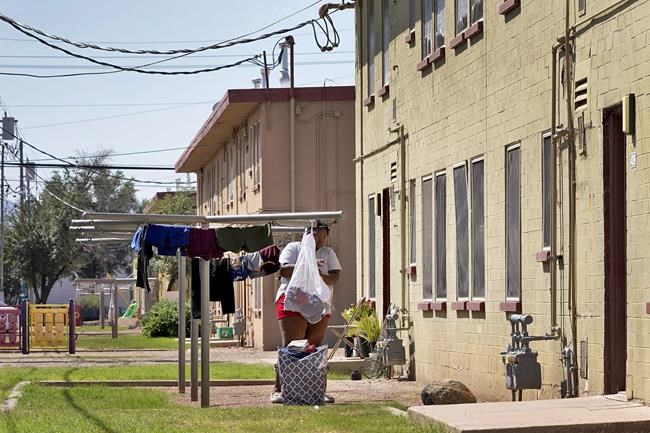
FILE - A woman hangs laundry outside a pubic housing building, Monday, Sept. 13, 2021, in Phoenix. Extreme heat is not only uncomfortable, it's expensive. That's the conclusion of a study presented Monday, Dec. 6, 2021, by The Nature Conservancy, which commissioned a look at the costs of rising temperatures in Phoenix, the hottest large metropolitan area in the U.S. (AP Photo/Matt York,File)

“As Phoenix continues to urbanize and its population expands, the benefits of adapting to extreme heat may only increase, as will the consequences of inaction,” the report said. “To implement the ambitious solution scenarios and realize the associated benefits, both the public and private sector will need to play an active role.”

David Hondula, a climate scientist formerly with Arizona State University who now heads Phoenix’s new heat response and mitigation office, said the report will be useful for cities like his in getting funding for measures to help cool down neighborhoods. He served on the study’s advisory committee.

Phoenix was always scorching, but climate change has made it even hotter, with temperatures in early September still climbing to 111 degrees (43.8 Celsius). Temperatures reached as high as 118 degrees (48 Celsius) over the summer. The city is the nation’s fifth largest, with 1.6 million people.

The people most vulnerable to the heat are often in poor and racially diverse communities where many households lack the means to cope with heat waves that are becoming more frequent, widespread and severe. Phoenix’s Maricopa County recorded 323 heat related deaths in 2020,

The Nature Conservancy’s study looked at the costs that can be caused by steadily rising temperatures to human health, labor productivity, electricity and roadways.

Extreme heat already costs people in metro Phoenix $7.3 million every year in emergency room visits and hospitalizations due to heat-related illnesses, according to the study. Maintaining roadways in the metro area costs transportation agencies over $100 million annually as streets and highways buckle, rut and crack from high temperatures.

The study concluded planting enough trees to provide canopy for a quarter of the desert city and covering all of the area’s buildings with “cool roofs” made of materials that don’t absorb heat could help the city save billions of dollars over the next three decades.

It said installing cool roofs on just a third of the structures in the Phoenix metro area could help save as much as $280 million annually in avoidable losses from decreased labor productivity, increased energy needs and heat-related illnesses and deaths.


Report Error Submit a Tip

More Stories

City rapped for taking five days to remove animal carcass

Morgan Modjeski 2 minute read Thursday, Sep. 10, 2026

A Winnipeg resident said she’s upset it took the city five days to retrieve a dead fawn from her yard after she reported it to 311.

Amy Gelhorn said she and her family noticed the animal carcass in her garden on Saturday. She called 311 and was told it would be picked up after the long weekend.

“It was removed this afternoon,” the north River Heights resident said Thursday. “So it took six days to remove it and we had to basically phone every day.”

She said neighbours on both sides of her house told her they saw the animal acting strangely on Friday and reported their concerns to 311. It’s believed the animal died overnight. As the days dragged on, the body continued to rot.

New study outlines high costs of extreme heat in Phoenix

Anita Snow, The Associated Press 3 minute read Preview

New study outlines high costs of extreme heat in Phoenix

Anita Snow, The Associated Press 3 minute read Monday, Dec. 6, 2021

PHOENIX (AP) — Extreme heat is expensive.

That's the conclusion of a study presented Monday by The Nature Conservancy, which commissioned a look at the costs of rising temperatures in Phoenix.

Working with infrastructure consulting firm AECOM, the nonprofit environmental organization known for its nature preserves and efforts to protect biodiversity this time turned its attention to the country's hottest large metropolitan area.

“As Phoenix continues to urbanize and its population expands, the benefits of adapting to extreme heat may only increase, as will the consequences of inaction,” the report said. “To implement the ambitious solution scenarios and realize the associated benefits, both the public and private sector will need to play an active role.”

Read
Monday, Dec. 6, 2021

‘Serious incident’ shuts down stretch on Broadway

1 minute read Updated: Yesterday at 6:09 PM CDT

Winnipeg police are investigating a "serious incident" that left people injured following a police pursuit near Broadway and Young Street Friday afternoon.

Police said the incident has ended, but the scene remains secured as officers investigate. No details about the number or severity of injuries were immediately released.

Broadway is closed between Furby and Young streets until further notice. Motorists are being asked to avoid the area and use alternate routes.

Police said more information will be released as it becomes available.

Puzzles Palace

1 minute read Monday, Jul. 27, 2026

To solve our puzzles, please subscribe with this special offer: |

Downtown no place to be after dark, huge majority of Winnipeggers say in survey

Joyanne Pursaga 8 minute read Preview

Downtown no place to be after dark, huge majority of Winnipeggers say in survey

Joyanne Pursaga 8 minute read Updated: Yesterday at 7:22 PM CDT

Most Winnipeggers are afraid to walk alone downtown and believe the city needs more police officers, a new survey finds.

Winnipeg Police Service released its 2026 citizen survey Friday.

Downtown safety appears to remain a major concern, with just 44 per cent saying they feel very or reasonably safe walking alone in the area during the day. The number plummets to eight per cent overall at night, down from nine per cent in 2024, the last time the survey was conducted.

This year, 14 per cent of men felt very or reasonably safe walking alone downtown at night, compared to just three per cent of women.

Read
Updated: Yesterday at 7:22 PM CDT

Don’t let bitterness isolate and dispirit you

Maureen Scurfield 4 minute read Yesterday at 2:01 AM CDT

DEAR MISS LONELYHEARTS: I just got out of a relationship a few months ago, and I’m still so hurt that life seems unreal.

The woman I thought I was going to marry cheated on me with an old boyfriend — a real jerk, but very good-looking. I’m still feeling totally crushed.

I worry I won’t be able to trust any woman now. I know that sounds unfair, but I’ve been cheated on twice before, in just five years! I realize it might just be the type of person I’m attracted to — a bit on the wild side — but my most-recent girlfriend wasn’t like that and seemed to have her life together and knew what she wanted. But she was also secretly playing around on me — Mr. Clueless.

I can feel resentment building inside me toward all women. I really don’t want to become one of those bitter guys who ends up single for the rest of his life because they don’t trust anyone. But how do I get over this? Is it even possible or am I going to be a loser who is forever cheated on?