Rising seas: Delays to safeguarding Chignecto Isthmus worry N.S., N.B. politicians

Advertisement

Advertise with us

HALIFAX - Legislators on both sides of the Nova Scotia-New Brunswick boundary say efforts to safeguard their area from a potential climate disaster have dragged on too long.

Read this article for free:


or

Already have an account? Log in here »

To continue reading, please subscribe:

Subscribe and receive a limited-edition Free Press branded hat or tote.

Digital Subscription

One year of digital access for only $205*

  • Enjoy unlimited reading on winnipegfreepress.com
  • Read the E-Edition, our digital replica newspaper
  • Access News Break, our award-winning app
  • Play interactive puzzles

*First annual payment billed as $205.00 + GST for one year. This annual subscription will automatically renew at $233.00 + GST every 52 weeks (10% off the regular annual price of $259.35). Offer available to new and qualified returning subscribers only. Cancel any time.

To continue reading, please subscribe:

Add Free Press access to your Brandon Sun subscription for only an additional

$1 for the first 4 weeks*

  • Enjoy unlimited reading on winnipegfreepress.com
  • Read the E-Edition, our digital replica newspaper
  • Access News Break, our award-winning app
  • Play interactive puzzles
Start now

*Your next Brandon Sun subscription payment will increase by $1.00 and you will be charged $17.95 plus GST for four weeks. After four weeks, your payment will increase to $24.95 plus GST every four weeks.

Hey there, time traveller!
This article was published 28/10/2021 (1803 days ago), so information in it may no longer be current.

HALIFAX – Legislators on both sides of the Nova Scotia-New Brunswick boundary say efforts to safeguard their area from a potential climate disaster have dragged on too long.

An engineering study commissioned to develop “three viable solutions” to the risk of the 35 kilometres of dikes being overwhelmed on the Chignecto Isthmus, which straddles the boundary, was expected in the spring but still hasn’t been released.

Meanwhile, an Oct. 15 deadline for seeking Ottawa’s help under the disaster mitigation and adaptation fund for such projects has passed.
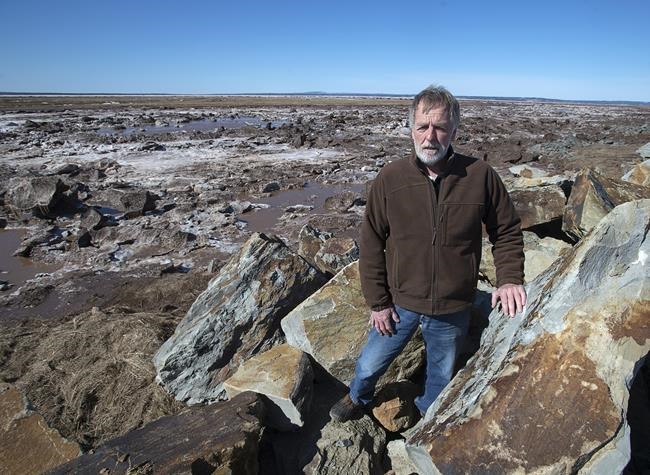
John Atkinson, an area farmer and land owner, stands on a dike along the LaPlanche River near Amherst, N.S. on Wednesday, March 20, 2019. Legislators on both sides of the Nova Scotia-New Brunswick border say efforts to safeguard their area from a potential climate disaster have dragged on too long. THE CANADIAN PRESS/Andrew Vaughan

Elizabeth Smith-McCrossin, the Independent member of the legislature for Cumberland North — the Nova Scotia riding on the provincial boundary — said in an interview Wednesday that she is preparing a private member’s bill that would call on the new Progressive Conservative government to commit to funding Nova Scotia’s share of a solution.

“Even though the past (Liberal) government said it was a priority, there isn’t any money allocated for it, and it’s going to take significant dollars,” she said.

“I don’t know the real cause of the delays. But as a member for the area, I’m asking for it to be made a priority, and soon.”

Megan Mitton, the Green Party member representing the New Brunswick riding of Memramcook-Tantramar, also said the delays are unacceptable given the risks to about 20 kilometres of rail line, highway, energy and communications infrastructure in the low-lying region that connects the two provinces.

“We don’t want to end up with a situation where whole communities have been flooded, sewage lagoons damaged and people are displaced,” she said in an interview. Mitton’s riding includes the community of Sackville, which has key infrastructure, including a sewage treatment plant, protected by the dikes.

Experts have for decades warned that the combination of a high tide with a powerful storm up the Bay of Fundy could overwhelm aging dikes and flood large portions of the Amherst, N.S., area, as well as neighbouring Sackville. Meanwhile, the sea level at the mouth of the Bay of Fundy has been rising at a rate of about 2.4 millimetres a year over the past century, even as the dikes and coastal land continue to subside.

In 2019, Réal Daigle, a meteorologist who models sea level rise, told The Canadian Press the dikes could be breached by a once-in-a-fifty-year storm occurring during the period of highest tides and with sustained winds gusting to 80 kilometres per hour over the Bay of Fundy — potentially adding 40 to 50 centimetres to the height of the water.

The New Brunswick government has taken the lead on overseeing the engineering study being funded by Ottawa and the two provinces, but it did not provide an official for an interview.

“The Department of Transportation and Infrastructure was waiting for the federal cabinet to be sworn in. We look forward to working with our counterparts in Nova Scotia and the new federal cabinet on this project,” Jeremy Trevors, a department spokesman, wrote in response to a request for an interview with the lead engineer.

In Nova Scotia, the Progressive Conservative government’s new Environmental Goals and Climate Change Reduction Act, which was tabled Wednesday, doesn’t include a specific mention of a fix to the Chignecto Isthmus in its list of goals.

Tim Halman, Nova Scotia’s minister of Environment and Climate Change, said the risk of flooding at the isthmus is a “major issue impacting the province” but offered no details on when the study might be completed.

Potential costs also remain largely unknown. A 2016 federal study concluded possible costs ranged from $90 million to build up and alter the existing dikes to $345 million to completely reroute highways and railways.

Jeff Ollerhead, who teaches coastal geography at Mount Allison University in Sackville, said in an interview that governments have long known how to protect the low-lying communities and could have proceeded with an analysis of the dikes section by section.

He said options include raising and reinforcing the dikes; removing the dikes and restoring salt marshes; and relocating infrastructure such as highways and the rail line to higher ground.

“In some cases it will make sense to reinforce them (dikes) and preserve critical infrastructure, but in other cases it makes no sense to spend the money to raise and reinforce dikes that could be turned back into salt marshes that could be turned into places where carbon is stored and fish habitat restored,” he said.

He argues that a strategic plan for the dikes, including close consultations with the communities involved, should have been underway years ago.

“You have to get on with the work of deciding on a kilometre-by-kilometre basis what options are going to apply to each section of the dike,” he said.

This report by The Canadian Press was first published Oct. 28, 2021.

Report Error Submit a Tip

More Stories

Bombers on outside looking in after beatdown from Als

Taylor Allen 7 minute read Preview

Bombers on outside looking in after beatdown from Als

Taylor Allen 7 minute read 6:34 PM CDT

The visitors’ locker room at Percival Molson Memorial Stadium was eerily quiet late Saturday night.

Many of the Winnipeg Blue Bombers sat in their stalls with dejected looks on their faces, trying to wrap their heads around what had just transpired: a 37-10 beatdown at the hands of the Montreal Alouettes.

“(That game) felt like s—-, honestly,” receiver Tim White told the Free Press postgame.

And the Bombers have plenty of reason to feel that way, especially when looking at the West Division standings.

Read
6:34 PM CDT

Volunteer pop-up library axed from Manitoba Youth Centre

Matthew Frank 4 minute read Preview

Volunteer pop-up library axed from Manitoba Youth Centre

Matthew Frank 4 minute read Updated: Yesterday at 11:25 AM CDT

Manitoba Corrections has cancelled a pop-up library program at the Manitoba Youth Centre, leaving inmates without librarian services and fewer options to borrow certain books.

The Prison Libraries Committee, part of the non-profit Manitoba Library Association, operated and funded the volunteer program since 2024 before it was shut down by the province last month. The group previously partnered with the province to offer the service because the facility has no dedicated library of its own.

“It is concerning that community members who are incarcerated, especially youth, are losing out on meaningful programming, access to information and rehabilitation efforts, which are offered at no cost to (Manitoba) Corrections. We urge Manitoba Justice to promote more library services and programming, not less,” said a Sept. 24 letter from the non-profit addressed to the justice minister.

Ashley Huot, chair of the Prison Libraries Committee, said she was puzzled when she received an email last month from Manitoba Corrections stating that the pop-up library was no longer needed.

Read
Updated: Yesterday at 11:25 AM CDT

Broadening prediction-market gambling a bad idea

Editorial 4 minute read Preview

Broadening prediction-market gambling a bad idea

Editorial 4 minute read Yesterday at 2:01 AM CDT

Let’s make a prediction: sooner or later, when Canadian governments find a way to take their own cut of the action, prediction-contract gambling on everything from sports to entertainment to political decisions is going to come to Canada.

And that’s a horrible, dangerous, pernicious idea.

Unless you have particular access to information — either inside information or strategic information based on skills or education — you’re not likely to make money at it. In fact, structurally, you’re likely to lose. In prediction markets, you basically pay an amount, plus fees from the company involved, to bet on whether something will or will not happen within a certain time frame. The amount you pay for your contract depends on how other people are also betting.

As Wealthsimple describes it, “You buy whichever side you think is right. Prices move with demand, so if the market leans towards one outcome, the more that side costs. If a lot of people are backing the TSX to finish above 38,000, yes gets more expensive and no gets cheaper.”

Read
Yesterday at 2:01 AM CDT

Khan should’ve taken high road: Goertzen

Carol Sanders 5 minute read Preview

Khan should’ve taken high road: Goertzen

Carol Sanders 5 minute read Friday, Oct. 2, 2026

The veteran Progressive Conservative who championed Obby Khan’s leadership bid says the former Blue Bomber dropped the ball by dissing his Tory teammates before he stepped down.

“I wouldn’t recommend it, and I didn’t recommend it,” Kelvin Goertzen (Steinbach) said in an interview Friday.

Khan resigned as PC leader and quit the caucus Monday saying some members were secretly plotting his ouster, even after he won a confidence vote on Sept. 25.

On Tuesday, Khan lashed out in a CJOB interview, naming the alleged plotters, saying constituents deserved to know which of their elected representatives “lacked moral integrity.” Khan told the Free Press he was “deeply emotionally hurt,” and felt stabbed in the back.

Read
Friday, Oct. 2, 2026

Mayoral candidate Vogiatzakis criticized for living outside Winnipeg

Malak Abas 4 minute read Preview

Mayoral candidate Vogiatzakis criticized for living outside Winnipeg

Malak Abas 4 minute read Friday, Oct. 2, 2026

A mayoral hopeful took heat from other candidates Friday for living outside Winnipeg while running in the civic election.

Mike Vogiatzakis’s primary residence is in the Rural Municipality of St. Andrews, about 25 kilometres north of Winnipeg — a community with its own mayor and councillors.

But the funeral director said he owns a home in Winnipeg where he divides his time, and he would move to the city full-time if elected mayor.

“It doesn’t matter where a person lives. Why are we dividing St. Andrews and Manitoba and Winnipeg? I’ve met the criteria to run for mayor,” Vogiatzakis said Friday morning.

Read
Friday, Oct. 2, 2026

May be whiff of truth to ex’s odour ardour

Maureen Scurfield 5 minute read Yesterday at 2:01 AM CDT

DEAR MISS LONELYHEARTS: I ran into an old boyfriend I used to curl on a team with, and we went for drinks. We’ve been almost eight years apart, and I couldn’t remember why we broke up, as we always had such a great time together.

It wasn’t until the second date — this time on a weekend — that it came back to me, with a jolt. Pee-yew! I remembered he doesn’t use deodorant on weekends. Why? He enjoys his own body odour. I recalled that a bit too late, and it was just as awful as ever! I went home early.

Tonight, he called and I refused him another date. I said, “Think back. You remember why we broke up?” Then he said, “Oh yeah, you hated my no-deodorant weekend policy. Well, guess what? Some women don’t mind!” I said I really doubted that, and that ended the conversation. Miss L., wouldn’t any women find stinky underarms offensive?

— Sensitive Nose, Fort Richmond