Heady research
Baltimore clinic collects brains to study disorders, diseases
Advertisement
Read this article for free:
or
Already have an account? Log in here »
To continue reading, please subscribe:

Digital Subscription
One year of digital access for only $205*
- Enjoy unlimited reading on winnipegfreepress.com
- Read the E-Edition, our digital replica newspaper
- Access News Break, our award-winning app
- Play interactive puzzles
*First annual payment billed as $205.00 + GST for one year. This annual subscription will automatically renew at $233.00 + GST every 52 weeks (10% off the regular annual price of $259.35). Offer available to new and qualified returning subscribers only. Cancel any time.
To continue reading, please subscribe:
Add Free Press access to your Brandon Sun subscription for only an additional
$1 for the first 4 weeks*
- Enjoy unlimited reading on winnipegfreepress.com
- Read the E-Edition, our digital replica newspaper
- Access News Break, our award-winning app
- Play interactive puzzles
*Your next Brandon Sun subscription payment will increase by $1.00 and you will be charged $17.95 plus GST for four weeks. After four weeks, your payment will increase to $24.95 plus GST every four weeks.
Read unlimited articles for free today:
or
Already have an account? Log in here »
Hey there, time traveller!
This article was published 20/04/2019 (2660 days ago), so information in it may no longer be current.
About noon most days, the Lieber Institute for Brain Development in East Baltimore gets a case — that is, a brain. It arrives in an inconspicuous red cooler. Almost immediately, resident neuropathologist Rahul Bharadwaj gets to work, carefully inspecting it for any abnormalities, such as tumours or lesions.
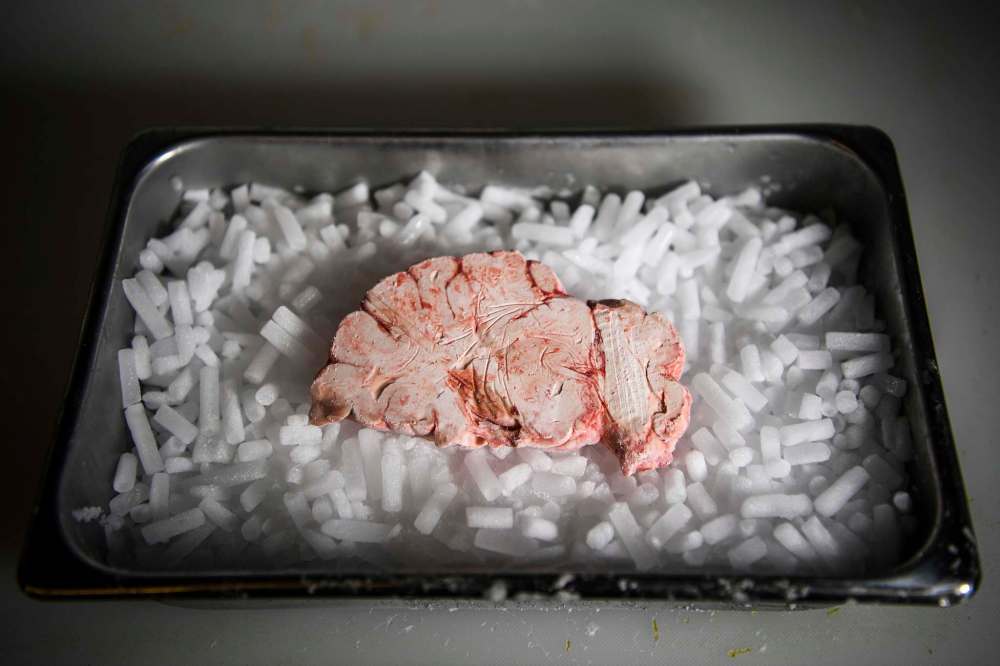
Often, the brains come from the Maryland Medical Examiner’s Office, just a 15-minute drive across town. On other days, they are flown in — packed on dry ice — from around the United States.
Since opening in 2011, the institute has amassed more than 3,000 of these post-mortem brains that it is studying to better understand the biological mechanisms behind such neuropsychiatric disorders as schizophrenia, major depression, substance abuse, bipolar disorder and post-traumatic stress disorder. About 100 brain banks exist across the country for all sorts of brain diseases. But Lieber, founded with the support and funding of a wealthy couple whose daughter suffered a psychotic break in her 20s, is the biggest collection dedicated specifically to mental conditions.
Current therapies for neuropsychiatric disorders — antipsychotics and antidepressants — treat symptoms rather than the underlying cause of illness, which remains largely unknown. And while they can be life-saving for certain people, they can cause unpleasant and sometimes serious side-effects. In some cases, they won’t work at all.
Most of these drugs were also discovered by accident. Lieber’s goal is to unravel what happens biologically in the brain to make these conditions occur and then to develop therapies to treat these conditions at their root cause, or even prevent them from happening in the first place.
“Most of us have some of the variations in the human genome that are associated with psychiatric problems,” says Daniel Weinberger, director and chief executive of the institute.
More than 100 genetic variants have been identified as possibly related to schizophrenia, and about 30 variants have been linked to bipolar disorder. What’s not known is how having one of these genetic variants or a group of them alters the structure and function of the brain — and why some people who harbour these variants don’t develop mental illness while others do.
Researchers think a combination of genetic, lifestyle and environmental risk factors changes the brain’s chemistry in people with various neuropsychiatric disorders, causing imbalances in neurotransmitters, important chemicals that send messages to nerve cells in the brain.
“Once we understand some of these genetic risk mechanisms, then we can start thinking about what molecular pathways seem to be perturbed,” says Thomas Hyde, Lieber’s chief medical officer. “The key is to find new therapeutics and then figure out which is the best target population for those therapeutics to work in.”
Lieber researchers first do a physical examination of the brains, then carefully slice them into sections that can be more easily studied. DNA, RNA and proteins are extracted and analyzed to identify genetic mutations and observe how genes are expressed in different cells. Using a technique called laser capture microdissection, they can isolate specific brain cells from a mixed population.
Other experiments in the lab involve taking a sample of cells from the dura, the outer membrane that coats the brain, and reprogramming them into stem cells, which can then be differentiated into neurons. Scientists want to observe whether neurons from brains with neuropsychiatric disorders act differently than ones from healthy brains.
Through this research, the institute has identified what it believes is a handful of promising drug candidates, including one for traumatic brain injury and another for a rare form of autism, a neurodevelopmental disorder. Researchers hope these experimental drugs will move into human clinical trials within the next two years.
Most of the Lieber Institute’s brains come from people who have died unexpectedly, often by suicide or drug overdose. After a physical examination of the brains, investigators interview family members and pore over medical records to make a post-mortem diagnosis, a process that can take three to six months after they get a brain.
The morning hours leading up to a case are a flurry of activity.
The institute gets a call from one of four partner medical examiner’s offices — in Maryland, Michigan, North Dakota or Santa Clara County, Calif. — after an autopsy has been performed at those sites. Medical examiners are tasked with investigating deaths that are suspicious or of public interest. They determine the cause of death and whether the case might be a good fit for the Lieber Institute. At that point, it’s Hyde’s job to contact next of kin and ask permission to use their loved one’s brain for research.
Hyde has a small window of time in which to get that consent — just one to three hours. But often, he’s successful. More than 60 per cent of family members asked agree to brain donation. “We try to be very sensitive and not too intrusive,” Hyde says. “To me, it’s remarkable that, given the sudden loss of a loved one, people are so generous with the tissue donations.”
The Lieber team needs that tissue to be as intact as possible to study it. And since tissue starts to degrade immediately after death, researchers try to obtain brains within 24 to 36 hours. Once a family consents, the brain is flash-frozen on-site and sent to the Lieber Institute, along with a few vials of the person’s blood and a small piece of the dura.
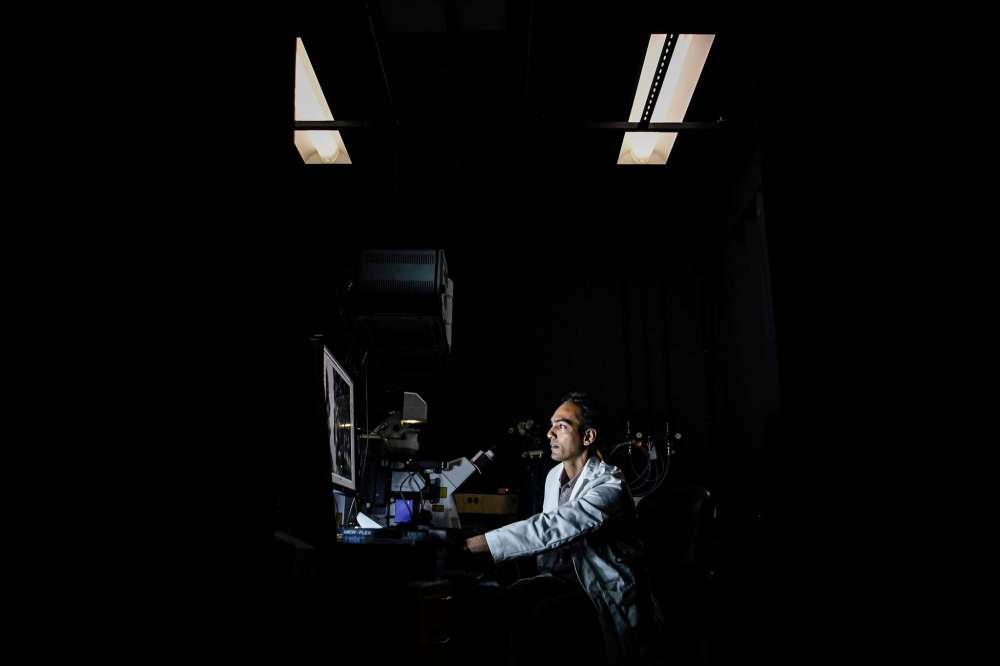
Once a brain arrives, it is ushered into a small, well-lit room and placed on a white marble slab for the dissection. Bharadwaj and research assistant Sam Allen don protective blue suits, blue shoe covers and plastic gloves to prevent any contamination.
After examining a brain, Bharadwaj delicately cuts it into slices, to expose certain parts — such as the amygdala, the almond-shaped mass of neurons located deep in each hemisphere that serves as the brain’s emotion-processing centres. Abnormal functioning of the amygdala has been found in some patients with depression, PTSD and phobias. Sometimes, brain abnormalities can be seen with the naked eye, but often, scientists need to look at smaller brain sections under a microscope to observe how brain cells and tissue might look different compared with healthy brains.
Lieber not only boasts the biggest collection of brains with a confirmed diagnosis of PTSD, but it also has a collection of about 600 brains from African-Americans with and without neuropsychiatric disorders — the largest such repository.
Barbara Lipska, director of the Human Brain Collection Core at the National Institute of Mental Health in Bethesda, Md., says it’s important to study brains from people of diverse backgrounds because most of the genetic information collected so far has been from people of European heritage. “We know that there are differences in the frequencies of certain genetic mutations in people of different races.”
The blood that’s collected, along with brain tissue, is used for DNA sequencing — a process in which researchers determine the full readout of a person’s genetic code. It was once thought that a person has the same DNA throughout all of the cells in their body. But that hypothesis doesn’t seem to hold up in the brain. Researchers are finding that certain genetic changes — deletions and duplications of DNA — may appear only in neurons in the brain, not in the rest of the cells in the body.
Michael McConnell, assistant professor of biochemistry and molecular genetics at the University of Virginia, is investigating what role these deletions and duplications of DNA, called copy number variants, play in neuropsychiatric disease. He has been studying brains in the Lieber collection to explore this mystery, pulling out single cells from brain tissue and profiling their DNA.
McConnell says he thinks these copy number variants might have an effect on neurotransmitters, raising the risk of neuropsychiatric disease. And because brain cells stick around in the body for much longer than other cells, these variants could be with people for most of their lives.
This is where brains prove invaluable. Most genetic studies of neuropsychiatric disorders have looked at only blood, not brain cells. These blood-based studies have turned up two kinds of genetic variants: ones that are common in a lot of people but seem to have a small effect on neuropsychiatric disease, and rare ones that are found in only a small number of people with these disorders.
“Maybe if we look at the brain we’ll find that they’re not as rare as we think they are,” McConnell says. If a certain variant is in a big enough chunk of the population, “it’s worth making a drug to try.”
— Washington Post