Canadians reporting more wildlife sightings during COVID-19 isolation

Advertisement

Advertise with us

MONTREAL - When Josianne Plante looked out her window on a recent morning, she was surprised to see a pair of large, bare-headed wild turkeys going for a stroll through her east-end Montreal neighbourhood.

Read this article for free:


or

Already have an account? Log in here »

To continue reading, please subscribe:

Subscribe and receive a limited-edition Free Press branded hat or tote.

Digital Subscription

One year of digital access for only $205*

  • Enjoy unlimited reading on winnipegfreepress.com
  • Read the E-Edition, our digital replica newspaper
  • Access News Break, our award-winning app
  • Play interactive puzzles

*First annual payment billed as $205.00 + GST for one year. This annual subscription will automatically renew at $233.00 + GST every 52 weeks (10% off the regular annual price of $259.35). Offer available to new and qualified returning subscribers only. Cancel any time.

To continue reading, please subscribe:

Add Free Press access to your Brandon Sun subscription for only an additional

$1 for the first 4 weeks*

  • Enjoy unlimited reading on winnipegfreepress.com
  • Read the E-Edition, our digital replica newspaper
  • Access News Break, our award-winning app
  • Play interactive puzzles
Start now

*Your next Brandon Sun subscription payment will increase by $1.00 and you will be charged $17.95 plus GST for four weeks. After four weeks, your payment will increase to $24.95 plus GST every four weeks.

Hey there, time traveller!
This article was published 19/04/2020 (2354 days ago), so information in it may no longer be current.

MONTREAL – When Josianne Plante looked out her window on a recent morning, she was surprised to see a pair of large, bare-headed wild turkeys going for a stroll through her east-end Montreal neighbourhood.

“They were just walking down the street and sidewalk like nothing was happening,” the Pointe-aux-Trembles resident said in a recent interview.

“I’ve never seen anything like that before here.”
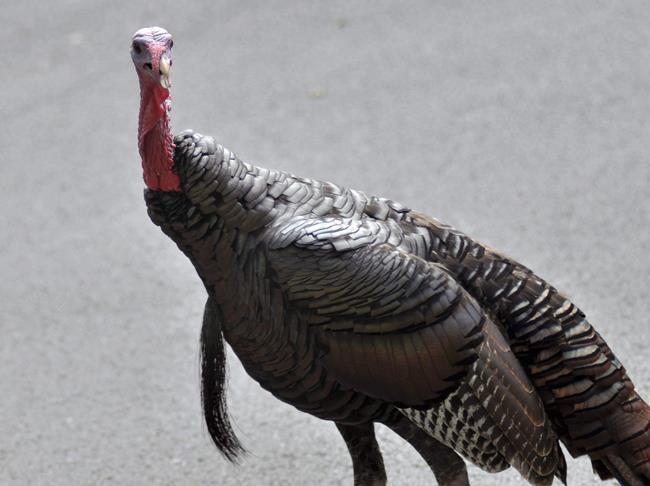
A wild turkey walks through a residential neighborhood in Brookline, Mass. on Sept. 27, 2017. When Josianne Plante looked out her window on a recent morning, she was surprised to see a pair of large, bare-headed wild turkeys going for a stroll through her east-end Montreal neighbourhood. THE CANADIAN PRESS/AP/Collin Binkley

With countries around the world on lockdown due to COVID-19, many people have been reporting seeing more wildlife, and Canada is no exception.

David Rodrigue, the executive director of the Ecomuseum Zoo in Ste-Anne-de-Bellevue, Que., says there has been an uptick in sightings of common urban species such as skunks, raccoons, white-tailed deer, rabbits and foxes in the greater Montreal area since the pandemic began.

He said that fewer vehicles and quieter streets and parks likely mean normally shy animals are roaming more freely.

“That lessens the pressure of disturbance on those animals, who seem to be wandering more,” he said.

Rodrigue said that for the most part, the animals being noticed are those which were already present in the city, although the turkeys are an exception.

“They’re a very wary species and they’re hard to approach,” he said.

“That some of them came into an urban setting speaks volumes about the effect of fewer people walking around.”

He said he’s heard reports of birds flocking in large numbers in normally busy areas, including Montreal’s Old Port.

Perhaps surprisingly, coyotes, which have grabbed headlines in Montreal in recent years, haven’t been sighted in higher numbers. The most frequently spotted? Rats.

Increased sightings of wildlife have been occurring all across Canada, according to James Page of the Canadian Wildlife Federation.

Page said there were 15,000 new sightings reported in the first days of April at inaturalist.ca, an online database that allows citizens to input their plant and animal observations, compared to 9,500 for the same period last year.

But Page, a species at risk and biodiversity specialist, says it’s too early to talk about a “re-wilding” of cities or of nature bouncing back.

He said that while animals are probably more visible, part of the increase is likely because people are staying home due to the pandemic, and therefore are more likely to spot wildlife.

Marie-Eve Muller, a spokeswoman for the Quebec-based Group for Research and Education on Marine Mammals, said it’s too soon to know if a reduction in boat traffic could have a positive impact on marine mammals.

She said shipping traffic in the St-Lawrence River hasn’t diminished so far, but a reduction in pleasure boats and whale-watching could be beneficial to whales, which are known to be disturbed by engine noise and vibrations.

Both Page and Rodrigue said it remains to be seen whether there will be a lasting effect on animal populations.

In the short term, they say less disturbance during breeding season could allow some species to raise larger litters, while a reduction in vehicle traffic could reduce fatal collisions.

But Page said that the human impact on animals is still enormous, including from roads and dams that cut through their habitats.

Rodrigue and Page suggest people keep garbage containers sealed and avoid feeding wild animals, which often causes them problems down the line.

But both experts say that seeing wildlife can offer people a rare bright spot in a difficult time, and give us a small glimpse of what the world could looks like with better cohabitation.

“Maybe it can give us a pause to think about our relationship with nature and what it could look like, going forward,” Page said.

This report by The Canadian Press was first published April 19.

Report Error Submit a Tip

More Stories

Canada resorting to its tried and true playbook

Niigaan Sinclair 5 minute read Preview

Canada resorting to its tried and true playbook

Niigaan Sinclair 5 minute read Yesterday at 6:00 AM CDT

In 1846, Britain faced an emergency influenced by the Irish famine, so leaders repealed the country’s “Corn Laws” and restrictions on imported food and grain, transitioning to a system of free trade.

This created a crisis in the then Province of Canada, which had relied on British “preferential” status to prop up its agricultural and resource industries.

As a result, Canada looked south for new markets and eventually negotiated a free trade agreement with the United States.

This required land to be acquired and converted for industrial use quickly, so Canada quickly dispatched Commissioner William Robinson to negotiate with Indigenous communities along Lake Huron and Lake Superior for land.

Read
Yesterday at 6:00 AM CDT

Wildlife sightings increasing during COVID-19

Morgan Lowrie, The Canadian Press 4 minute read Preview

Wildlife sightings increasing during COVID-19

Morgan Lowrie, The Canadian Press 4 minute read Sunday, Apr. 19, 2020

MONTREAL - When Josianne Plante looked out her window on a recent morning, she was surprised to see a pair of large, bare-headed wild turkeys going for a stroll through her east-end Montreal neighbourhood.

"They were just walking down the street and sidewalk like nothing was happening," the Pointe-aux-Trembles resident said in a recent interview.

"I've never seen anything like that before here."

With countries around the world on lockdown due to COVID-19, many people have been reporting seeing more wildlife, and Canada is no exception.

Read
Sunday, Apr. 19, 2020

Uncaring hubby fell flat at first hurdle

Maureen Scurfield 4 minute read Yesterday at 2:00 AM CDT

DEAR MISS LONELYHEARTS: I re-rented my favourite summer cabin this fall because I’m trying to finish my thesis. My husband of just over a year was very annoyed with me for going on my own, but didn’t say much about it because I paid.

I thought we were both OK with this arrangement, until I got the flu up at the lake very badly and couldn’t keep anything down. I felt faint. I phoned him and he said he was at a party with the guys. I could hear music and girls laughing.

He wouldn’t come for me, so at 4 a.m. when I was getting even more sick and scared, I drove back to the city unannounced.

I went straight to my parents’ house and pretty much fell through the door. Mom said to me when she grabbed me: “This is not right. You could have died in the ditch. Where is your husband?”

The Brazilian election

Gwynne Dyer 5 minute read Preview

The Brazilian election

Gwynne Dyer 5 minute read 2:00 AM CDT

“Flávio Bolsonaro is Trump’s candidate and what Trump wants is to colonize Brazil, take our riches, steal our future and leave us in the dust,” claims the latest video released by President Luiz Inácio ‘Lula’ da Silva’s re-election campaign. The weird thing is about half of Brazil’s voters would be okay with Trump running the country (through Bolsonaro).

Nobody in Brazil thinks that Flávio Bolsonaro is his own man. He is the son of Jair Bolsonaro, the hard right ex-soldier and former president who tried a coup after he lost the 2022 election. It was even clumsier and more half-hearted than Trump’s brief excursion in sedition after he lost the U.S. 2020 election — but Jair Bolsonaro went to jail for his attempt.

In a strange way Trump even recognizes the parallel, showing special sympathy for his imprisoned fellow traveler. He claimed that the senior Bolsonaro was the victim of a “witch-hunt” by the Brazilian Supreme Court and slapped 50 per cent tariffs on the country. And next Sunday (Oct. 4) the junior Bolsonaro faces Lula in another presidential election.

We already know that there will be a second round of voting on Oct. 25, when the other three candidates have dropped out and it’s a straight race between Lula and Junior. We have no idea what that outcome will be, because the two men have been only one or two points apart (i.e. ‘within the margin of error’) in every opinion poll for months.

Read
2:00 AM CDT

First Manitoba-U.K. Defence Summit begins

Free Press staff 1 minute read 2:00 AM CDT

United Kingdom delegates from the aerospace and defence sector are visiting Winnipeg this week for the first Manitoba-U.K. Defence Summit.

Industry executives will discuss trade, investment and collaboration with their Manitoba counterparts, according to a Manitoba Aerospace & Defence news release.

The group started with a conference at the Manitoba Club on Monday. Today, United Kingdom leaders will visit Boeing Winnipeg, StandardAero and Magellan Aerospace, the news release says.

The summit is being led by the Canada-Manitoba Defence Alliance, which the provincial government launched earlier this month.

Bathhouse owner upset after judge grants bail to man accused in foiled bombing

Dean Pritchard and Morgan Modjeski 5 minute read Preview

Bathhouse owner upset after judge grants bail to man accused in foiled bombing

Dean Pritchard and Morgan Modjeski 5 minute read Updated: Yesterday at 5:00 PM CDT

The owner of a Notre Dame Avenue bathhouse is troubled after a man accused of planting a pipe bomb outside his club was granted bail.

Erik Lymen Olson, 59, was granted release following a contested bail hearing last Monday.

“I don’t think he should have got out with something like this — at all,” said Christopher Gregoire, owner of AQ Sauna.

Olson was arrested Sept. 12, one day after allegedly planting a pipe bomb outside the sex and lifestyle club.

Read
Updated: Yesterday at 5:00 PM CDT