Most Canadians comfortable with pace of easing restrictions: poll

Advertisement

Advertise with us

OTTAWA - As provinces start to tiptoe toward normalcy by gently lifting restrictions aimed at slowing the spread of COVID-19, a new poll suggests Canadians are largely happy with the pace.

Read this article for free:


or

Already have an account? Log in here »

To continue reading, please subscribe:

Subscribe and receive a limited-edition Free Press branded hat or tote.

Digital Subscription

One year of digital access for only $205*

  • Enjoy unlimited reading on winnipegfreepress.com
  • Read the E-Edition, our digital replica newspaper
  • Access News Break, our award-winning app
  • Play interactive puzzles

*First annual payment billed as $205.00 + GST for one year. This annual subscription will automatically renew at $233.00 + GST every 52 weeks (10% off the regular annual price of $259.35). Offer available to new and qualified returning subscribers only. Cancel any time.

To continue reading, please subscribe:

Add Free Press access to your Brandon Sun subscription for only an additional

$1 for the first 4 weeks*

  • Enjoy unlimited reading on winnipegfreepress.com
  • Read the E-Edition, our digital replica newspaper
  • Access News Break, our award-winning app
  • Play interactive puzzles
Start now

*Your next Brandon Sun subscription payment will increase by $1.00 and you will be charged $17.95 plus GST for four weeks. After four weeks, your payment will increase to $24.95 plus GST every four weeks.

Hey there, time traveller!
This article was published 05/05/2020 (2318 days ago), so information in it may no longer be current.

OTTAWA – As provinces start to tiptoe toward normalcy by gently lifting restrictions aimed at slowing the spread of COVID-19, a new poll suggests Canadians are largely happy with the pace.

People in most provinces taking steps to reopen were between 60 and 70 per cent supportive of those moves, while 16 to 30 per cent would like to see their government slow down a little.

Some provinces have already begun loosening physical distancing measures put in place as the growth in the number of COVID-19 cases started picking up steam in March.
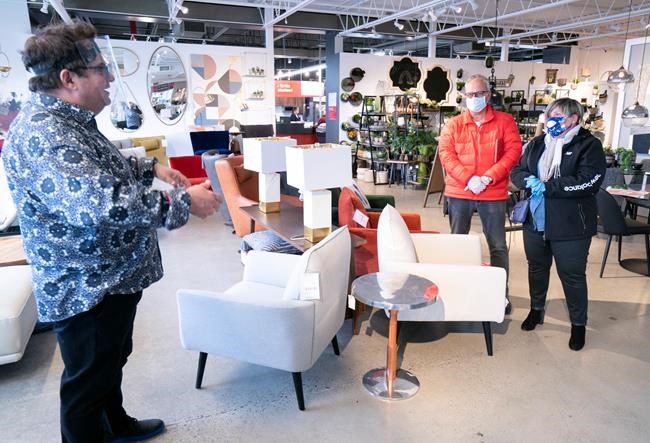
A sales clerk keeps his distance from clients at a furniture store in St-Jean-sur-Richelieu, Que. on Monday, May 4, 2020. Retail stores outside the greater Montreal area have been allowed to reopen after weeks of forced closure due to the COVID-19 pandemic. THE CANADIAN PRESS/Paul Chiasson

In Quebec, which has the highest number of COVID-19 cases in Canada, the province is allowing some retail stores to reopen outside of Montreal with an eye to reopen the manufacturing and construction sectors next week. On Monday it pushed back the reopening of non-essential stores in the Montreal area at least another week.

Ontario, with the second-highest number of confirmed cases in the country, is allowing the partial reopening of some seasonal businesses. Manitoba has gone even further, allowing slightly restricted access to libraries, museums, and restaurant patios.

But in Alberta, which plans to allow certain retail stores, restaurants and daycare centres to reopen as early as May 14, people seem less comfortable with how quickly things are moving.

There, 50 per cent of respondents would like the province to slow down.

The poll, conducted by Leger and the Association for Canadian Studies between May 1 and 3, surveyed 1,526 adult Canadians and 1,002 adult Americans randomly recruited from its online panel. The internet-based survey cannot be assigned a margin of error because online polls are not considered random samples.

“Alberta is a bit different,” said Christian Bourque, vice-president of Leger.

“Everywhere else people seem to be in tune with what their governments have announced.”

Bourque was surprised by the latest results, considering similar polls in the last weeks indicated Canadians wanted to see major milestones hit before physical distancing measures were lifted, such as the development of a vaccine or a two-week period without new cases.

“I expected people to be even more cautious than they are,” he said.

In the latest poll, 28 per cent said they would be comfortable lifting restrictions if there are only sporadic cases and no pressure on the health-care system.

One reason for the acceptance of provincial plans to gradually reopen may be the steady support and trust respondents have expressed in their governments, which have remained high throughout the Canadian epidemic, Bourque said.

That’s in stark contrast to the United States, where 43 per cent of respondents expressed satisfaction with measures put in place by President Donald Trump to fight COVID-19. In Canada, 77 per cent of respondents said they were satisfied with what Ottawa is doing.

The other reason may be that people are starting to slip when it comes to following the rules.

In general, the poll suggests Canadians’ fear of themselves or a loved one contracting the virus is lower than it was at the end of March. And while 27 per cent of Canadians said they did not comply with at least one of the public health measures two weeks ago, that number grew to 35 per cent in the latest poll.

That’s mainly because people are a little more likely to visit friends and family now, Bourque said. Last week only 16 per cent reported doing that and this week it was 18 per cent.

“More people now find it harder to do everything governments are asking them to do,” he said.

This report by The Canadian Press was first published May 5, 2020.

Report Error Submit a Tip

More Stories

DNA on beer can helps solve killing

Dean Pritchard 4 minute read Preview

DNA on beer can helps solve killing

Dean Pritchard 4 minute read 2:00 AM CDT

Two years after 74-year-old James Monaghan was stabbed in his Sherburn Street home, DNA found on a beer can led police to his killer.

Shara Harper, 29, pleaded guilty to manslaughter and on Tuesday was sentenced to six years in prison.

A neighbour found Monaghan dead in his home on July 29, 2022. He had been stabbed twice in the chest and back.

The investigation into Monaghan’s killing had stalled until June 2024, when DNA found on an empty beer can in Monaghan’s home was confirmed to be a match for Harper.

Read
2:00 AM CDT

Trump ramps up retaliation against Canada, banning imports of booze, other products

Kelly Geraldine Malone, The Canadian Press 6 minute read Preview

Trump ramps up retaliation against Canada, banning imports of booze, other products

Kelly Geraldine Malone, The Canadian Press 6 minute read Updated: Yesterday at 10:13 PM CDT

WASHINGTON - U.S. President Donald Trump signed new executive orders on Tuesday, ramping up retaliation after Canada imposed its latest set of duties on the United States. 

The five orders, which will take effect later this month, will completely bar imports of certain Canadian goods, including motorcycles, some dairy products and alcoholic beverages.

U.S. Trade Representative Jamieson Greer, in a statement later Tuesday, said the decision was a "natural consequence" of Canada's "discriminatory" treatment of American exports.

"After weeks of good faith and intensive efforts between U.S. and Canadian negotiators, Canada walked away from a near-final trade deal that offered better treatment than any other trading partner, and instead Canada chose to embark on senseless retaliation against the United States," Greer said in the statement.

Read
Updated: Yesterday at 10:13 PM CDT

Childfree Winnipeg group gives women without kids a place to gather

AV Kitching 5 minute read Preview

Childfree Winnipeg group gives women without kids a place to gather

AV Kitching 5 minute read 4:48 PM CDT

Katelyn Sawatzky founded Childfree Winnipeg Women in 2021 to bring together women who don’t have kids — be it by choice or circumstance — and do not plan on raising children.

The group is designed to help them share experiences and build meaningful friendships.

The community welcomes cisgender, straight, transgender, bisexual and lesbian women. Parents, including empty nesters and men, are turned away.

“Our group is a safe space where women can hang out with other women without being asked when you’re going to have kids or why you don’t have kids … where you don’t feel like you have to validate or defend your choices in any way, because everyone gets it,” Sawatzky says.

Read
4:48 PM CDT

‘Dynacare sucks:’ premier muses about bringing lab services back into public system after strike halted

Free Press staff 4 minute read Preview

‘Dynacare sucks:’ premier muses about bringing lab services back into public system after strike halted

Free Press staff 4 minute read Updated: 11:49 AM CDT

Manitoba’s premier said the province is looking at bringing diagnostic lab services back into the public system rather than continuing to contract Dynacare, declaring the for-profit company “sucks.”

“Maybe we’ll take over the whole system… we’re working on it, we’re looking at it, the situation is not great, this company’s making a mess — I think it’s pretty clear I’m not happy with them,” Premier Wab Kinew told CBC Radio Wednesday morning. “At the same time, nobody should be trying to use people’s health care as leverage.”

Kinew made the comments the day after the Manitoba Labour Board cut short a strike by 350 lab technicians and technologists employed by Dynacare, which administers blood, urine and other medical tests for patients in Winnipeg, Brandon and surrounding communities.

Dynacare, which is contracted by the provincial government, performs the majority of non-emergency blood and urine tests in the province.

Read
Updated: 11:49 AM CDT

Parts of River Heights hammered by storm

Melissa Martin 5 minute read Preview

Parts of River Heights hammered by storm

Melissa Martin 5 minute read Monday, Sep. 7, 2026

A powerful storm cut a swath of destruction through River Heights on Sunday, leaving much of the area without power.

Nobody was hurt in the storm.

By the time it subsided, parts of the quiet neighbourhood, especially Borebank and Lindsay streets between Grant and Taylor, had been ravaged: power lines downed, Manitoba Hydro poles toppled, trees splintered and crashed down on vehicles and homes.

In one case, a vehicle was flipped into a yard and sat under a partially downed tree. Shingles were stripped from roofs. Some residents described looking out during the storm and seeing power lines ablaze and the blue glow of electricity arcing over their backyards.

Read
Monday, Sep. 7, 2026

Most Canadians OK with slow reopening: poll

Laura Osman, The Canadian Press 4 minute read Preview

Most Canadians OK with slow reopening: poll

Laura Osman, The Canadian Press 4 minute read Tuesday, May. 5, 2020

OTTAWA - As provinces start to tiptoe toward normalcy by gently lifting restrictions aimed at slowing the spread of COVID-19, a new poll suggests Canadians are largely happy with the pace.

People in most provinces taking steps to reopen were between 60 and 70 per cent supportive of those moves, while 16 to 30 per cent would like to see their government slow down a little.

Some provinces have already begun loosening physical distancing measures put in place as the growth in the number of COVID-19 cases started picking up steam in March.

In Quebec, which has the highest number of COVID-19 cases in Canada, the province is allowing some retail stores to reopen outside of Montreal with an eye to reopen the manufacturing and construction sectors next week. On Monday it pushed back the reopening of non-essential stores in the Montreal area at least another week.

Read
Tuesday, May. 5, 2020