Senators likely to propose major amendments to assisted dying bill
Advertisement
Read this article for free:
or
Already have an account? Log in here »
To continue reading, please subscribe:

Digital Subscription
One year of digital access for only $205*
- Enjoy unlimited reading on winnipegfreepress.com
- Read the E-Edition, our digital replica newspaper
- Access News Break, our award-winning app
- Play interactive puzzles
*First annual payment billed as $205.00 + GST for one year. This annual subscription will automatically renew at $233.00 + GST every 52 weeks (10% off the regular annual price of $259.35). Offer available to new and qualified returning subscribers only. Cancel any time.
To continue reading, please subscribe:
Add Free Press access to your Brandon Sun subscription for only an additional
$1 for the first 4 weeks*
- Enjoy unlimited reading on winnipegfreepress.com
- Read the E-Edition, our digital replica newspaper
- Access News Break, our award-winning app
- Play interactive puzzles
*Your next Brandon Sun subscription payment will increase by $1.00 and you will be charged $17.95 plus GST for four weeks. After four weeks, your payment will increase to $24.95 plus GST every four weeks.
Read unlimited articles for free today:
or
Already have an account? Log in here »
Hey there, time traveller!
This article was published 14/12/2020 (2115 days ago), so information in it may no longer be current.
OTTAWA – It was out of the political frying pan and into the fire Monday for the Trudeau government’s bill to expand access to medically assisted dying.
Opening debate on Bill C-7 began in the Senate, where the government has no control over independent-minded, less-partisan senators who appear determined to amend the legislation.
Senators offered conflicting views on whether the bill is constitutional, does enough to protect people with disabilities, should be amended and even whether there’s any real urgency to deal with it this week.
In the House of Commons, the minority government faced delay tactics from a majority of Conservative MPs who vehemently oppose expanding assisted dying to intolerably suffering people who are not already near death.
But, with the Bloc Québécois and NDP backing the bill, its eventual passage last Thursday was assured. The government did not have to make any significant amendments and it faced no political pressure to do more to help Canadians access medical assistance in dying (MAID).
That is not the case in the Senate, where the government can expect a flurry of amendments from both sides of the equation: senators who think the bill is unconstitutional because it goes too far and those who think it’s unconstitutional because it doesn’t go far enough.
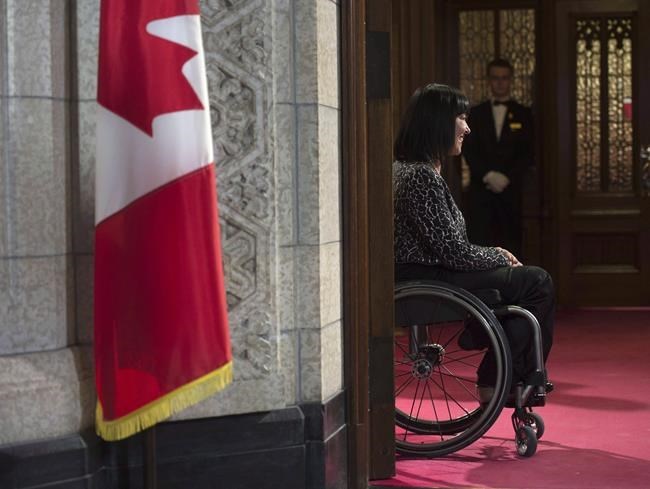
Sen. Chantal Petitclerc, who is sponsoring the bill in the Senate, implored her colleagues Monday to think about the Canadians who are suffering intolerably as they wait for the bill to be passed.
“They are not statistics,” she said, reading off the names of Quebecers who have had to go to court for their right to an assisted death.
Petitclerc, a member of the Independent Senators Group, urged senators to deal with the bill thoroughly but expeditiously, without undue delays.
The government is pressuring senators to put the bill through all the legislative hoops by Friday, the court-imposed deadline for revamping Canada’s assisted dying regime.
Justice Minister David Lametti last week asked the court for more time, until Feb. 26, but the court has already granted two extensions and there’s no guarantee it will agree to a third.
The Justice Department’s lawyers have asked for that request to be heard Thursday.
Once opening debate on the bill concludes, it will be sent back to the Senate’s legal and constitutional affairs committee, which has already conducted a weeklong pre-study of the bill.
The committee has heard from dozens of witnesses but Petitclerc said in an interview that she expects more will be called. She, for one, wants to hear from more legal experts about the constitutionality of the bill.
The committee must then give clause-by-clause scrutiny to the bill, with members proposing and voting on amendments, before sending it back to the full Senate for final debate and likely more proposed amendments.
Conservative Senate leader Don Plett took issue Monday with the Senate being pressured to decide a life and death issue in a mere five days. He blamed the time crunch on the government’s decision last August to prorogue Parliament for six weeks, vaporizing the previous iteration of the bill and forcing it to start the legislative process all over again.
Sen. Peter Harder, the former government representative in the Senate who now sits with the Progressive Senate Group, suggested it would be more reasonable for the Senate to wrap up opening debate this week and let the legal affairs committee scrutinize the bill over the holiday break so that the Senate can conclude its deliberations upon its return in late January.
Harder also advised senators that he will not support any amendments that would alter the content of the bill or delay or block its passage. He argued that unelected senators have an even greater obligation to defer to the will of the House of Commons on a bill that was overwhelmingly approved by a majority of MPs from five parties in a minority Parliament.
But that is unlikely to deter other senators who believe the bill is unconstitutional.
Conservative Sen. Claude Carignan contended that the bill violates the charter of rights on two fronts: the explicit ban on MAID for people suffering solely from mental illnesses and the imposition of a 90-day assessment period for people who are not near death.
Bill C-7 is intended to bring the law into compliance with a September 2019 Quebec Superior Court ruling. Justice Christine Baudouin struck down the provision in the law that allows medically assisted dying only for those whose natural death is reasonably foreseeable.
The bill would scrap the near-death requirement but would retain the concept to create two eligibility tracks for MAID: somewhat relaxed rules for people who are close to death and more stringent rules for those who aren’t.
Judging from concerns raised by senators during the pre-study, Petitclerc expects a number of significant amendments to be proposed.
Among the most likely amendments:
— A sunset clause on the bill’s proposed explicit prohibition on MAID for people suffering solely from mental illnesses. Senators with extensive legal backgrounds, such as former judge Pierre Dalphond and Carignan, believe excluding an entire class of people violates equality rights.
Such an amendment would be vigorously opposed by other senators, such as Conservative Sen. Denise Batters, who fear it would amount to state-sanctioned suicide for people whose illness makes them prone to depression.
— Remove or reduce the more stringent eligibility rules the bill would impose on people who are not near death, which Carignan and others believe violates equality rights.
But other senators, Batters and Plett among them, are expected to propose even more stringent safeguards to, as they see it, protect vulnerable people from being coerced — either directly or indirectly through societal attitudes and a lack of support services — into receiving MAID.
— Add a clause specifying that doctors and nurses can’t raise the subject of MAID until a patient initiates a discussion about it. Plett wrung a promise out of Disability Inclusion Minister Carla Qualtrough that the government would seriously consider such an amendment, which she said she’d personally support.

— Require longer than the proposed 90 days for assessing a MAID request from a person who is not near death.
— Require that persons not near death be given access to counselling services, mental health and disability support services, community services and palliative care — not just be informed of such options as proposed in the bill.
— Restore some of the safeguards the bill proposes to eliminate for those who are near death, including the 10-day waiting period between being approved for MAID and receiving the procedure, and requiring two witnesses instead of just one.
This report by The Canadian Press was first published Dec. 14, 2020.
Note to readers: This is a corrected story. A previous version said the government’s request for an extension will be heard on Thursday, but that date has not been set by the court.