‘The value of your elders’: First Nation using youth to spread COVID-19 message

Advertisement

Advertise with us

MORLEY, Alta. - A First Nation in Alberta is turning to its youth to help spread the message to older members about the dangers of COVID-19.

Read this article for free:


or

Already have an account? Log in here »

To continue reading, please subscribe:

Subscribe and receive a limited-edition Free Press branded hat or tote.

Digital Subscription

One year of digital access for only $205*

  • Enjoy unlimited reading on winnipegfreepress.com
  • Read the E-Edition, our digital replica newspaper
  • Access News Break, our award-winning app
  • Play interactive puzzles

*First annual payment billed as $205.00 + GST for one year. This annual subscription will automatically renew at $233.00 + GST every 52 weeks (10% off the regular annual price of $259.35). Offer available to new and qualified returning subscribers only. Cancel any time.

To continue reading, please subscribe:

Add Free Press access to your Brandon Sun subscription for only an additional

$1 for the first 4 weeks*

  • Enjoy unlimited reading on winnipegfreepress.com
  • Read the E-Edition, our digital replica newspaper
  • Access News Break, our award-winning app
  • Play interactive puzzles
Start now

*Your next Brandon Sun subscription payment will increase by $1.00 and you will be charged $17.95 plus GST for four weeks. After four weeks, your payment will increase to $24.95 plus GST every four weeks.

Hey there, time traveller!
This article was published 28/12/2020 (2106 days ago), so information in it may no longer be current.

MORLEY, Alta. – A First Nation in Alberta is turning to its youth to help spread the message to older members about the dangers of COVID-19.

Three reserves in the shadow of the Rocky Mountains make up the Stoney Nakoda First Nation, where there have been only a couple of outbreaks of the novel coronavirus since the pandemic began.

CEO Ryan Robb said the First Nation, including Morley about 70 kilometres west of Calgary, has faced a difficult challenge. Stoney remains the first language for an overwhelming majority of members, regardless of their age.
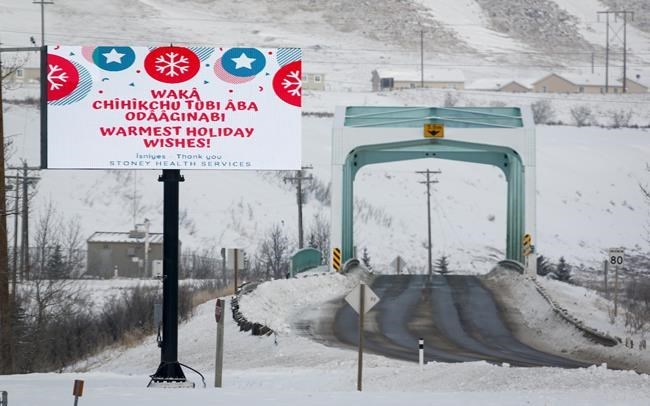
A sign in Stoney and English proclaims holiday wishes in Morley, Alta., Sunday, Dec. 27, 2020. THE CANADIAN PRESS/Jeff McIntosh

“They have an extremely high language retention, even though we’re very, very close to a major city,” said Robb in an interview. “Quite quickly we realized we needed to get our information out in Stoney as well as English.”

Robb said that included messages from chief and council played on the radio in both languages and a large digital billboard that flashes bilingual information along the road into the community

Audio files have also been created that can be downloaded onto phones.

“We made it in a very simple, small, downloadable file,” Robb said. “We translated it into Stoney and I can take my phone to go see my grandmother to play it in Stoney, so she may understand.”

Robb said a lot of messaging is being delivered in schools to get young people onside over fear of harming their grandparents.

“Make sure you’re protecting grandma and grandpa. The value of your elders is really important for First Nations,” he said.

“I may not be worried about it as a 20-year-old or a 30-year-old, but guess what? I don’t want to give it to my grandparents.”

Robb said as in many ethnic communities, multiple generations live together in small homes, so containing the spread of the virus is essential.

“We have 1,100 households on the three reserves. How are we managing to keep this into four or five houses rather than just running rampant through the entire reserve?”

The Alberta government has recognized that many COVID-19 hot spots in the province share similar circumstances with First Nations, so outreach teams are going into communities to get the message and resources out.

“These hardest-hit neighbourhoods tend to be lower income areas, where people naturally live in high density housing arrangements, sometimes with multi-generational families that can make it very difficult for family members to self-isolate effectively if needed,” Alberta Premier Jason Kenney said earlier this month.

“Many of these families also have English language barriers, which in some cases makes it more difficult for them to obtain current and accurate health information and to access the social supports that are available to them.”

Dr. John Conly, a professor at Calgary’s Cumming School of Medicine and an expert on infectious diseases, spent time working on the Stoney Nakoda Nation.

Conly, who has had more than 100 patients with COVID-19, said he’s not surprised at the measures being taken to get out vital information.

“We see that in many of our new immigrant settings as well. We’ve got Punjabi, Vietnamese, Mandarin, Cantonese and Spanish, even in Calgary,” he said.

“Some COVID materials they have to put in eight to 10 languages, because there are many people who may have some fluency in English, but when it gets to be more sophisticated, their first tongue is always their best delivery in terms of information.”

This report by The Canadian Press was first published December 28, 2020

— Follow @BillGraveland on Twitter

Report Error Submit a Tip

More Stories

Brandonmeat packer thriving on its own

Abiola Odutola 3 minute read Preview

Brandonmeat packer thriving on its own

Abiola Odutola 3 minute read 2:01 AM CDT

BRANDON — Canada Packers has strengthened its business and laid the foundation for future growth during its first year as an independent company, its president says.

The Brandon-based pork producer, separated from Maple Leaf Foods in October 2025, established its own leadership, strategy, systems, culture and identity while continuing operations across its hog production farms and regional hog barns in southern and eastern Manitoba.

The company’s first year was focused on building a successful standalone business while continuing to serve customers, communities and shareholders, president Dennis Organ said.

“Market conditions over the past year have been more challenging than we anticipated when we became a separate entity,” he said in an email. “Despite that, we continued to execute against our priorities, including increasing processing volumes, maintaining disciplined operations and strengthening the business.”

Read
2:01 AM CDT

’Disgusting’ posters being investigated by police

Morgan Modjeski 4 minute read 2:22 PM CDT

The Winnipeg Police Service major crimes unit is investigating what some have labelled offensive and hateful posters on full-display at a Winnipeg home.

One of the people irked by the display is Gracie Garrett. She’s has lived on Ashburn Street in Winnipeg’s Minto neighbourhood for almost ten years. She’s never felt unsafe in the neighbourhood before, but now, a set of posters plastered on a nearby house are making her feel uneasy.

The five signs, posted facing the street prominently on a front window, contain a slur, refer to Nazis as “heroes” and call Muslims, Christians and other groups “evil.”

Learning of the signs Friday, Garrett said she’ll be reporting the posters to police, as she worries they incite and promote violence.

Manitoban Kent Monkman debuts beaver sculpture in Toronto’s ambitious new waterfront park

Alex Nino Gheciu, The Canadian Press 2 minute read Preview

Manitoban Kent Monkman debuts beaver sculpture in Toronto’s ambitious new waterfront park

Alex Nino Gheciu, The Canadian Press 2 minute read Updated: 9:17 AM CDT

TORONTO - Kent Monkman’s first-ever public art installation is dam good.

The celebrated Cree artist’s new permanent sculpture, dubbed “The Colony,” debuts Wednesday in Toronto’s east end.

The 15-foot-high bronze structure features beavers dancing, feasting and celebrating, evoking Indigenous ceremonies.

It highlights the vital role of beavers in the natural, Indigenous and colonial histories of Turtle Island, says a release.

Read
Updated: 9:17 AM CDT

Broadening prediction-market gambling a bad idea

Editorial 4 minute read Preview

Broadening prediction-market gambling a bad idea

Editorial 4 minute read 2:01 AM CDT

Let’s make a prediction: sooner or later, when Canadian governments find a way to take their own cut of the action, prediction-contract gambling on everything from sports to entertainment to political decisions is going to come to Canada.

And that’s a horrible, dangerous, pernicious idea.

Unless you have particular access to information — either inside information or strategic information based on skills or education — you’re not likely to make money at it. In fact, structurally, you’re likely to lose. In prediction markets, you basically pay an amount, plus fees from the company involved, to bet on whether something will or will not happen within a certain time frame. The amount you pay for your contract depends on how other people are also betting.

As Wealthsimple describes it, “You buy whichever side you think is right. Prices move with demand, so if the market leans towards one outcome, the more that side costs. If a lot of people are backing the TSX to finish above 38,000, yes gets more expensive and no gets cheaper.”

Read
2:01 AM CDT

Mayoral candidate Vogiatzakis criticized for living outside Winnipeg

Malak Abas 4 minute read Preview

Mayoral candidate Vogiatzakis criticized for living outside Winnipeg

Malak Abas 4 minute read Updated: Yesterday at 6:03 PM CDT

A mayoral hopeful took heat from other candidates Friday for living outside Winnipeg while running in the civic election.

Mike Vogiatzakis’s primary residence is in the Rural Municipality of St. Andrews, about 25 kilometres north of Winnipeg — a community with its own mayor and councillors.

But the funeral director said he owns a home in Winnipeg where he divides his time, and he would move to the city full-time if elected mayor.

“It doesn’t matter where a person lives. Why are we dividing St. Andrews and Manitoba and Winnipeg? I’ve met the criteria to run for mayor,” Vogiatzakis said Friday morning.

Read
Updated: Yesterday at 6:03 PM CDT

Health minister warns $1.2 billion in annual federal funding set to expire in March

Scott Billeck 4 minute read Preview

Health minister warns $1.2 billion in annual federal funding set to expire in March

Scott Billeck 4 minute read Thursday, Oct. 1, 2026

Manitoba’s health minister is warning of possible cuts to health care with $1.2 billion in annual funding from Ottawa set to expire next year.

“We’re very concerned that what would be the largest cut to health care in a generation is right in front of us,” Health Minister Uzoma Asagwara said Thursday at the Manitoba legislature. “It means that services that Manitobans depend on will be in jeopardy and be at risk.

“Any reductions, any cuts from Canada, will have direct impacts on the health outcomes of Manitobans.”

Asagwara, who serves as the provincial and territorial health minister lead, chaired a virtual meeting Tuesday with provincial and territorial health ministers to discuss federal funding for health care, mental health care and substance use services, which is scheduled to expire March 31, 2027.

Read
Thursday, Oct. 1, 2026