Ontario won’t administer Oxford-AstraZeneca vaccine to seniors, health minister says

Advertisement

Advertise with us

TORONTO - Ontario seniors won't receive the Oxford-AstraZeneca COVID-19 vaccine since there's limited data on its effectiveness in older populations, the province said Tuesday, but it remained unclear who those shots would go to.

Read this article for free:


or

Already have an account? Log in here »

To continue reading, please subscribe:

Subscribe and receive a limited-edition Free Press branded hat or tote.

Digital Subscription

One year of digital access for only $205*

  • Enjoy unlimited reading on winnipegfreepress.com
  • Read the E-Edition, our digital replica newspaper
  • Access News Break, our award-winning app
  • Play interactive puzzles

*First annual payment billed as $205.00 + GST for one year. This annual subscription will automatically renew at $233.00 + GST every 52 weeks (10% off the regular annual price of $259.35). Offer available to new and qualified returning subscribers only. Cancel any time.

To continue reading, please subscribe:

Add Free Press access to your Brandon Sun subscription for only an additional

$1 for the first 4 weeks*

  • Enjoy unlimited reading on winnipegfreepress.com
  • Read the E-Edition, our digital replica newspaper
  • Access News Break, our award-winning app
  • Play interactive puzzles
Start now

*Your next Brandon Sun subscription payment will increase by $1.00 and you will be charged $17.95 plus GST for four weeks. After four weeks, your payment will increase to $24.95 plus GST every four weeks.

Hey there, time traveller!
This article was published 02/03/2021 (2041 days ago), so information in it may no longer be current.

TORONTO – Ontario seniors won’t receive the Oxford-AstraZeneca COVID-19 vaccine since there’s limited data on its effectiveness in older populations, the province said Tuesday, but it remained unclear who those shots would go to.

Health Minister Christine Elliott said Ontario plans to follow the advice of a national panel that’s recommended against using the newly approved vaccine on people aged 65 and older.

“Anyone over that age it’s recommended that they receive either the Pfizer or the Moderna vaccine,” Elliott said.
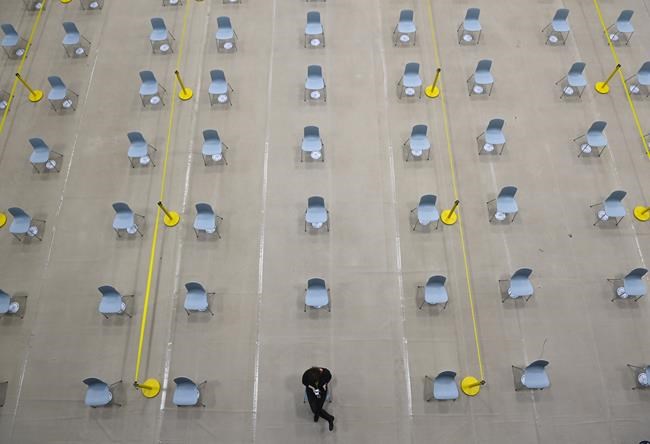
A person sits in the post vaccine waiting area at a mass COVID-19 vaccination clinic for Peel Region during the COVID-19 pandemic in Mississauga, Ont., on Monday, March 1, 2021. THE CANADIAN PRESS/Nathan Denette

There are no concerns that the vaccine is unsafe for use, but the National Advisory Committee on Immunization said this week that the vaccines from Pfizer-BioNTech and Moderna are preferred for seniors due to “suggested superior efficacy.”

Elliott said the Oxford-AstraZeneca shot is still a “very versatile” vaccine because it doesn’t have the same cold storage requirements as the other two.

As a result, the newly approved shot might be used in correctional facilities, she said, although she did not provide further details.

Canada is set to receive a half-million doses of the Oxford-AstraZeneca vaccine Wednesday, according to the federal procurement minister.

Elliott said an updated vaccination plan that factors in expected Oxford-AstraZeneca supply will be shared soon but the province is first awaiting federal guidance about potentially extending the interval of time between first and second doses of the Pfizer-BioNTech and Moderna vaccines to four months.

“There’s a lot that is in the mix right now, but we expect that to be finalized very shortly and we will be making a public announcement of the plan very soon,” Elliott said.

British Columbia announced Monday that it was implementing the four-month interval for doses.

Elliott said extending the time between doses would make a “considerable” difference in the vaccine rollout, but the government wants to make its decision based on scientific advice.

NDP Leader Andrea Horwath said the lack of clarity on the government’s vaccine distribution plan is troubling.

“Why isn’t the government being upfront, being clear, being transparent about what the plan is,” she said. “I don’t think the government is providing any of that information and Ontarians deserve to know.”

Ontario has so far focused on vaccinating the highest-priority groups, including long-term care residents and certain health-care workers.

The province has said it aims to start vaccinating residents aged 80 and older starting the third week of March, though the timeline is subject to change.

Some public health units, however, have moved ahead with vaccinations for the general population, starting with the 80 and older cohort. Those units are taking bookings for immunizations through their own web or phone systems as a provincial portal remains under development.

In London, Ont., the city’s top doctor said the health unit booked more than 5,000 appointments for seniors aged 80 and older within two hours of opening its booking system Tuesday morning.

“Tremendous response from the 80+ crowd!” Dr. Chris Mackie wrote on Twitter, adding that the phone line was “overwhelmed” with 145,000 calls.

In York Region, seniors lined up outside large vaccination sites for the second day in a row, many leaning on walkers or wheelchairs in the cold weather.

Hamilton and Guelph reported long wait times amid high call volumes as vaccines were made available to older residents.

The province, meanwhile, began testing its vaccine booking web portal in six public health units on Monday ahead of its full launch on March 15.

The Leeds, Grenville and Lanark District Health Unit said Tuesday that it was testing the portal with a small group of health-care workers already scheduled to be vaccinated.

“We are evaluating the results of this pilot to help inform further development of the system before it opens up for the community,” it said.

Participants were contacted through their employer and the health unit said it’s not yet making appointments for those in the 80 and older age cohort.

Ontario reported 966 more COVID-19 cases on Tuesday and 11 more deaths from the virus.

It has administered a total of 727,021 doses of a COVID-19 vaccine so far.

This report by The Canadian Press was first published March 2, 2021.

Report Error Submit a Tip

More Stories

Confidence vote was gamble for MLA, Tories: political expert

Alex Lambert 5 minute read Preview

Confidence vote was gamble for MLA, Tories: political expert

Alex Lambert 5 minute read Thursday, Oct. 1, 2026

BRANDON — A Progressive Conservative MLA’s decision to put forward a confidence motion against the party’s former leader carries a lot of risk for her and the Tories, a political science expert says.

Obby Khan resigned as leader of the PCs on Monday after Jodie Byram (Agassiz) initiated a confidence vote against him the previous week.

The majority of the PC caucus voted in favour of Khan, but he resigned a few days later, citing continued efforts to undermine him by a minority of MLAs.

Brandon University political science Prof. Kelly Saunders said while she doesn’t know what Byram’s motivations were for triggering the vote, such a move carries a lot of risk.

Read
Thursday, Oct. 1, 2026

Ontario won't use Oxford-AstraZeneca on seniors

Holly McKenzie-Sutter, The Canadian Press 4 minute read Preview

Ontario won't use Oxford-AstraZeneca on seniors

Holly McKenzie-Sutter, The Canadian Press 4 minute read Tuesday, Mar. 2, 2021

TORONTO - Ontario seniors won't receive the Oxford-AstraZeneca COVID-19 vaccine since there's limited data on its effectiveness in older populations, the province said Tuesday, but it remained unclear who those shots would go to.

Health Minister Christine Elliott said Ontario plans to follow the advice of a national panel that's recommended against using the newly approved vaccine on people aged 65 and older.

"Anyone over that age it’s recommended that they receive either the Pfizer or the Moderna vaccine," Elliott said.

There are no concerns that the vaccine is unsafe for use, but the National Advisory Committee on Immunization said this week that the vaccines from Pfizer-BioNTech and Moderna are preferred for seniors due to "suggested superior efficacy.''

Read
Tuesday, Mar. 2, 2021

May be whiff of truth to ex’s odour ardour

Maureen Scurfield 5 minute read 2:01 AM CDT

DEAR MISS LONELYHEARTS: I ran into an old boyfriend I used to curl on a team with, and we went for drinks. We’ve been almost eight years apart, and I couldn’t remember why we broke up, as we always had such a great time together.

It wasn’t until the second date — this time on a weekend — that it came back to me, with a jolt. Pee-yew! I remembered he doesn’t use deodorant on weekends. Why? He enjoys his own body odour. I recalled that a bit too late, and it was just as awful as ever! I went home early.

Tonight, he called and I refused him another date. I said, “Think back. You remember why we broke up?” Then he said, “Oh yeah, you hated my no-deodorant weekend policy. Well, guess what? Some women don’t mind!” I said I really doubted that, and that ended the conversation. Miss L., wouldn’t any women find stinky underarms offensive?

— Sensitive Nose, Fort Richmond

Clock ticks down on destruction of records documenting residential school abuses

Marsha McLeod 13 minute read Preview

Clock ticks down on destruction of records documenting residential school abuses

Marsha McLeod 13 minute read Yesterday at 12:49 PM CDT

In less than a year, a private company is set to destroy the largest cache of records detailing the widespread abuse of Indigenous children at residential schools in Canada.

The destruction, which was ordered by an Ontario court in 2014 and later upheld by the Supreme Court, is set to take place on Sept. 19, 2027.

This countdown is igniting emotional conversations that seek to balance the immense historical value of the records alongside the confidentiality survivors were promised as part of the process of providing detailed testimony about abuses they’d suffered.

The records were created as part of the Indian Residential Schools Settlement Agreement, a class-action settlement stemming from survivors who began suing the federal government in the late 1990s over the harm they’d been subjected to at residential schools.

Read
Yesterday at 12:49 PM CDT

Free Press staff 2 minute read 2:01 AM CDT

Advance voting for civic and school board elections begins next week.

Voters can cast early ballots for the Oct. 28 election in certain locations from Monday through Oct. 23.

Eligible voters can use their address to search for a convenient location.

Early votes can be cast at the council building at city hall (510 Main St.) every day, except weekends and Thanksgiving, from Monday to Oct. 23.

A day on the campaign trail: Winnipeg's mayor, seeking a second term, does double duty

Malak Abas 12 minute read Preview

A day on the campaign trail: Winnipeg's mayor, seeking a second term, does double duty

Malak Abas 12 minute read Updated: Yesterday at 5:56 PM CDT

In the weeks leading up to the civic election, Scott Gillingham has been performing a juggling act: he’s running to be Winnipeg’s 45th mayor, while still serving as its 44th.

“If someone asks me about the campaign, I’m going to answer them. But I think for most people, I’m the mayor of Winnipeg, even if I’m showing up as a candidate,” Gillingham, 58, says. “I try to do all I can to maintain that distinction.”

The Free Press joined Gillingham on a recent rainy September Saturday on the campaign trail, where he served in both roles during an event-laden day. City council’s final meeting before the Oct. 28 election was days earlier.

In Winnipeg, it’s rare for an incumbent to be defeated. But Gillingham knows his win in 2022 wasn’t exactly a landslide — he won with 27.5 per cent of the vote — and he’s been thinking about his second term ever since.

Read
Updated: Yesterday at 5:56 PM CDT