Nurses, nonprofits, others take vaccine to homebound people

Advertisement

Advertise with us

SAN FRANCISCO (AP) — For months, Victoria McAllister searched online to make a vaccination appointment. Unlike other people who can hop into a car, though, she has ruptured discs that could slice her spinal cord if she hits a pothole or her wheelchair bumps floor molding.

Read this article for free:


or

Already have an account? Log in here »

To continue reading, please subscribe:

Subscribe and receive a limited-edition Free Press branded hat or tote.

Digital Subscription

One year of digital access for only $205*

  • Enjoy unlimited reading on winnipegfreepress.com
  • Read the E-Edition, our digital replica newspaper
  • Access News Break, our award-winning app
  • Play interactive puzzles

*First annual payment billed as $205.00 + GST for one year. This annual subscription will automatically renew at $233.00 + GST every 52 weeks (10% off the regular annual price of $259.35). Offer available to new and qualified returning subscribers only. Cancel any time.

To continue reading, please subscribe:

Add Free Press access to your Brandon Sun subscription for only an additional

$1 for the first 4 weeks*

  • Enjoy unlimited reading on winnipegfreepress.com
  • Read the E-Edition, our digital replica newspaper
  • Access News Break, our award-winning app
  • Play interactive puzzles
Start now

*Your next Brandon Sun subscription payment will increase by $1.00 and you will be charged $17.95 plus GST for four weeks. After four weeks, your payment will increase to $24.95 plus GST every four weeks.

Hey there, time traveller!
This article was published 13/05/2021 (1969 days ago), so information in it may no longer be current.

SAN FRANCISCO (AP) — For months, Victoria McAllister searched online to make a vaccination appointment. Unlike other people who can hop into a car, though, she has ruptured discs that could slice her spinal cord if she hits a pothole or her wheelchair bumps floor molding.

So McAllister, 64, was over the moon when her local county health department in Hayward, California, called offering to inoculate her against COVID-19 at home. Two paramedics with Hayward Fire came last month, jabbed her arm with the one-dose Johnson & Johnson vaccine and stuck around to make sure she was alright.

“Absolutely blessed,” she said of how she felt after receiving her vaccination. As soon as they left, she called her doctors and passed along the county phone number with this message: “Call this number and get all your homebound patients to call this number.”
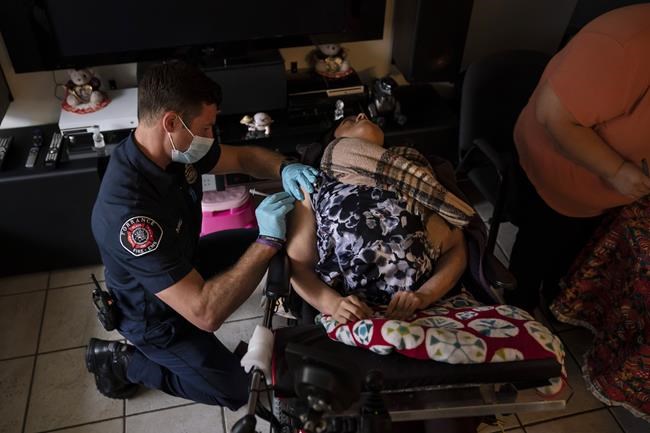
Torrance firefighter Trevor Borello, left, administers the second dose of the Pfizer COVID-19 vaccine to Barbara Franco, who suffers from muscular dystrophy, at her apartment, Wednesday, May 12, 2021, in Torrance, Calif. Teamed up with the Torrance Fire Department, Torrance Memorial Medical Center started inoculating people at home in March, identifying people through a city hotline, county health department, senior centers and doctor's offices, said Mei Tsai, the pharmacist who coordinates the program. (AP Photo/Jae C. Hong)

As interest in mass coronavirus vaccination sites dwindles nationwide, providers are ramping up efforts to find and reach millions of people in the U.S. who cannot leave their homes or who need help with transportation. The process is slow and requires careful planning, but advocates say getting vaccinated is critical for people who are constantly exposed to visiting aides — and that they should have been a focus sooner.

While the effort is happening in many states, experts say California has one of the most robust programs. Meanwhile, Pennsylvania is stepping up efforts, Gov. Tom Wolf said in April.

racing to inoculate patients since February. And New Jersey, under pressure from advocacy groups, recently posted a phone number and online form for people needing in-home vaccinations.

Elsewhere, the Visiting Nurse Association of Texas, which delivers hot meals to thousands of people in Dallas County, is partnering with the fire department to deliver about 60 in-home vaccinations a week.

Jennifer Atwood, managing director of development and communications for the Texas nonprofit, said a woman who survived brain cancer only to fear COVID-19 “was almost in tears” about getting the vaccine. Another client in her late 80s was persuaded to accept a vaccination after speaking with Atwood and others.

It’s hard to say just how many people are in the group. Harvard Medical School professor Dr. Christine Ritchie has said there are an estimated 2 million homebound adults in the U.S. and another 5 million who have trouble leaving their homes or require help to do so.

Inoculation efforts are scattered, and much depends on local officials and medical providers.

“California is one of the few states I’ve heard that’s doing anything in regards to that, like actually going out and vaccinating people in their homes,” said Kelly Buckland, executive director of the National Council on Independent Living, an advocacy group in Washington.
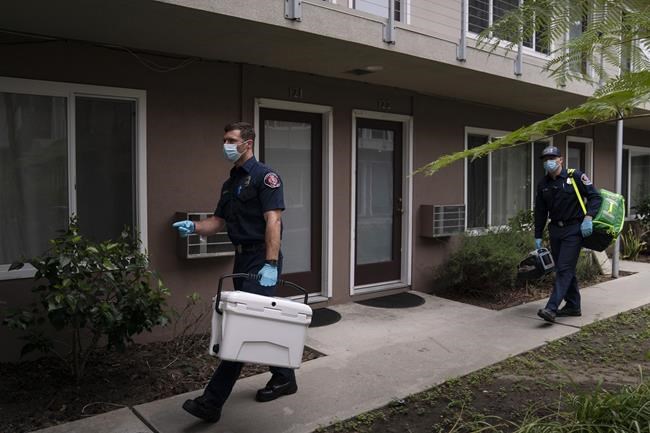
Torrance firefighter Trevor Borello, left, carries a cooler containing the Pfizer COVID-19 vaccine as he walks to an apartment to inoculate two sisters suffering from muscular dystrophy, Wednesday, May 12, 2021, in Torrance, Calif. Teamed up with the Torrance Fire Department, Torrance Memorial Medical Center started inoculating people at home in March, identifying people through a city hotline, county health department, senior centers and doctor's offices, said Mei Tsai, the pharmacist who coordinates the program. (AP Photo/Jae C. Hong)

He and others are frustrated that providers and government are just now starting to focus on that population.

“This was a problem we knew we were going to have,” said Caitlin Donovan, spokeswoman for the National Patient Advocate Foundation. “How are there not plans in place?”

In Los Angeles County, Torrance Memorial Medical Center started inoculating people at home in March, identifying people through a city hotline, county health department, senior centers and doctors offices, said Mei Tsai, a pharmacist who coordinates the program.

Socorro Franco-Martinez, 50, and her sister, Barbara Franco, 47, were vaccinated Wednesday. The sisters both have weakened lungs from muscular dystrophy and have stayed home for more than a year, tended to by Socorro’s husband, Martin Martinez.

The socially active sisters can’t wait to return to the beach, mall and Sunday Mass, as well as catch up on medical and dental visits.

“I don’t want to be here in the house forever,” said Barbara Franco. “After my COVID-19 shot, I can have a little freedom.”

Under federal guidelines, seniors in nursing homes and health care workers were prioritized when California began vaccinations in December. Homebound people were not in the spotlight.

“This is a group of people who, since the pandemic began last year, have been afraid for their lives and who were worried they would be left behind,” said Dr. Kathleen Clanon, medical director Alameda County’s Health Care Services Agency in the San Francisco Bay Area.
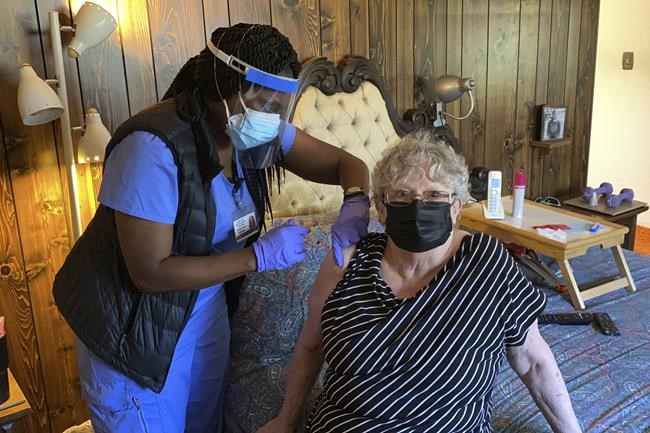
Alameda County nurse Devette Laflore administers a COVID-19 vaccine to Patti Amaral, 73, in the bedroom of her condominium in Hayward, Calif., May 6, 2021. Amaral, who suffers from severe sciatica and has difficulty walking, has not left the upper floor of her condominium since the pandemic began. As interest in vaccinations dwindles statewide and nationally, local health offices and other providers are ramping up efforts to find and reach millions of people in the U.S. who cannot leave their homes or who need help with transportation. (AP Photo/Terry Chea)

Last week, nurses Patricia Calloway and Devette Laflore wheeled carriers of vaccine and paperwork to several homes, including the Hayward condo of Patti Amaral, 73. She has severe sciatica and hasn’t left the upstairs for at least a year and a half.

The nurses stayed after the shots to monitor Amaral and her husband, John McFarland, who called their visit a treat.

“You’re both angels,” he told the nurses.

___

Associated Press video journalist Terence Chea contributed from Hayward, California.

Report Error Submit a Tip

More Stories

Broadening prediction-market gambling a bad idea

Editorial 4 minute read Preview

Broadening prediction-market gambling a bad idea

Editorial 4 minute read 2:01 AM CDT

Let’s make a prediction: sooner or later, when Canadian governments find a way to take their own cut of the action, prediction-contract gambling on everything from sports to entertainment to political decisions is going to come to Canada.

And that’s a horrible, dangerous, pernicious idea.

Unless you have particular access to information — either inside information or strategic information based on skills or education — you’re not likely to make money at it. In fact, structurally, you’re likely to lose. In prediction markets, you basically pay an amount, plus fees from the company involved, to bet on whether something will or will not happen within a certain time frame. The amount you pay for your contract depends on how other people are also betting.

As Wealthsimple describes it, “You buy whichever side you think is right. Prices move with demand, so if the market leans towards one outcome, the more that side costs. If a lot of people are backing the TSX to finish above 38,000, yes gets more expensive and no gets cheaper.”

Read
2:01 AM CDT

Letters, Oct. 3

7 minute read 2:01 AM CDT

A morning in the life …

My very first lesson does not start when I walk into that lecture hall, oh no — it starts long before. It begins when I walk to my car, check the estimated arrival time to the University of Manitoba and hope that Winnipeg traffic agrees with it.

A drive that appears completely manageable changes almost immediately when I’m greeted by a tsunami of orange pylons and a line of cars that appears to go on forever. Traffic moves by the inch, lanes magically disappear and the detour I took yesterday now has a detour of its own. These factors make me do a calculation that I have become all too familiar with. How late can I arrive and still find parking, run to my class across campus and get to class with enough time left to make it worth it?

I have grown used to people saying, “Why not just leave earlier?” I do. But when I’m already leaving for my 8:30 a.m. class at 7 a.m., there’s only so much I can do. This drive that some would think is relaxing is one that feels like an assignment that I didn’t know I had to complete and is due at 8:30 a.m.

A day on the campaign trail: Winnipeg's mayor, seeking a second term, does double duty

Malak Abas 12 minute read Preview

A day on the campaign trail: Winnipeg's mayor, seeking a second term, does double duty

Malak Abas 12 minute read Updated: Yesterday at 5:56 PM CDT

In the weeks leading up to the civic election, Scott Gillingham has been performing a juggling act: he’s running to be Winnipeg’s 45th mayor, while still serving as its 44th.

“If someone asks me about the campaign, I’m going to answer them. But I think for most people, I’m the mayor of Winnipeg, even if I’m showing up as a candidate,” Gillingham, 58, says. “I try to do all I can to maintain that distinction.”

The Free Press joined Gillingham on a recent rainy September Saturday on the campaign trail, where he served in both roles during an event-laden day. City council’s final meeting before the Oct. 28 election was days earlier.

In Winnipeg, it’s rare for an incumbent to be defeated. But Gillingham knows his win in 2022 wasn’t exactly a landslide — he won with 27.5 per cent of the vote — and he’s been thinking about his second term ever since.

Read
Updated: Yesterday at 5:56 PM CDT

Sisters relieved hospital takes accountability after mother’s death

Scott Billeck 5 minute read Preview

Sisters relieved hospital takes accountability after mother’s death

Scott Billeck 5 minute read Thursday, Oct. 1, 2026

Eight months after losing their mother, two Winnipeg sisters say an internal hospital review has finally given them something they had been seeking since her death: accountability.

Chelsea Mann and Samantha Burns said St. Boniface Hospital officials acknowledged mistakes were made in the care of their mother, Judy Burns, during a recent meeting to discuss the findings of a critical incident review into her death.

The acknowledgement marked a significant departure from an earlier meeting with hospital officials, when they felt their concerns were largely dismissed.

Burns, 68, died on Jan. 21, three days after being admitted, after experiencing rectal bleeding.

Read
Thursday, Oct. 1, 2026

Nearly four in 10 Manitobans hope Canada restarts trade talks after U.S. midterm elections, poll reveals

Gabrielle Piché 5 minute read Preview

Nearly four in 10 Manitobans hope Canada restarts trade talks after U.S. midterm elections, poll reveals

Gabrielle Piché 5 minute read Yesterday at 7:00 AM CDT

Disorganized — that’s what Marcus Langlois calls recent United States tariffs.

He expects suppliers’ prices to increase — on mugs, pens, hoodies — for his employer, Dreamcatcher Promotions, if the United States–Canada trade war persists.

Still, he’s not pining for a quick trade deal.

“I think it should wait,” said Langlois, Dreamcatcher Promotions’ vice-president. “Let’s hope that it’s later on with proper negotiations happening.”

Read
Yesterday at 7:00 AM CDT

Retired guidance counsellor defends explicit 2025 sex-ed presentation to high school football team in disciplinary hearing

Maggie Macintosh 7 minute read Preview

Retired guidance counsellor defends explicit 2025 sex-ed presentation to high school football team in disciplinary hearing

Maggie Macintosh 7 minute read Updated: Yesterday at 12:26 PM CDT

Gus Watanabe, a former employee of Oak Park High School in Winnipeg, was the subject of a public disciplinary hearing on Thursday.

Read
Updated: Yesterday at 12:26 PM CDT