G-7 leaders can’t sway Biden to delay Afghanistan withdrawal
Advertisement
Read this article for free:
or
Already have an account? Log in here »
To continue reading, please subscribe:

Digital Subscription
One year of digital access for only $205*
- Enjoy unlimited reading on winnipegfreepress.com
- Read the E-Edition, our digital replica newspaper
- Access News Break, our award-winning app
- Play interactive puzzles
*First annual payment billed as $205.00 + GST for one year. This annual subscription will automatically renew at $233.00 + GST every 52 weeks (10% off the regular annual price of $259.35). Offer available to new and qualified returning subscribers only. Cancel any time.
To continue reading, please subscribe:
Add Free Press access to your Brandon Sun subscription for only an additional
$1 for the first 4 weeks*
- Enjoy unlimited reading on winnipegfreepress.com
- Read the E-Edition, our digital replica newspaper
- Access News Break, our award-winning app
- Play interactive puzzles
*Your next Brandon Sun subscription payment will increase by $1.00 and you will be charged $17.95 plus GST for four weeks. After four weeks, your payment will increase to $24.95 plus GST every four weeks.
Read unlimited articles for free today:
or
Already have an account? Log in here »
Hey there, time traveller!
This article was published 24/08/2021 (1863 days ago), so information in it may no longer be current.
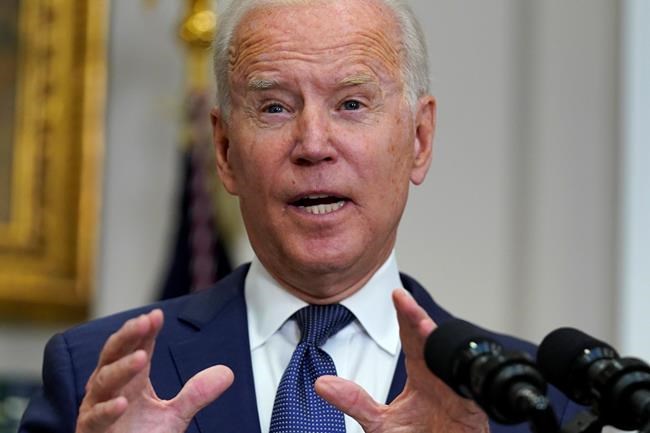
WASHINGTON (AP) — Sharply divided leaders of the Group of Seven industrialized democracies clashed Tuesday over U.S. President Joe Biden’s insistence on withdrawing from Afghanistan by August 31 in the face of the Taliban takeover of the country.
In a partial show of unity, G7 leaders agreed on conditions for recognizing and dealing with a future Taliban-led Afghan government, but there was palpable disappointment Biden could not be persuaded to extend the U.S. operation at the Kabul airport to ensure that tens of thousands of Americans, Europeans, other third-country nationals and all at-risk Afghans can be evacuated.
The virtual meeting of the leaders of Britain, Canada, France, Germany, Italy, Japan and the U.S. served not only as a bookend to the West’s 20-year involvement in Afghanistan that began as a response to the Sept. 11, 2001 terrorist attacks but also a resigned acknowledgment from European powers that the U.S. calls the shots.
“Our immediate priority is to ensure the safe evacuation of our citizens and those Afghans who have partnered with us and assisted our efforts over the past twenty years, and to ensure continuing safe passage out of Afghanistan,” the leaders said in a joint statement that did not address precisely how they would guarantee continuing safe passage without any military presence.
Going forward, the leaders said they would “judge the Afghan parties by their actions, not words,” echoing previous warnings to the Taliban not to revert to the strict Islamic form of government that they ran when they last held power from 1996 until the U.S.-led invasion that ousted them in 2001.
“In particular, we reaffirm that the Taliban will be held accountable for their actions on preventing terrorism, on human rights in particular those of women, girls and minorities and on pursuing an inclusive political settlement in Afghanistan,” the leaders said. “The legitimacy of any future government depends on the approach it now takes to uphold its international obligations and commitments to ensure a stable Afghanistan.”
Yet, individual leaders offered less sanguine descriptions of the meeting as well as the state of affairs in Afghanistan, which have dramatically changed since the bloc last met in Britain in June. At the time of that summit, Afghanistan had been almost an afterthought with the leaders more concentrated on the coronavirus pandemic, China and Russia. Although Biden had announced his plan for complete withdrawal from Afghanistan, the Cornwall meeting did not anticipate Taliban’s rapid takeover.
“I want to stress again that of course the United States of America has the leadership here,” German Chancellor Angela Merkel told reporters in Berlin after the meeting. “Without the United States of America, for example, we — the others — cannot continue the evacuation mission.”
“We will go on right up until the last moment that we can,” said British Prime Minister Boris Johnson, who had openly lobbied to keep the airport presence after Aug. 31. Johnson acknowledged he was unable to sway Biden to extend the U.S. military presence. “But you’ve heard what the president of the United States has had to say, you’ve heard what the Taliban have said,” he said.
A senior French official, speaking anonymously in accordance with the French presidency’s customary practices, said President Emmanual Macron had pushed for extending the Aug. 31 deadline but would “adapt” to the American sovereign decision. “That’s in the hands of the Americans,” he said.
On Monday, CIA chief William Burns met with Taliban leader Mullah Abdul Ghani Baradar in Kabul in talks in which the Taliban underscored they would not accept a U.S. military presence at the airport beyond Aug. 31.
And, just minutes after the G7 leaders finished their meeting on Tuesday, a White House official confirmed that Biden planned to stick to that date. Biden addressed the leaders for several minutes near the start of the meeting that lasted less than an hour, according to the White House.
Ahead of the meeting, British defense secretary Ben Wallace said he was doubtful that Biden would agree to extend the deadline. And Taliban spokesman Zabihullah Mujahid on Tuesday said his group would accept “no extensions” to the deadline.
Biden addressed the leaders for several minutes near the start of the meeting that lasted less than an hour, according to the White House. He was expected to deliver public remarks on Afghanistan later in the day.

The G-7 leaders were also joined by European Commission President Ursula von der Leyen, European Council President Charles Michel, United Nations Secretary-General António Guterres, and NATO Secretary General Jens Stoltenberg.
U.S. and European officials are increasingly concerned about Islamic State militants targeting their troops and Afghan civilians near the chaotic scene outside Kabul’s international airport.
The leaders put Afghanistan as number 57 out of 70 points in their final 25-page communique -– behind Ukraine, Belarus and Ethiopia. Afghanistan didn’t even feature in the one-and-a-half page summary of the document. NATO had already signed off on the U.S. withdrawal and all that appeared to be left was the completion of an orderly withdrawal and hopes for a peace deal between the Afghan government and Taliban.
___
AP writers Nomaan Merchant in Washington, Jonathan Lemire in Lowell, Mass., and Frank Jordans in Berlin, contributed to this report.
Related Articles
Federal minister Maryam Monsef calls Taliban ‘our brothers,’ stresses she views them as a terrorist group
Advertisement Advertise With Us
Advertisement Advertise With Us