Alberta introduces new rules, passport as COVID puts health system days from collapse

Advertisement

Advertise with us

Alberta Premier Jason Kenney, facing a COVID-19 crisis that is threatening to collapse its health system in just over a week, has reintroduced limits on gatherings along with elements of a vaccine passport system.

Read this article for free:


or

Already have an account? Log in here »

To continue reading, please subscribe:

Subscribe and receive a limited-edition Free Press branded hat or tote.

Digital Subscription

One year of digital access for only $205*

  • Enjoy unlimited reading on winnipegfreepress.com
  • Read the E-Edition, our digital replica newspaper
  • Access News Break, our award-winning app
  • Play interactive puzzles

*First annual payment billed as $205.00 + GST for one year. This annual subscription will automatically renew at $233.00 + GST every 52 weeks (10% off the regular annual price of $259.35). Offer available to new and qualified returning subscribers only. Cancel any time.

To continue reading, please subscribe:

Add Free Press access to your Brandon Sun subscription for only an additional

$1 for the first 4 weeks*

  • Enjoy unlimited reading on winnipegfreepress.com
  • Read the E-Edition, our digital replica newspaper
  • Access News Break, our award-winning app
  • Play interactive puzzles
Start now

*Your next Brandon Sun subscription payment will increase by $1.00 and you will be charged $17.95 plus GST for four weeks. After four weeks, your payment will increase to $24.95 plus GST every four weeks.

Hey there, time traveller!
This article was published 15/09/2021 (1831 days ago), so information in it may no longer be current.

Alberta Premier Jason Kenney, facing a COVID-19 crisis that is threatening to collapse its health system in just over a week, has reintroduced limits on gatherings along with elements of a vaccine passport system.

Alberta is also asking for help from other provinces to use their intensive care beds and staff while prepping its triage protocols, which would see doctors forced to choose who gets life-saving treatment and who does not.

The United Conservative government declared Wednesday a state of public health emergency.
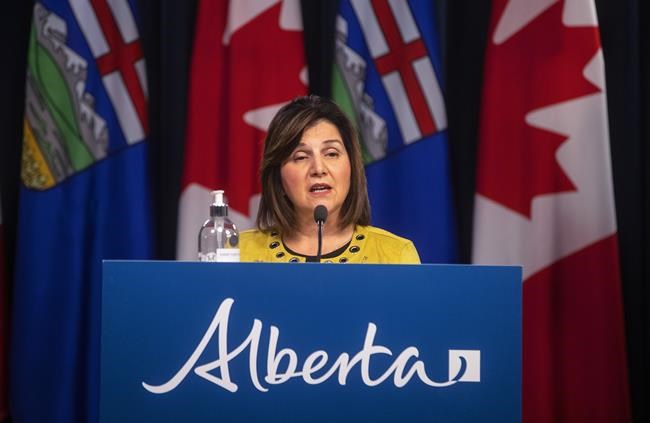
Alberta Education Minister Adriana LaGrange provides an update on COVID-19 and back-to-school guidance in Edmonton on Aug. 13, 2021. THE CANADIAN PRESS/Jason Franson

“We may run out of staff and intensive care beds within the next 10 days,” Kenney said.

“Unless we slow (virus) transmission, particularly amongst unvaccinated Albertans, we simply will not be able to provide adequate care to everyone who gets sick.”

Alberta has 269 patients in intensive care in a system set up for 173. Of the 269 patients in ICUs, 218 have COVID-19 — the vast majority unvaccinated or partially vaccinated.

There have been mass cancellations of non-urgent surgeries throughout the province — transplants, some cancer treatments and children’s surgeries, as staff are reassigned to COVID-19 care.

Dr. Verna Yiu, the head of Alberta Health Services, said the health system has never had so many people in intensive care at one time.

Triage has not been activated yet, she said, but staff are being briefed on rules and processes.

“If activated, the triage will be provincial in scope (and) applicable to all health facilities and critical care units in Alberta,” said Yiu.

Federal Health Minister Patty Hajdu said on Twitter that Ottawa is prepared to help.

“We’ll be there with ventilators, vaccines and people. In the meantime stay safe, get vaccinated and help each other.”

Alberta premier Jason Kenney shakes hands with Leela Aheer, Minister of Culture, Multiculturalism and Status of Women, after being sworn into office, in Edmonton on April 30, 2019. Aheer is calling on the premier to admit he botched the fourth wave of COVID-19 and to outline a plan to fix it. THE CANADIAN PRESS/Jason Franson

Alberta has more than 18,000 active COVID-19 cases, by far the highest in Canada.

It has been lagging on vaccinations, with less than 72 per cent of those 12 and older, who are eligible, fully immunized.

To stem transmission, Kenney’s government introduced an array of measures including a form of the vaccine passport.

Several provinces are bringing in the passports, which compel people to prove they have been vaccinated before being allowed to use non-essential services.

Kenney had resisted such measures for health privacy reasons. But critics said he did so to prevent a revolt by anti-restriction members of his caucus.

Kenney said he was reluctant to approve what he called, not a passport, but a “restriction exemption program.”

“With unvaccinated patients overwhelming now our hospitals, this is now the only responsible choice that we have,” he said.

Starting Sept. 20, people will need to show proof of vaccination to enter select non-essential businesses, including retail shops, restaurants, nightclubs, casinos, concerts and libraries.

However, businesses that opt out of the program can operate at reduced capacity and with distancing rules or restrictions. For example, restaurants not in the program are limited to outdoor dining with no more than six people at a table.

Alberta Premier Jason Kenney arrives for a press conference in Calgary, Friday, Sept. 3, 2021.THE CANADIAN PRESS/Todd Korol

There is a welter of other rules to reduce capacity at weddings, funerals and private social gatherings starting Thursday.

Mandatory work-from-home orders are also in place unless it’s essential a worker is on-site. Masking in schools, previously left to school boards, is now mandatory for students in Grade 4 and up, along with staff and teachers.

Opposition NDP Leader Rachel Notley said the necessary measures were sadly preventable.

“This is a crisis of this premier and his cabinet’s own making.”

She said Kenney pushed Alberta faster and harder than any other province and refused to act for weeks when it was obvious something had to be done.

“He refused to take responsibility. He blamed in fact low vaccination rates for the fact that he ignored the evidence and went into hiding.

“What we saw today from the premier was not an apology. It was an embarrassing attempt to duck responsibility.”

Kenney pushed back on suggestions that he and his government are to blame for the crisis. His government lifted nearly all health restrictions on July 1 despite warnings of the Delta variant. No action was taken through the summer as cases and hospitalizations soared.

At the time, Kenney triumphantly announced COVID-19 was on the wane and mocked reporters who warned of the Delta variant. He announced there was no Plan B for high hospitalization rates because the government didn’t foresee it happening.
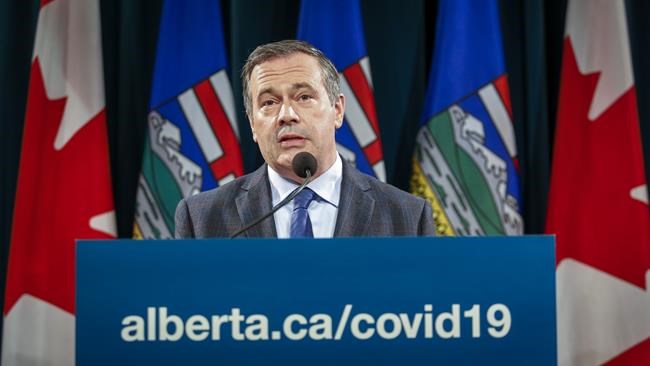
Alberta Premier Jason Kenney announces new COVID-19 measures for Alberta in Calgary, Wednesday, Sept. 15, 2021.THE CANADIAN PRESS/Jeff McIntosh

Earlier this week, the province’s chief medical health officer, Dr. Deena Hinshaw, acknowledged the decision to drop restrictions was wrong and that it lit the fuse on the skyrocketing caseload.

Kenney apologized for misreading COVID’s predicted path in June but said he wasn’t sorry for lifting all restrictions. He said he didn’t think a COVID-weary population would continue to follow them.

— With files from Alanna Smith in Calgary

This report by The Canadian Press was first published Sept. 15, 2021.

Note to readers: This is a corrected story. A previous version said restaurants that opt out of the vaccine program are limited to no more than six people at a table, but that is only for outdoor dining.

Report Error Submit a Tip

More Stories

Not good bet to shoulder gambling issue alone

Maureen Scurfield 5 minute read 2:01 AM CDT

DEAR MISS LONELYHEARTS: We’re living a lie over at our house, but it’s holding the family together.

I know my husband is deeply into gambling. If it weren’t for my steady job I don’t know where the family would be! I insist on paying all of our bills. I also funnel some major cash off to my sister, in case my husband tries to tap into my accounts somehow when I’m out of the house.

He doesn’t know my passwords, since I keep changing them, but he sometimes shows up behind me when I’m online, like he’s dying to ask something.

I say, “What are you looking at? Stop looking over my shoulder!” Then he makes a lame joke and goes away.

Puzzles Palace

1 minute read Monday, Jul. 27, 2026

To solve our puzzles, please subscribe with this special offer: |

Near-future U.S. the setting for surreal dual-world storyline

Reviewed by Morley Walker 4 minute read Preview

Near-future U.S. the setting for surreal dual-world storyline

Reviewed by Morley Walker 4 minute read 2:01 AM CDT

It’s not every day you encounter a seriously intended literary novel that attempts to dramatize a mind-bending physics theory like quantum entanglement.

But then the B.C.-born-and-raised Emily St. John Mandel is not your everyday Canadian literary writer.

In her late 40s, she has lived in the U.S. for her entire writing career. She is best known for her 2014 dystopian novel Station Eleven, about a Shakespearean acting troupe navigating a pandemic-ravaged America.

Her new outing, her seventh, Exit Party, shares DNA with detective and sci-fi genres more than with conventional literary fiction.

Read
2:01 AM CDT

A quick look at where provinces and territories stand on time changes

The Canadian Press 2 minute read Preview

A quick look at where provinces and territories stand on time changes

The Canadian Press 2 minute read Updated: Yesterday at 6:28 AM CDT

WINNIPEG - Manitoba's government said Thursday the province will be sticking with daylight time year-round, making it the latest jurisdiction to move away from twice-annual time changes. Here's a look at where things stand across Canada:

British Columbia said in March that it was moving to permanent Pacific daylight time. The change also means that parts of northeastern B.C., which have been on mountain standard time year round, are now in alignment with the rest of the province.

Alberta also switched to permanent daylight time this year in what it calls Alberta time. The change means it now has the same time as Saskatchewan year round.

Saskatchewan has been on permanent central standard time since 1966.

Read
Updated: Yesterday at 6:28 AM CDT

Desperate Poilievre wants Canadians to believe the sky is falling when it’s just cloudy outside

Tom Brodbeck 5 minute read Preview

Desperate Poilievre wants Canadians to believe the sky is falling when it’s just cloudy outside

Tom Brodbeck 5 minute read Yesterday at 12:47 PM CDT

Pierre Poilievre has a problem.

Canadians just don’t seem to be paying much attention to him anymore.

So, naturally, the Conservative Opposition leader has decided to turn up the volume.

At a recent party caucus retreat in Penticton, B.C., Poilievre delivered the familiar message: Canada is in trouble, Canadians are hurting and the Liberal government is making everything worse.

Read
Yesterday at 12:47 PM CDT

Cabernet Sauvignon star of wine festival

Ben Sigurdson 5 minute read Preview

Cabernet Sauvignon star of wine festival

Ben Sigurdson 5 minute read 3:00 AM CDT

The Winnipeg Wine Festival will celebrate the king of red wine grapes next weekend — the theme of this year’s festival, which takes place Sept. 25 and 26 at the RBC Convention Centre, is Cabernet Sauvignon.

Cab Sauv, as it’s also known, is the world’s most widely planted wine grape of any colour, first coming to prominence in the 1800s in France’s Bordeaux region, where the grape is still popular. Rather than single-variety wines, Bordeaux reds tend to be blends, with those coming from the left bank of the Gironde estuary being Cabernet-dominant, while right-bank wines are Merlot-dominant, with Cabernet Sauvignon playing a supporting role. Cabernet and Merlot work well together and many other countries have followed suit in blending the two.

A team at University of California Davis put Cabernet Sauvignon through a DNA test in 1996 and discovered its parent grapes are Cabernet Franc and Sauvignon Blanc — it’s likely that at some point the two varieties, planted next to each other in some vineyard, crossed and mutated and became the grape we know today. (Someone growing grapes in the 19th century must have had an inkling of what was up, as the grape has been called Cabernet Sauvignon since long before the DNA test.)

Flavour-wise, most Cabernet Sauvignon wines are big and bold, with a core of deep dark berry flavours, some graphite and spice notes and relatively bright acidity. It’s a grape that is well-suited to barrel aging, with most examples seeing at least some time in wood.

Read
3:00 AM CDT