
Nobel in chemistry honors ‘greener’ way to build molecules

Advertisement

Advertise with us

STOCKHOLM (AP) — Two scientists won the Nobel Prize in chemistry Wednesday for finding an ingenious and environmentally cleaner way to build molecules — an approach now used to make a variety of compounds, including medicines and pesticides.

Read this article for free:


or

Already have an account? Log in here »

To continue reading, please subscribe:

Subscribe and receive a limited-edition Free Press branded hat or tote.

Digital Subscription

One year of digital access for only $205*

  • Enjoy unlimited reading on winnipegfreepress.com
  • Read the E-Edition, our digital replica newspaper
  • Access News Break, our award-winning app
  • Play interactive puzzles

*First annual payment billed as $205.00 + GST for one year. This annual subscription will automatically renew at $233.00 + GST every 52 weeks (10% off the regular annual price of $259.35). Offer available to new and qualified returning subscribers only. Cancel any time.

To continue reading, please subscribe:

Add Free Press access to your Brandon Sun subscription for only an additional

$1 for the first 4 weeks*

  • Enjoy unlimited reading on winnipegfreepress.com
  • Read the E-Edition, our digital replica newspaper
  • Access News Break, our award-winning app
  • Play interactive puzzles
Start now

*Your next Brandon Sun subscription payment will increase by $1.00 and you will be charged $17.95 plus GST for four weeks. After four weeks, your payment will increase to $24.95 plus GST every four weeks.

Hey there, time traveller!
This article was published 06/10/2021 (1833 days ago), so information in it may no longer be current.

STOCKHOLM (AP) — Two scientists won the Nobel Prize in chemistry Wednesday for finding an ingenious and environmentally cleaner way to build molecules — an approach now used to make a variety of compounds, including medicines and pesticides.

The work of Benjamin List and David W.C. MacMillan has allowed scientists to produce those molecules more cheaply, efficiently, safely and with significantly less hazardous waste.

“It’s already benefiting humankind greatly,” said Pernilla Wittung-Stafshede, a member of the Nobel panel.
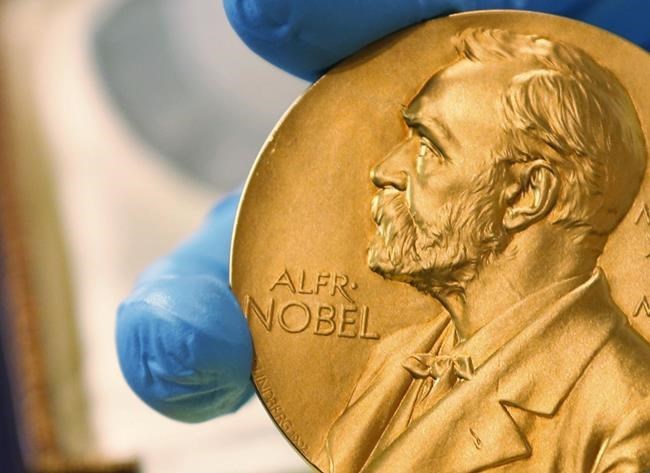
FILE - A April 17, 2015 file photo shows a gold Nobel Prize medal. The Nobel Prize for Chemistry will be announced on Wednesday Oct. 6, 2021. (AP Photo/Fernando Vergara, File)

It was the second day in a row that a Nobel rewarded work that had environmental implications. The physics prize honored developments that expanded our understanding of climate change, just weeks before the start of global climate negotiations in Scotland.

The chemistry prize focused on the making of molecules. That requires linking atoms together in specific arrangements, an often difficult and slow task. Until the beginning of the millennium, chemists had only two methods — or catalysts — to speed up the process, using either complicated enzymes or metal catalysts.

That all changed when List, of the Max Planck Institute in Germany, and MacMillan, of Princeton University in New Jersey, independently reported that small organic molecules can be used to do the job. The new tools have been important for developing medicines and minimizing drug manufacturing glitches, including problems that can cause harmful side effects.

Johan Åqvist, chair of the Nobel panel, called the method as “simple as it is ingenious.”

“The fact is that many people have wondered why we didn’t think of it earlier,” he added.

MacMillan said that winning the prize left him “stunned, shocked, happy, very proud.”

“I grew up in Scotland, a working-class kid. My dad’s a steelworker. My mom was a home help. … I was lucky enough to get a chance to come to America, to do my Ph.D.,” he said.

In fact, he said at a news conference in Princeton, he was planning to follow his older brother into physics, but the physics classes in college were at 8 a.m. in a cold and leaky classroom in rainy Scotland, while the chemistry courses were two hours later in warmer, drier spaces. As he told that story, he said he could hear his wife pleading with him not to share it.

His said the inspiration for his Nobel-winning work came when thinking about the dirty process of making chemicals — one that requires precautions he likened to those taken at nuclear power plants.

If he could devise a way of making medicines faster by completely different means that didn’t require vats of metal catalysts, the process would be safer for both workers and the planet, he reasoned.

List said he did not initially know MacMillan was working on the same subject and figured his own hunch might just be a “stupid idea” — until it worked. At that eureka moment, “I did feel that this could be something big,” the 53-year-old said.
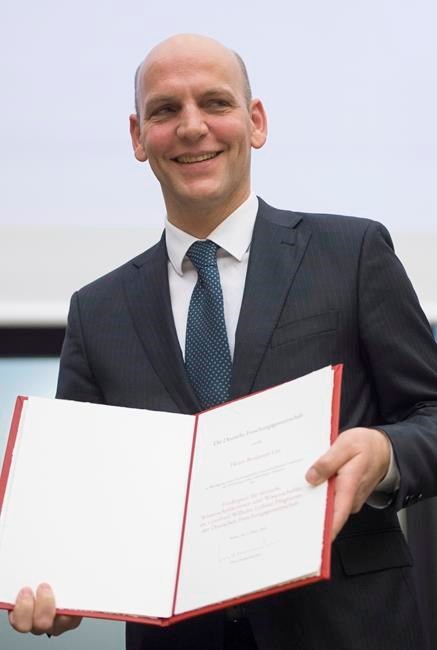
FILE - In this March 3, 2016 file photo Benjamin List, of the Max Planck Institute, smiles during an event in Berlin, Germany. Two scientists have won the Nobel Prize for chemistry for finding an “ingenious” new way to build molecules that can be used to make everything from medicines to food flavorings. Benjamin List of Germany and Scotland-born David W.C. MacMillan developed “asymmetric organocatalysis.” (Soeren Stache/dpa via AP, file)

H.N. Cheng, president of the American Chemical Society, said the laureates developed “new magic wands.”

Before the their work, “the standard catalysts frequently used were metals, which frequently have environmental downsides,” Cheng said. “They accumulate, they leach, they may be hazardous.”

The catalysts that MacMillan and List pioneered “are organic, so they will degrade faster, and they are also cheaper,” he said.

The Nobel panel noted that their contributions made the production of key drugs easier, including an antiviral and an anti-anxiety medication.

“One way to look at their work is like molecular carpentry,” said John Lorsch, director of the National Institute of General Medical Sciences at the U.S. National Institutes of Health.

“They’ve found ways to not only speed up the chemical joining,” he said, “but to make sure it only goes in either the right-handed or left-handed direction.”

The ability to control the orientation in which new atoms are added to molecules is important. Failing to do so can result in side effects in drugs, the Nobel panel explained, citing the catastrophic example of thalidomide, which caused severe birth defects in children.

Since the scientists’ discovery, the tool has been further refined, making it many times more efficient.

Peter Somfai, another member of the committee, stressed the importance of the discovery for the world economy.

“It has been estimated that catalysis is responsible for about 35% of the world’s GDP, which is a pretty impressive figure,” he said. “If we have a more environmentally friendly alternative, it’s expected that that will make a difference.”

The NIH supported List’s research with a grant in 2002. MacMillan’s work has received funding from NIH since 2000, for a total of around $14.5 million to date.

German scientist Benjamin List drinks champagne as arrives at the Max-Planck-Institute for Coal Research in Muelheim, Germany, Wednesday, Oct. 6, 2021. Two scientists have won the Nobel Prize for chemistry for finding an
German scientist Benjamin List drinks champagne as arrives at the Max-Planck-Institute for Coal Research in Muelheim, Germany, Wednesday, Oct. 6, 2021. Two scientists have won the Nobel Prize for chemistry for finding an "ingenious" new way to build molecules that can be used to make everything from medicines to food flavorings. Benjamin List of Germany and Scotland-born David W.C. MacMillan developed "asymmetric organocatalysis." (AP Photo/Martin Meissner)

“It’s a great example of supporting basic science that you don’t necessarily know where it’s going to go” but can have major impact, said Francis Collins, NIH director.

The Nobel comes with a gold medal and 10 million Swedish kronor,, or more than $1.14 million. The money comes from a bequest left by the prize’s creator, Swedish inventor Alfred Nobel, who died in 1895.

Over the coming days, Nobels will be awarded in literature, peace and economics.

___

Jordans reported from Berlin and Larson from Washington. Associated Press journalists Mike Corder in Amsterdam and Ted Shaffrey in Princeton, New Jersey, contributed.

___

Read more stories about Nobel Prizes past and present at https://www.apnews.com/NobelPrizes.

Report Error Submit a Tip

More Stories

A question of public utility

Tom Pearson 5 minute read 2:00 AM CDT

The editorial page of the Free Press often provides perspectives that are thought-provoking and sometimes contradictory. Keeping the lights on, (Oct. 5) by Hal Turner and Wasteful operations should be held accountable, (Oct. 6) by Barry Prentice are both thought-provoking. They are not contradictory because they cover two quite different topics. Where they differ is in their delivery and the quality of the underlying facts.

Mr. Turner provides what is, in my view, the most cogent rationale for gas-fuelled generation that I have read. He highlights the essential aspect of power supply to Manitobans. He supports the argument for natural gas generation with succinct, relatable facts and anecdotes relating to what other comparable utilities have done. He states that, “Manitoba Hydro’s experts are neither anti-wind nor pro-fossil fuel.” They are simply seeking the best possible solution for Manitobans — a fact many special-interest groups either ignore or sadly, impugn.

Although some would argue the contrary, I believe that Mr. Turner’s position and longevity in the Manitoba Hydro organization lend gravitas to his column. Mr. Turner understands that “keeping the lights on” is a non-negotiable requirement and a public trust.

Before I turn to Mr. Prentice’s column, I should disclose that before I retired (it’s been a while), I was responsible at different times for Winnipeg’s regional water system and subsequently water supply from source to tap. In that context I was also responsible for the operation of the Greater Winnipeg Water District (GWWD) railway. Like Mr. Turner’s perspective on the supply of electricity to Manitobans, I regard the supply of safe drinking water to Winnipeggers as a public trust.

Creatures’ comfort key to coping with loss

Maureen Scurfield 4 minute read 2:00 AM CDT

DEAR MISS LONELYHEARTS: Not long ago I lost my husband to illness at far too young an age. My spouse was a great guy, but I do want another one.

I just want to pass on a little tip. When my husband was dying, he encouraged me to bring home warm and loving pets to our acreage just outside the city. They were my saviours when my husband was ill.

Since he has died, they continue to help me keep warm, happy and affectionate. They were my greatest comfort in the later stages when my man was in too much pain to hold me or be held. The cats and the dog would welcome me home from the hospital and transfer their cuddling to me, giving me all the attention I needed, and I always felt so loved.

I have been dating a fair bit for a fairly recent widow because I’m ready to be held and loved, and I feel my husband and the pets saying, “Way to go.”

Hydro’s unpredictable fortunes

Editorial 4 minute read Preview

Hydro’s unpredictable fortunes

Editorial 4 minute read 2:00 AM CDT

Hope for rain. Or snow. Or both. There’s a truism buried deep in a financial outlook in Manitoba Hydro’s 2025-26 annual report, released in late September: “Manitoba Hydro’s net income is highly dependent on several uncontrollable factors.”

Read
2:00 AM CDT

Manitoba e-scooter legislation changes set to impose speed limit, age restrictions, sidewalk ban

Matthew Frank 5 minute read Preview

Manitoba e-scooter legislation changes set to impose speed limit, age restrictions, sidewalk ban

Matthew Frank 5 minute read Updated: 11:26 AM CDT

People riding e-scooters and other personal electric vehicles in Manitoba will have to strap on a helmet, stay off sidewalks and follow new age limits once new provincial rules for the devices take effect next year.

The vehicles, which also include electric skateboards, hoverboards and unicycles, will fall under The Highway Traffic Act starting in 2027, according to the province’s website. E-bikes are excluded from the new rules, according to the province’s frequently-asked-questions page.

All riders must be at least 16 years old and wear properly fitting helmets — that goes for passengers, too, the province said.

The proposed new legislation sets a speed limit of 25 km/h and would prohibit personal electric vehicles from sidewalks unless signs specifically allow sidewalk use. Riders would be using shared paths or roads with speed limits of 50 km/hr or less. They won’t be allowed to operate the vehicles under the influence of alcohol or drugs and they must use hand signals and obey traffic signs.

Read
Updated: 11:26 AM CDT

Israel and Palestine: 30 wasted years

Gwynne Dyer 5 minute read 2:00 AM CDT

Here is how the high command of the Israel Defence Forces (IDF) laid down the rules for “remotely” killing suspected Palestinian activists in the densely populated Gaza Strip after the surprise Hamas attack on Israel on Oct. 7, 2023.

Puzzles Palace

1 minute read Monday, Jul. 27, 2026

To solve our puzzles, please subscribe with this special offer: |
