Testing better than travel ban ‘whack-a-mole,’ infectious disease specialist says

Advertisement

Advertise with us

OTTAWA - An Ontario infectious disease specialist says there is evidence testing all travellers before and after they arrive in Canada will identify most cases of COVID-19 coming into the country.

Read this article for free:


or

Already have an account? Log in here »

To continue reading, please subscribe:

Subscribe and receive a limited-edition Free Press branded hat or tote.

Digital Subscription

One year of digital access for only $205*

  • Enjoy unlimited reading on winnipegfreepress.com
  • Read the E-Edition, our digital replica newspaper
  • Access News Break, our award-winning app
  • Play interactive puzzles

*First annual payment billed as $205.00 + GST for one year. This annual subscription will automatically renew at $233.00 + GST every 52 weeks (10% off the regular annual price of $259.35). Offer available to new and qualified returning subscribers only. Cancel any time.

To continue reading, please subscribe:

Add Free Press access to your Brandon Sun subscription for only an additional

$1 for the first 4 weeks*

  • Enjoy unlimited reading on winnipegfreepress.com
  • Read the E-Edition, our digital replica newspaper
  • Access News Break, our award-winning app
  • Play interactive puzzles
Start now

*Your next Brandon Sun subscription payment will increase by $1.00 and you will be charged $17.95 plus GST for four weeks. After four weeks, your payment will increase to $24.95 plus GST every four weeks.

Hey there, time traveller!
This article was published 03/12/2021 (1745 days ago), so information in it may no longer be current.

OTTAWA – An Ontario infectious disease specialist says there is evidence testing all travellers before and after they arrive in Canada will identify most cases of COVID-19 coming into the country.

McMaster University physician Dr. Zain Chagla is highly critical of Canada’s plan to try and slow the spread of the new Omicron variant by banning travellers from 10 African nations only, and said testing, not travel bans, is a less harmful and more effective mitigation strategy.

“Look, I don’t think we’re going to be able to shut our border to this variant,” Chagla said.
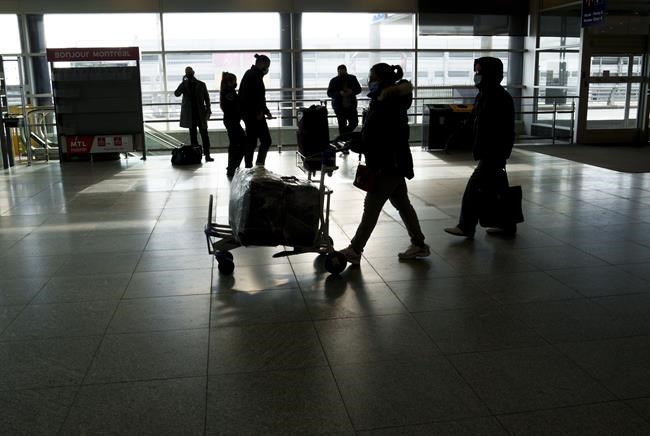
Passengers make their way through Montreal-Trudeau airport in Montreal, on Wednesday, December 1, 2021. THE CANADIAN PRESS/Paul Chiasson

He points to the fact in the early days of the pandemic most focus was on paying extra attention to travellers from China, but for Canada, the majority of early cases came in from Iran, the United States, Europe and Egypt.

And he says a study done in Canada in September and October 2020 found 1.5 per cent of international travellers were testing positive for COVID-19, and two-thirds of those were identified by testing them at the airport when they arrived. Another 27 per cent were picked up by testing a week later. Only six per cent tested positive two weeks later.

He said if you test people a few days before they leave, that helps lower the risk people on planes have COVID-19, and if you test when they land and pick up two in every three travel cases, that will go a long way toward mitigating the spread of new cases coming into Canada.

Canada is starting to test many international air travellers upon arrival, but Health Minister Jean-Yves Duclos said Friday — days after the new measures were first announced — it’s still not happening everywhere.

“It will take a few days before we are able to test all targeted travellers but we are ramping up our capacity quickly and testing more and more travellers every day,” Duclos said at a news conference.

He said since Wednesday testing had expanded by 60 per cent, but not every airport is testing all international travellers yet due to problems finding space in airports to do the tests and lab capacity to process them, as well as human resource limitations.

Travellers who were in the United States are still exempt from the policy, though people arriving from somewhere else via the U.S. will still be affected.

Duclos also defended Canada’s decision to ban travel from 10 African countries as a way to slow the spread of the variant while other measures take hold.

“We knew from the start that it would eventually occur in almost all our countries,” he said.

The World Health Organization said Friday 38 countries have now reported at least one case.

He said that’s why the universal measure to test international air travellers is being implemented. But in the meantime he said it was important to try and stop most incoming travel from countries which, even if they hadn’t identified Omicron, were showing signs of high rates of overall transmission, and where there is limited local testing capacity.

Chief public health officer Dr. Theresa Tam said Canada was finding that travellers coming from Nigeria and Egypt, for example, were more likely to test positive for COVID-19 than those coming from elsewhere.

She said the testing being done is going to help Canada spot any trends if there are countries that are a bigger risk than others, and that will help inform Canada’s plans going forward.

“We do have to re-examine these measures almost every day,” she said. “I think we need to be flexible and if the situation changes, we don’t think this list is applicable for example, we need to prepare to scale it down or up.”

The world learned about Omicron just a week ago, after South Africa publicized data identifying the presence of a new variant spreading there.

The variant has multiple mutations from other known versions of the virus that causes COVID-19 raising concerns that it might find ways around existing vaccines. It is believed to be transmitted more easily but whether it causes more severe illness is still not known.

But Chagla said playing “whack-a-mole” with travel bans affecting only some countries is based on political expediency, not science.

“It was reactive,” Chagla said Friday in an interview with The Canadian Press. “I think as countries started pulling the trigger other countries started pulling the trigger and showing their population that they were doing something about it.”

This report by The Canadian Press was first published Dec. 3, 2021.

Report Error Submit a Tip

More Stories

A life's story: ‘Ivor the Driver’ found his calling in the ranching life

Aaron Epp 7 minute read Preview

A life's story: ‘Ivor the Driver’ found his calling in the ranching life

Aaron Epp 7 minute read Updated: 9:59 AM CDT

Ivor Asham’s family couldn’t have picked a better image to accompany his obituary. There he is, riding Flash, his beloved brown and white quarter horse, a black cowboy hat on his head and a drink in his hand.

Asham owned and operated Birds Hill Park Ranch for nearly 35 years, where he shared his lifelong passion for horses with thousands of visitors. He moved hay, harnessed horses and drove the wagons, introducing himself as “Ivor the Driver.”

Over the years, Asham built a reputation as the quintessential cowboy.

There’s a restaurant at the ranch filled with memorabilia that he collected over the years. Calgary Stampede posters, cowboy boot-shaped shot glasses, a child’s rocking horse, a wagon wheel and numerous photos of legendary actor John Wayne are just some of the items that line the walls.

Read
Updated: 9:59 AM CDT

Chrétien says Canada bows to no one in fiery address at 9/11 commemoration

Sarah Smellie, The Canadian Press 6 minute read Preview

Chrétien says Canada bows to no one in fiery address at 9/11 commemoration

Sarah Smellie, The Canadian Press 6 minute read Updated: Yesterday at 8:15 PM CDT

GANDER - Former prime minister Jean Chrétien drew a standing ovation inside a Gander, N.L., hockey arena on Friday as he delivered a pointed message to American leaders during a ceremony marking the 9/11 terrorist attacks in the United States, 25 years ago.

The 92-year-old warned Americans never to mistake Canadian generosity for weakness, nor its kindness for softness.

U.S. Ambassador Pete Hoekstra looked on as Chrétien insisted his pointed words were a sign of friendship. Friends tell each other the truth, he said.

“We embraced our friends and we helped them in their moment of need, but we bow to no one,” Chretien said, as the crowd erupted again.

Read
Updated: Yesterday at 8:15 PM CDT

Citizen reports help highlight connectivity issues across southwest Manitoba

Nicole Buffie 5 minute read Preview

Citizen reports help highlight connectivity issues across southwest Manitoba

Nicole Buffie 5 minute read Updated: 10:43 AM CDT

A southwestern Manitoba man has created a map to document cell service blackout spots in an effort to push for better access in rural areas.

Mark Custance compiled more than 300 citizen reports over the last few months to document where service in southwest Manitoba is strong, spotty or doesn’t exist at all.

“I’ve heard people complain and say, ‘cell service sucks’ or ‘this is not working.’ But what does the data actually say?” Custance said from his office in Melita, where he has installed a cell-service booster to maintain connectivity with the rest of the world.

Analyzing where service is good and poor, he cross-references it with the location of cellphone towers across the region.

Read
Updated: 10:43 AM CDT

Drug recovery centre opens office in ‘heart of the city’

Morgan Modjeski 4 minute read Preview

Drug recovery centre opens office in ‘heart of the city’

Morgan Modjeski 4 minute read 3:38 PM CDT

Richard Halverson found his freedom from addiction through Adult & Teen Challenge and, six years later, he hopes a new Winnipeg location will bring hope to the city.

Dozens gathered Saturday morning to mark the grand opening of the recovery centre’s community services office on Main Street.

Located inside the former Wojcik funeral home, the bright-white building — which was also formerly a liquor store — will serve as an access point for people fighting drug addiction. That includes connecting them to addictions support, housing and training.

“For me, I always start with: ‘What’s your story?’” said Halverson, who now works for the faith-based organization.

Read
3:38 PM CDT

Downtown no place to be after dark, huge majority of Winnipeggers say in survey

Joyanne Pursaga 8 minute read Preview

Downtown no place to be after dark, huge majority of Winnipeggers say in survey

Joyanne Pursaga 8 minute read Updated: Yesterday at 7:22 PM CDT

Most Winnipeggers are afraid to walk alone downtown and believe the city needs more police officers, a new survey finds.

Winnipeg Police Service released its 2026 citizen survey Friday.

Downtown safety appears to remain a major concern, with just 44 per cent saying they feel very or reasonably safe walking alone in the area during the day. The number plummets to eight per cent overall at night, down from nine per cent in 2024, the last time the survey was conducted.

This year, 14 per cent of men felt very or reasonably safe walking alone downtown at night, compared to just three per cent of women.

Read
Updated: Yesterday at 7:22 PM CDT

Artist’s inspired work brings Red River Métis story back to Portage and Main

Conrad Sweatman 8 minute read Preview

Artist’s inspired work brings Red River Métis story back to Portage and Main

Conrad Sweatman 8 minute read Updated: Yesterday at 2:47 PM CDT

Jennine Krauchi calls them the “grandmothers.” “They speak to you very silently. You never hear a word, but they speak,” Krauchi says, referring to the antique pieces of Métis needlework she’s carefully studied for years. But there are few precedents for her latest art project: a 85-foot-wide by 32-foot-high chain curtain of Métis needlework that drapes over the historic Bank of Montreal’s neoclassical facade.

Read
Updated: Yesterday at 2:47 PM CDT