Ontario could see 3,000 cases, nearly 400 in ICU in Jan even without variant: experts
Advertisement
Read this article for free:
or
Already have an account? Log in here »
To continue reading, please subscribe:

Digital Subscription
One year of digital access for only $205*
- Enjoy unlimited reading on winnipegfreepress.com
- Read the E-Edition, our digital replica newspaper
- Access News Break, our award-winning app
- Play interactive puzzles
*First annual payment billed as $205.00 + GST for one year. This annual subscription will automatically renew at $233.00 + GST every 52 weeks (10% off the regular annual price of $259.35). Offer available to new and qualified returning subscribers only. Cancel any time.
To continue reading, please subscribe:
Add Free Press access to your Brandon Sun subscription for only an additional
$1 for the first 4 weeks*
- Enjoy unlimited reading on winnipegfreepress.com
- Read the E-Edition, our digital replica newspaper
- Access News Break, our award-winning app
- Play interactive puzzles
*Your next Brandon Sun subscription payment will increase by $1.00 and you will be charged $17.95 plus GST for four weeks. After four weeks, your payment will increase to $24.95 plus GST every four weeks.
Read unlimited articles for free today:
or
Already have an account? Log in here »
Hey there, time traveller!
This article was published 07/12/2021 (1758 days ago), so information in it may no longer be current.
TORONTO – Ontario’s pandemic advisers predict the province’s hospitals may be strained by mid-January, with close to 400 COVID-19 patients in intensive care and possibly 3,000 new infections reported daily, even without accounting for the new Omicron variant.
The projections from the COVID-19 Science Advisory Table issued Tuesday note that the variant’s impacts could be “substantial,” though its characteristics aren’t yet known.
The group called for increased vaccination and public health measures to reduce transmission, while Ontario’s top doctor maintained that more data is needed before deciding whether to bring in provincewide measures to contain spread.
Dr. Allison McGeer, a member of the science table, said the predicted trends are the result of exponential case growth that began in October and accelerated as cases multiplied.
“It will start to get worse more quickly,” she said in an interview, as Ontario reported 928 new COVID-19 cases and nine virus deaths Tuesday.
The projections don’t factor in the possibility of increased socialization over the holiday season. McGeer said that makes the scenario predicting 3,000 daily cases the most “realistic” outcome based on the current situation.
That scenario, which also said 400 patients could be in intensive care, was based on the assumption that residents maintain their current behaviour and 30 per cent of children aged five to 11 are vaccinated by the end of December.
Another scenario with no change in behaviour and 50 per cent of young children vaccinated predicted 1,750 daily cases by mid-January and 300 patients in intensive care.
A third scenario with a 15 per cent decrease in transmission through more public health measures pegs the mid-January daily case count at just over 1,000 and 250 patients in intensive care.
To get to that level of decreased transmission, McGeer said everyone would need to reduce their contacts from social gatherings, work, transit and recreation. That could mean cutting back on holiday parties or reintroducing capacity limits on some high-risk settings like restaurants and gyms.
Some health units have already taken such measures in response to rising cases, which McGeer said can be effective.
But she also pointed out that cases are rising in most public health units and a provincewide approach could avoid repeating scenarios from earlier in the pandemic, when people travelled between regions that had different public health measures to gain access to certain settings.
Dr. Kieran Moore, the province’s chief medical officer of health, said the projections were “disconcerting,” as was the rise in cases and the predicted impact on the health system.
But he declined to name any public health measures he would recommend for the entire province to get ahead of the projections, pointing instead to regional restrictions being imposed in health units where infections are high.
“We’re really having to try to put fires out where they come up,” he said.
The science table said intensive care occupancy will increase over the coming weeks, “likely exceeding” 250 patients by the end of December without accounting for the Omicron variant, of which at least 21 cases had been confirmed as of Tuesday morning.
The provincial government said Tuesday that Ontario can “safely admit” approximately 300 critically ill COVID-19 patients without risking urgent surgery capacity, with capacity to add more spaces.
McGeer said the government’s 300 figure is reasonable, but the province’s ongoing health-care worker shortage is going to be the biggest challenge.
There were 165 people in intensive care with COVID-19 related critical illness as of Tuesday including 95 people on ventilators.
The science table’s projections came as the Progressive Conservative government faces calls to decide whether to keep proof-of-vaccination requirements in place for certain venues after Jan. 17 – a tentative date it set to begin lifting those rules.
Health Minister Christine Elliott said the province is waiting for “final data” on the Omicron variant and advice from top medical advisors before deciding to pause that plan, with more information expected in the next week.
Moore wouldn’t commit to a date at which he would make his recommendation to government, aside from saying he would advise keeping proof-of-vaccination rules “if our cases continue to rise through and after the holidays.”
“If there is a decrease in risk, we could make the recommendation to leave it up to the private business,” he said.
David Earn, co-chair of the science table’s modelling consensus group, said he understands the hesitation of decision makers who are balancing disease projections with other factors but encouraged caution on the province’s part.
“All the indications are that we need to be more cautious, and opening further and encouraging more contact would not be good,” he said, adding that residents should give thought to their activities over the holidays.
Also on Tuesday, the government said it wouldmaintain a pause on lifting capacity rules in certain setting, including nightclubs, event spaces with dancing, strip clubs and sex clubs.
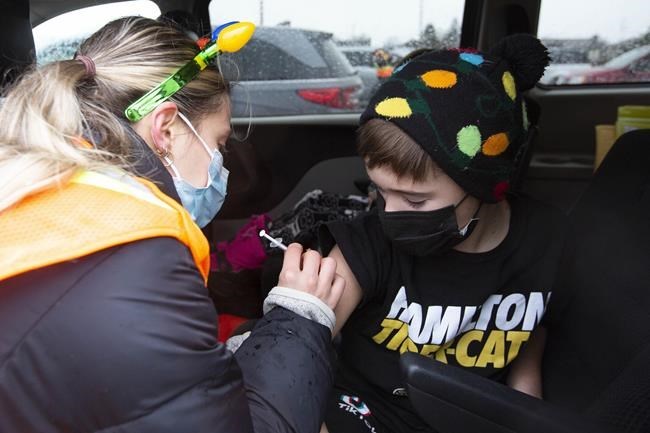
The province reported 80 per cent of residents aged five and older were fully vaccinated against COVID-19 as of Tuesday, noting that 22 per cent of children between five to 11 had received their first doses.
This report by The Canadian Press was first published Dec. 7, 2021.