Shanghai lockdown triggers complaints as COVID cases rise

Advertisement

Advertise with us

BEIJING (AP) — COVID-19 cases in China’s largest city of Shanghai are still rising with millions isolated at home under a sweeping lockdown, as the draconian “zero tolerance” approach to the pandemic increasingly draws complaints from residents fed up with the restrictions.

Read this article for free:


or

Already have an account? Log in here »

To continue reading, please subscribe:

Subscribe and receive a limited-edition Free Press branded hat or tote.

Digital Subscription

One year of digital access for only $205*

  • Enjoy unlimited reading on winnipegfreepress.com
  • Read the E-Edition, our digital replica newspaper
  • Access News Break, our award-winning app
  • Play interactive puzzles

*First annual payment billed as $205.00 + GST for one year. This annual subscription will automatically renew at $233.00 + GST every 52 weeks (10% off the regular annual price of $259.35). Offer available to new and qualified returning subscribers only. Cancel any time.

To continue reading, please subscribe:

Add Free Press access to your Brandon Sun subscription for only an additional

$1 for the first 4 weeks*

  • Enjoy unlimited reading on winnipegfreepress.com
  • Read the E-Edition, our digital replica newspaper
  • Access News Break, our award-winning app
  • Play interactive puzzles
Start now

*Your next Brandon Sun subscription payment will increase by $1.00 and you will be charged $17.95 plus GST for four weeks. After four weeks, your payment will increase to $24.95 plus GST every four weeks.

Hey there, time traveller!
This article was published 02/04/2022 (1645 days ago), so information in it may no longer be current.

BEIJING (AP) — COVID-19 cases in China’s largest city of Shanghai are still rising with millions isolated at home under a sweeping lockdown, as the draconian “zero tolerance” approach to the pandemic increasingly draws complaints from residents fed up with the restrictions.

Health officials on Sunday reported 438 confirmed cases over the previous 24 hours, along with 7,788 asymptomatic ones. Both figures were up slightly from the day before, while the northeastern province of Jilin posted a combined 4,455 cases Sunday, also marking an increase from Saturday.

While small by the standards of some countries, the daily increases are some of the largest since the virus was first detected in the central city of Wuhan in late 2019.
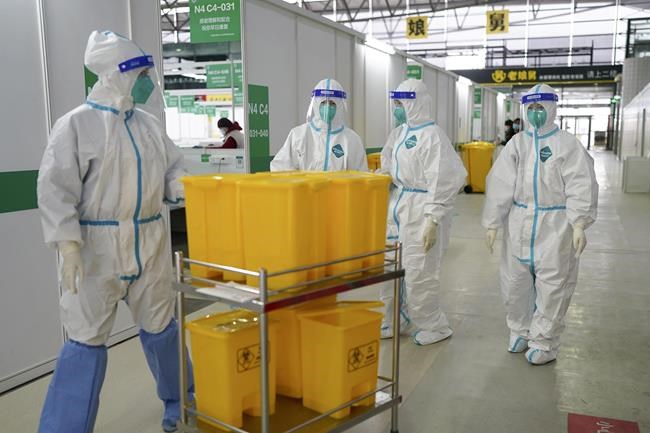
In this photo released by China's Xinhua News Agency, medical workers in protective suits walk at the Shanghai New International Expo Center, which has been converted to a quarantine facility for people with mild and symptomatic cases of COVID-19, in Shanghai, Friday, April 1, 2022. (Xinhua via AP)

Shanghai with its 26 million people last week began a two-stage lockdown, with residents of the eastern Pudong section supposed to be allowed to leave their homes Friday, while their neighbors in the western Puxi section underwent their own four-day isolation period.

Despite that assurance, millions in Pudong continue to be confined to their homes amid complaints over food deliveries and the availability of medications and health services.

Notices delivered to residents said they were required to self-test for COVID-19 daily and take precautions including wearing masks at home and avoiding contact with family members — measures not widely enforced since the early days of the pandemic.

While Wuhan endured a 76-day lockdown in 2020 with relatively little complaint, Shanghai residents — many of whom were in isolation even before last week’s lockdown began — appear to be growing increasingly fed up with the measures and methods being used to enforce them.

Although coverage in China’s entirely state-controlled media remains overwhelmingly positive, complaints have been appearing online, including in the form of videos and sound recordings purporting to show heavy-handed practices by officials and volunteers and alleging that sound medical advice has been ignored in favor of political expediency.

“Whereas there was little societal resistance to the lockdown once it was imposed in Wuhan, resistance in Shanghai is palpable now,” Dali Yang, a professor of political science at the University of Chicago tweeted on Sunday.
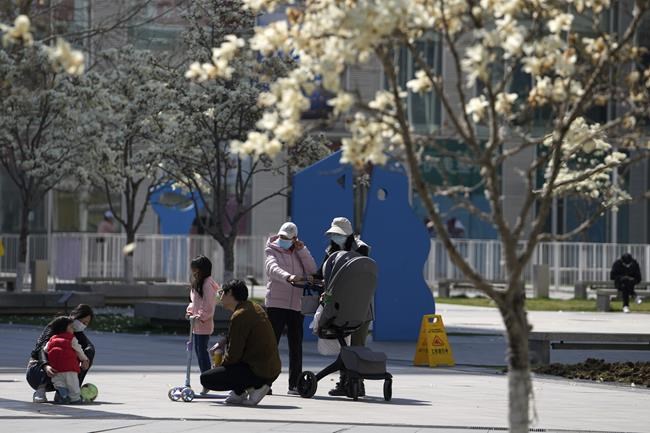
Residents wearing face masks to help protect from the coronavirus bring their children for sunbathing outside a residential compound, Sunday, April 3, 2022, in Beijing. COVID-19 cases in China's largest city of Shanghai are still rising as millions remain isolated at home under a sweeping lockdown. (AP Photo/Andy Wong)

Given that the vast majority of cases in Shanghai are not life threatening, “it is not surprised that the imposition of the lockdown and forced quarantine of the infected in harsh conditions are meeting resistance,” Yang tweeted.

A city official last week apologized in response to complaints over the government’s handling of the lockdown, and a vice premier made sweeping demands for improvements during a tour of Shanghai on Saturday.

Sun Chunlan, who sits on the ruling Communist Party’s Politburo, urged “resolute and swift moves to stem the spread of COVID-19 in Shanghai in the shortest time possible,” the official Xinhua News Agency reported.

However, Sun stressed “unswerving adherence” to China’s hard-line “zero-COVID” approach, mandating lockdowns, forced isolation of all suspected cases and mass testing, even while acknowledging the social and economic toll that is taking.

“It is an arduous task and huge challenge to combat the omicron variant while maintaining the normal operation of core functions in a megacity,” Sun said.

She called for safeguarding key industries and institutions and the functioning of supply and industrial chains in the commercial hub, along with ensuring “people’s basic living conditions and normal medical needs.”
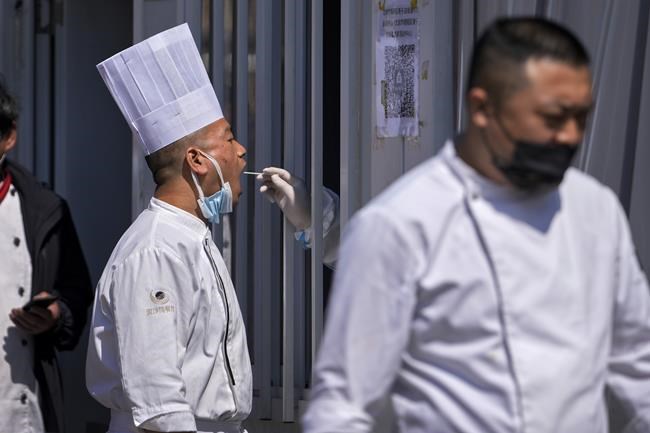
A restaurant chef gets their throat swab taken at a coronavirus testing site, Sunday, April 3, 2022, in Beijing. COVID-19 cases in China's largest city of Shanghai are still rising as millions remain isolated at home under a sweeping lockdown. (AP Photo/Andy Wong)

State media reports indicate president and Communist Party leader Xi Jinping is directing the continuing tough approach, while seeking to avoid further damage to the sputtering economy and ensure overall stability ahead of a key party congress expected for November.

Despite the spike in infections, China has recorded no new COVID-19 deaths since March 20th, when two were added for a total 4,638. China’s vaccination rate is above 87% — although significantly lower among seniors — and omicron is known to be more infectious while the illness it brings on is typically more mild than with the earlier delta variant.
Report Error Submit a Tip

More Stories

Brandonmeat packer thriving on its own

Abiola Odutola 3 minute read Preview

Brandonmeat packer thriving on its own

Abiola Odutola 3 minute read 2:01 AM CDT

BRANDON — Canada Packers has strengthened its business and laid the foundation for future growth during its first year as an independent company, its president says.

The Brandon-based pork producer, separated from Maple Leaf Foods in October 2025, established its own leadership, strategy, systems, culture and identity while continuing operations across its hog production farms and regional hog barns in southern and eastern Manitoba.

The company’s first year was focused on building a successful standalone business while continuing to serve customers, communities and shareholders, president Dennis Organ said.

“Market conditions over the past year have been more challenging than we anticipated when we became a separate entity,” he said in an email. “Despite that, we continued to execute against our priorities, including increasing processing volumes, maintaining disciplined operations and strengthening the business.”

Read
2:01 AM CDT

Nearly four in 10 Manitobans hope Canada restarts trade talks after U.S. midterm elections, poll reveals

Gabrielle Piché 5 minute read Preview

Nearly four in 10 Manitobans hope Canada restarts trade talks after U.S. midterm elections, poll reveals

Gabrielle Piché 5 minute read Yesterday at 7:00 AM CDT

Disorganized — that’s what Marcus Langlois calls recent United States tariffs.

He expects suppliers’ prices to increase — on mugs, pens, hoodies — for his employer, Dreamcatcher Promotions, if the United States–Canada trade war persists.

Still, he’s not pining for a quick trade deal.

“I think it should wait,” said Langlois, Dreamcatcher Promotions’ vice-president. “Let’s hope that it’s later on with proper negotiations happening.”

Read
Yesterday at 7:00 AM CDT

A day on the campaign trail: Winnipeg's mayor, seeking a second term, does double duty

Malak Abas 12 minute read Preview

A day on the campaign trail: Winnipeg's mayor, seeking a second term, does double duty

Malak Abas 12 minute read Updated: Yesterday at 5:56 PM CDT

In the weeks leading up to the civic election, Scott Gillingham has been performing a juggling act: he’s running to be Winnipeg’s 45th mayor, while still serving as its 44th.

“If someone asks me about the campaign, I’m going to answer them. But I think for most people, I’m the mayor of Winnipeg, even if I’m showing up as a candidate,” Gillingham, 58, says. “I try to do all I can to maintain that distinction.”

The Free Press joined Gillingham on a recent rainy September Saturday on the campaign trail, where he served in both roles during an event-laden day. City council’s final meeting before the Oct. 28 election was days earlier.

In Winnipeg, it’s rare for an incumbent to be defeated. But Gillingham knows his win in 2022 wasn’t exactly a landslide — he won with 27.5 per cent of the vote — and he’s been thinking about his second term ever since.

Read
Updated: Yesterday at 5:56 PM CDT

Free Press staff 2 minute read 2:01 AM CDT

Advance voting for civic and school board elections begins next week.

Voters can cast early ballots for the Oct. 28 election in certain locations from Monday through Oct. 23.

Eligible voters can use their address to search for a convenient location.

Early votes can be cast at the council building at city hall (510 Main St.) every day, except weekends and Thanksgiving, from Monday to Oct. 23.

Manitoba marks end of sending simple workplace problems to doctor’s office

Tory McNally 7 minute read Preview

Manitoba marks end of sending simple workplace problems to doctor’s office

Tory McNally 7 minute read 2:01 AM CDT

There are some changes in the workplace that make you think: “Well, it’s about time.”

This is one of them.

Starting Oct. 1, Manitoba changed the rules around sick notes. I think it is going to be a wonderful change — not just for doctors and patients, but for employers, employees and the way we think about accountability at work.

The change comes from Bill 11, the Employment Standards Code Amendment Act (Sick Notes for Employee Absences), which received royal assent on June 1 and came into force Thursday. Under the new rules, employers generally cannot require a sick note for an illness or injury unless the employee is away for more than one week or has been absent because of illness or injury for more than 10 scheduled workdays in the calendar year.

Read
2:01 AM CDT

The idea of Alberta separation viewed through a faith lens shows further fracture lines

Josiah Neufeld 10 minute read Preview

The idea of Alberta separation viewed through a faith lens shows further fracture lines

Josiah Neufeld 10 minute read 2:01 AM CDT

CALGARY — One morning in May, John Pentland, a minister at Hillhurst United Church in Calgary, opened his newspaper and read about a group of Albertans who were trying to divide his country.

Something inside of him felt like it cracked open. He started to weep.

“I couldn’t stop, I couldn’t breathe,” he said. He called a friend and told him: “I think I’m losing my mind.”

Pentland has always believed in Canada — flawed as it might be — as a nation gifted with diversity and welcoming of asylum seekers, refugees and immigrants. But recently that belief has been shaken as he’s witnessed right-wing ideologies charged with anti-immigrant sentiment take root in his province. It makes him angry and embarrassed for the country he loves.

Read
2:01 AM CDT