A ‘terrible nightmare’: Treating Ukraine’s wounded civilians

Advertisement

Advertise with us

POKROVSK, Ukraine (AP) — In wheelchairs and on stretchers, in ambulances and on train station platforms, they wait. Medical workers pull out ramps and wheel the patients onto the specially equipped train that will carry them westwards, away from the fighting raging in eastern Ukraine.

Read this article for free:


or

Already have an account? Log in here »

To continue reading, please subscribe:

Subscribe and receive a limited-edition Free Press branded hat or tote.

Digital Subscription

One year of digital access for only $205*

  • Enjoy unlimited reading on winnipegfreepress.com
  • Read the E-Edition, our digital replica newspaper
  • Access News Break, our award-winning app
  • Play interactive puzzles

*First annual payment billed as $205.00 + GST for one year. This annual subscription will automatically renew at $233.00 + GST every 52 weeks (10% off the regular annual price of $259.35). Offer available to new and qualified returning subscribers only. Cancel any time.

To continue reading, please subscribe:

Add Free Press access to your Brandon Sun subscription for only an additional

$1 for the first 4 weeks*

  • Enjoy unlimited reading on winnipegfreepress.com
  • Read the E-Edition, our digital replica newspaper
  • Access News Break, our award-winning app
  • Play interactive puzzles
Start now

*Your next Brandon Sun subscription payment will increase by $1.00 and you will be charged $17.95 plus GST for four weeks. After four weeks, your payment will increase to $24.95 plus GST every four weeks.

Hey there, time traveller!
This article was published 31/05/2022 (1587 days ago), so information in it may no longer be current.

POKROVSK, Ukraine (AP) — In wheelchairs and on stretchers, in ambulances and on train station platforms, they wait. Medical workers pull out ramps and wheel the patients onto the specially equipped train that will carry them westwards, away from the fighting raging in eastern Ukraine.

Run by the aid organization Medecins Sans Frontieres (Doctors Without Borders), the train is a lifeline for the overwhelmed hospitals in cities and towns near Ukraine’s front lines that are struggling to cope with an influx of war wounded on top of their usual flow of sick patients.

“Since the beginning of the war, the hospital capacity in the east is under pressure,” said Yasser Kamaledin, MSF’s emergency project coordinator for the medical evacuation train, which includes an intensive care unit.
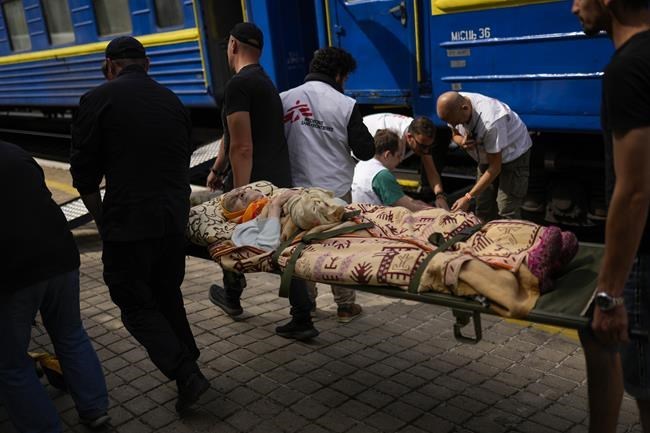
An elderly patient is carried in a stretcher to board a medical evacuation train run by MSF (Doctors Without Borders) at the train station in Pokrovsk, eastern Ukraine, eastern Ukraine, Sunday, May 29, 2022. In wheelchairs and on stretchers, in ambulances and on the station platform, they wait. Medical staff pull out ramps and wheel the patients onto the specially equipped train that will carry them westwards, away from the fighting raging in eastern Ukraine. (AP Photo/Francisco Seco)

“The idea of this activity is to support the hospitals that are closer to the front line, to empty some bed capacity so they can receive more patients from the attacks, the conflict, but also other chronic patients,” Kamaledin said.

Since it started running on March 31, the train has ferried nearly 600 people to hospitals in safer areas of western Ukraine, he said, including around 30 more people on Sunday.

They included 40-year-old Mykola Pastukh. He was wounded Saturday near Sievierodonetsk by a mortar shell that landed as he tried to ferry humanitarian aid into the city, which has been under fierce attack as Russian forces intensify their efforts to seize Ukrainian territory in the east.

There was still shrapnel inside him, he said as he stood on the train platform nursing his right arm in a sling under his shirt. He needed surgery but the hospital in Lysychansk, a city close to Sievierodonetsk that was also under fierce Russian attack, just couldn’t cope. So he was being evacuated to Lviv in western Ukraine for the operation.

There are other, regular evacuation trains going west and onto which older people and the sick are boarded, but the MSF train is especially equipped to care for patients.

The pressure on Ukraine’s eastern hospitals is most evident after an attack, when casualties arrive one after the other.

Last week, medics wheeled a patient with severe head injuries into the hospital in the town of Pokrovsk as doctors, jaws clenched, triaged patients who were wounded when two rockets landed.

There were only a handful of wounded people. But the hospital is stretched. It has been operating with around half the staff it used to have, working with a backdrop of sandbags stacked up against boarded-up windows.

Before the war “when there was normal work, we had 10 surgeons, now we have five,” said Dr. Ivan Mozhaiev. In his department, the 32-year-old is the only surgeon who remained out of five.

The radical change in the nature of their work since Russia invaded Ukraine on Feb. 24 has added an extra strain on the doctors and nurses who remain in hospitals near the fighting.

“Earlier we treated people from illnesses, sometimes there were traumas. Now we have to treat people from gunshot wounds,” said Dr. Viktor Krikliy, head of surgery at a hospital in the eastern city of Kramatorsk.

The city itself has come under attack, including on April 8, when a missile struck Kramatorsk train station, killing more than 50 people and wounding more than 100.

Many medical staff have left, and the hospital has had to shut down several departments while still providing care for people from the city and nearby towns. Krikliy’s section of the hospital has two surgery departments, which each used to have 15 surgeons. Now there are only six left for both. It’s the same with nurses, with units operating on around half the staff levels they had before the war.

Kramatorsk hospital, in the Donetsk region of Ukraine, has had to deal with war injuries before. The region, along with neighboring Luhansk, is part of the Donbas, where Russia-backed separatists began fighting Ukrainian forces in 2014 and have controlled sections of eastern Ukraine since then.

Krikliy had to operate on the wounded then too, “but the scale now and then is incomparable,” he said. In 2014, it was soldiers, but this is the first time that the medical staff in Kramatorsk are seeing many wounded civilians.

“We could not even dream in the most terrible nightmare” that civilians in Ukraine would suffer such injuries, he said, describing having to operate on young children whose limbs were blown off by explosions.

Despite the danger, and the physical and emotional toll of working under such conditions, Krikliy has no intentions of leaving.

“We are surgeons. Our task is to operate on the people and treat them. If everyone leaves, who is supposed to do the job?” he said. “Nobody says we are a suicide squad or looking for a way to die somewhere. But … we do our job. And we will continue to do so.”

___

Follow all AP stories on the war in Ukraine at https://apnews.com/hub/russia-ukraine

Report Error Submit a Tip

More Stories

Manitoban Kent Monkman debuts beaver sculpture in Toronto’s ambitious new waterfront park

Alex Nino Gheciu, The Canadian Press 2 minute read Preview

Manitoban Kent Monkman debuts beaver sculpture in Toronto’s ambitious new waterfront park

Alex Nino Gheciu, The Canadian Press 2 minute read Updated: 9:17 AM CDT

TORONTO - Kent Monkman’s first-ever public art installation is dam good.

The celebrated Cree artist’s new permanent sculpture, dubbed “The Colony,” debuts Wednesday in Toronto’s east end.

The 15-foot-high bronze structure features beavers dancing, feasting and celebrating, evoking Indigenous ceremonies.

It highlights the vital role of beavers in the natural, Indigenous and colonial histories of Turtle Island, says a release.

Read
Updated: 9:17 AM CDT

Board game company charts winning path

Aaron Epp 5 minute read Preview

Board game company charts winning path

Aaron Epp 5 minute read Yesterday at 7:09 PM CDT

Dennis Northcott has launched a game without frontiers.

The Winnipeg entrepreneur is the co-designer of Galactic Cruise, a board game published last year by Kinson Key Games LLC, the business he co-founded. Since its release, Galactic Cruise has been translated into 11 languages and sold around 50,000 copies worldwide.

It’s also one of three finalists for this year’s Deutsche Spiele Preis, a prestigious community-voted board game award. Northcott will travel to Essen, Germany, later this month, where the winner will be announced at Spiel Essen, an annual board game trade fair.

“It’s been amazing,” Northcott said of the response to Galactic Cruise during an interview in his Island Lakes neighbourhood home earlier this week. “The sales have been great, but it’s also been amazing in terms of people giving their reviews.”

Read
Yesterday at 7:09 PM CDT

Clock ticks down on destruction of records documenting residential school abuses

Marsha McLeod 13 minute read Preview

Clock ticks down on destruction of records documenting residential school abuses

Marsha McLeod 13 minute read Yesterday at 12:49 PM CDT

In less than a year, a private company is set to destroy the largest cache of records detailing the widespread abuse of Indigenous children at residential schools in Canada.

The destruction, which was ordered by an Ontario court in 2014 and later upheld by the Supreme Court, is set to take place on Sept. 19, 2027.

This countdown is igniting emotional conversations that seek to balance the immense historical value of the records alongside the confidentiality survivors were promised as part of the process of providing detailed testimony about abuses they’d suffered.

The records were created as part of the Indian Residential Schools Settlement Agreement, a class-action settlement stemming from survivors who began suing the federal government in the late 1990s over the harm they’d been subjected to at residential schools.

Read
Yesterday at 12:49 PM CDT

Broadening prediction-market gambling a bad idea

Editorial 4 minute read Preview

Broadening prediction-market gambling a bad idea

Editorial 4 minute read 2:01 AM CDT

Let’s make a prediction: sooner or later, when Canadian governments find a way to take their own cut of the action, prediction-contract gambling on everything from sports to entertainment to political decisions is going to come to Canada.

And that’s a horrible, dangerous, pernicious idea.

Unless you have particular access to information — either inside information or strategic information based on skills or education — you’re not likely to make money at it. In fact, structurally, you’re likely to lose. In prediction markets, you basically pay an amount, plus fees from the company involved, to bet on whether something will or will not happen within a certain time frame. The amount you pay for your contract depends on how other people are also betting.

As Wealthsimple describes it, “You buy whichever side you think is right. Prices move with demand, so if the market leans towards one outcome, the more that side costs. If a lot of people are backing the TSX to finish above 38,000, yes gets more expensive and no gets cheaper.”

Read
2:01 AM CDT

Province looks to seize notorious drug den

Erik Pindera 5 minute read Preview

Province looks to seize notorious drug den

Erik Pindera 5 minute read 12:00 PM CDT

Provincial justice officials are trying to seize a Dominion Street drug den that has been the source of trouble in the West End for years.

The owner of 982 Dominion St., 45-year-old Robert Edward Johnson, was most recently arrested in June along with several others after a lengthy Winnipeg Police investigation into thefts and illicit drug sales connected to the house.

“The residence has a reputation within the neighbourhood as being a location where individuals habitually attend for the purpose of purchasing and/or consuming controlled substances,” reads a statement of claim filed by the province’s director of civil forfeiture in the Court of King’s Bench last week.

“For several years, the residence has been associated with criminal activity, violence, and disorder, resulting in numerous police attendances and complaints from members of the surrounding community.”

Read
12:00 PM CDT

J’accuse!: Kinew uses French to fry interim Tory leader over alleged caucus subterfuge

Chris Kitching and Maggie Macintosh 4 minute read Preview

J’accuse!: Kinew uses French to fry interim Tory leader over alleged caucus subterfuge

Chris Kitching and Maggie Macintosh 4 minute read Thursday, Oct. 1, 2026

NDP Premier Wab Kinew took a dig at the Progressive Conservatives’ leadership change while facing off with Obby Khan’s short-term replacement for the first time in question period Thursday.

Read
Thursday, Oct. 1, 2026