COVID-19 pandemic stalled progress on eliminating tuberculosis among Inuit: officials

Advertisement

Advertise with us

Nunavut's health minister says the COVID-19 pandemic disrupted efforts to eliminate tuberculosis in Inuit communities, and questions remain over whether targets to stamp out the disease can be met.

Read this article for free:


or

Already have an account? Log in here »

To continue reading, please subscribe:

Subscribe and receive a limited-edition Free Press branded hat or tote.

Digital Subscription

One year of digital access for only $205*

  • Enjoy unlimited reading on winnipegfreepress.com
  • Read the E-Edition, our digital replica newspaper
  • Access News Break, our award-winning app
  • Play interactive puzzles

*First annual payment billed as $205.00 + GST for one year. This annual subscription will automatically renew at $233.00 + GST every 52 weeks (10% off the regular annual price of $259.35). Offer available to new and qualified returning subscribers only. Cancel any time.

To continue reading, please subscribe:

Add Free Press access to your Brandon Sun subscription for only an additional

$1 for the first 4 weeks*

  • Enjoy unlimited reading on winnipegfreepress.com
  • Read the E-Edition, our digital replica newspaper
  • Access News Break, our award-winning app
  • Play interactive puzzles
Start now

*Your next Brandon Sun subscription payment will increase by $1.00 and you will be charged $17.95 plus GST for four weeks. After four weeks, your payment will increase to $24.95 plus GST every four weeks.

Hey there, time traveller!
This article was published 16/04/2023 (1268 days ago), so information in it may no longer be current.

Nunavut’s health minister says the COVID-19 pandemic disrupted efforts to eliminate tuberculosis in Inuit communities, and questions remain over whether targets to stamp out the disease can be met.

“COVID has had a huge impact on every area of health care, and that includes TB,” said John Main. “While we were putting so much effort toward dealing with COVID, we did have to slow the pace of work on other areas.”

Five years ago, Ottawa and Inuit Tapiriit Kanatami, a national advocacy group, announced plans to reduce active tuberculosis across Inuit Nunangat by at least half to no more than 100 cases per 100,000 people by 2025, and eliminate it entirely by 2030. Inuit Nunangat, or Inuit homeland in Canada, is made up of more than 50 communities in Nunavut, the Northwest Territories, Quebec and Labrador.
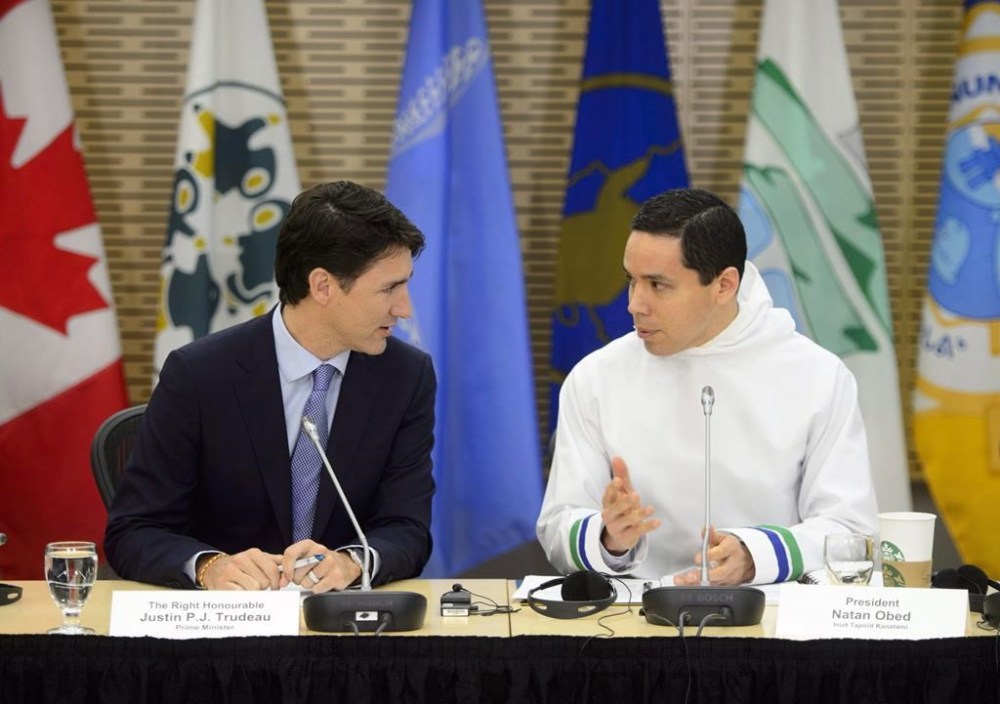
Prime Minister Justin Trudeau talk with Natan Obed, president of the Inuit Tapiriit Kanatami as they participate in the Inuit-Crown Partnership Committee Leaders Meeting in Ottawa on Thursday, March 29, 2018. Health officials say the COVID-19 pandemic disrupted efforts at eliminating tuberculosis in Inuit communities. THE CANADIAN PRESS/Sean Kilpatrick

Public Health Agency of Canada data indicates reported rates of active tuberculosis dropped significantly among Inuit between 2019 and 2020 from 188.7 cases per 100,000 to 72.2. Health officials in Inuit Nunangat, however, say that’s partly due to reduced screening.

Indigenous Services Canada says the rate of tuberculosis among Inuit increased to 135.1 in 2021.

Main said Nunavut is now “getting things back on track.” The territory signed a tuberculosis information sharing agreement with Nunavut Tunngavik Inc., a group representing Nunavut Inuit, in November. Main said they are also working to finalize a three-year plan to guide elimination efforts.

“It’s been made clear to me the amount of hardship and stigma that can be associated with TB, as well as the elements of historical trauma around tuberculosis,” he said. “That’s what we’re including as part of our work at every level, is this understanding of our role as health-care providers and that sometimes we need to listen and not just talk.”

Main added the territory is strengthening relationships with communities affected by the disease. In Pangnirtung, where an outbreak was declared in November 2021, staffing support has been provided alongside the Canadian Red Cross, epidemiological analysis, and improved education and awareness efforts.

Main said whether the 2025 and 2030 tuberculosis elimination targets will be met is “the big question.”

“At this point I can’t say, but it’s certainly not going to stop us from doing everything we can towards that goal,” he said. “I’m not going to say that I can look into a crystal ball and see what’s going to happen in the next two years, but I’m hopeful, cautiously optimistic I would say.”

The Nunavik Regional Board of Health and Social Services said community screenings have resumed in the region and it is working to better target services, including recruiting local public health officers. As of January, a vaccine that protects young children against complications and severe forms of tuberculosis has been available in all communities in Nunavik.

While the risk of developing tuberculosis in Canada is very low, rates are higher among Inuit.

Between 2015 and 2019, the reported rate of active tuberculosis among Inuit living in Inuit Nunangat was approximately 300 times that of Canadian-born, non-Indigenous people, says Indigenous Services Canada.

Health-care barriers, poverty, food insecurity and overcrowded housing with poor ventilation are among the contributors to the disproportionate rates. Main said challenges in Nunavut include a lack of health-care staff and infrastructure.

The latest federal budget has earmarked $16.2 million over three years to fight tuberculosis in Inuit communities. Inuit Tapiriit Kanatami said that’s roughly a quarter of what’s needed for the next phase of tuberculosis elimination.

“This modest investment in Inuit health priorities does not fulfil our joint commitment with the Government of Canada to eliminate tuberculosis in Inuit Nunangat by 2030,” President Natan Obed said in a statement. “But we remain optimistic that future federal budget cycles will unlock the funding needed to honour this commitment.”

A study published in the scientific journal Infectious Disease Modelling in December 2022 evaluated tuberculosis elimination strategies in Nunavut. It suggested that under current plans, the 2025 reduction target is not achievable and eliminating tuberculosis will extend beyond 2030.

The study identified challenges including prolonged delays to case detection, limited access to diagnostic tools and services, as well as inadequate capacity for contact-tracing and rapid start of treatment.

Indigenous Services Minister Patty Hajdu said the budget’s approach is “incremental but also substantial” and comes with other investments such as bilateral health transfer agreements with the provinces and territories.

She said the targets are ambitious but realistic.

“They’re realistic in the sense that if everybody is determined to reach those targets then we can,” she said. “It is going to require everybody to be very focused.”

This report by The Canadian Press was first published April 16, 2023.

This story was produced with the financial assistance of the Meta and Canadian Press News Fellowship.

Report Error Submit a Tip

More Stories

Bombers get ‘whopped’ in Montreal

Taylor Allen 5 minute read Preview

Bombers get ‘whopped’ in Montreal

Taylor Allen 5 minute read Yesterday at 11:32 PM CDT

MONTREAL — It’s hard to fathom that the Winnipeg Blue Bombers smacked these Montreal Alouettes five weeks ago.

The team that pulled off that 44-28 upset at Princess Auto Stadium was nowhere to be found in La Belle Province on Saturday night.

You can, however, now find them in the basement of the West Division at 7-8 after getting completely outmatched and outclassed by the Als in a 37-10 beatdown.

“This was bad,” left tackle Stanley Bryant told the Free Press postgame. “They basically had their way all around. They whopped our ass.”

Read
Yesterday at 11:32 PM CDT

May be whiff of truth to ex’s odour ardour

Maureen Scurfield 5 minute read Yesterday at 2:01 AM CDT

DEAR MISS LONELYHEARTS: I ran into an old boyfriend I used to curl on a team with, and we went for drinks. We’ve been almost eight years apart, and I couldn’t remember why we broke up, as we always had such a great time together.

It wasn’t until the second date — this time on a weekend — that it came back to me, with a jolt. Pee-yew! I remembered he doesn’t use deodorant on weekends. Why? He enjoys his own body odour. I recalled that a bit too late, and it was just as awful as ever! I went home early.

Tonight, he called and I refused him another date. I said, “Think back. You remember why we broke up?” Then he said, “Oh yeah, you hated my no-deodorant weekend policy. Well, guess what? Some women don’t mind!” I said I really doubted that, and that ended the conversation. Miss L., wouldn’t any women find stinky underarms offensive?

— Sensitive Nose, Fort Richmond

Winnipeggers witness unveiling of Japanese Canadian monument in B.C.

Morgan Modjeski 6 minute read Preview

Winnipeggers witness unveiling of Japanese Canadian monument in B.C.

Morgan Modjeski 6 minute read Yesterday at 8:39 PM CDT

As Miki Stewart gathered with her family at the Japanese Cultural Association of Manitoba on Saturday afternoon, she was thinking of her parents, Yoshimaru and Yoshi Abe.

Both Stewart, 80, and her sister Yumi Falk, 81, alongside an older brother, were born in the Tashme internment camp in British Columbia. They were among more than 2,600 Japanese Canadians who were forcefully removed and interned at the camp following the bombing of Pearl Harbour and Canada’s declaration of war on Japan in 1941.

“They didn’t talk much about how they suffered,” Stewart said of her parents. “But they did.”

She was amongst a group of more than 150 people who gathered at the association’s McPhillips headquarters on Saturday afternoon to watch the unveiling of the Japanese Canadian Monument in Victoria B.C.

Read
Yesterday at 8:39 PM CDT

Morning-show veteran swaps microphone for macchiatos at new Corydon café

David Sanderson 9 minute read Preview

Morning-show veteran swaps microphone for macchiatos at new Corydon café

David Sanderson 9 minute read Yesterday at 2:00 AM CDT

Good news if you were used to having your morning coffee with Terri Gale, who earlier this summer signed off from CTV Your Morning, after 15 years on the job.

Gale, the three-hour program’s longtime weather expert, and her husband Rob Gale, the ex-head soccer coach of Valour FC and co-founder of the Northern Super League’s new Winnipeg franchise, are the owners of Golden Hour Café and Bar at 775 Corydon Ave.

Gale (formerly Apostle) nods when she is asked who would know more about caffeinated beverages than a person who, for the last decade and a half, set her alarm to go off in the wee small hours.

“I do love coffee and take mine black. Except because I hate burning my tongue — not a good thing when you speak for a living — I got into the habit of throwing a couple of ice cubes in my cup, to be on the safe side,” Gale says, seated on the second level of their attractive, 2,100-square-foot premises, which officially opened in mid-September.

Read
Yesterday at 2:00 AM CDT

’Disgusting’ posters being investigated by police

Morgan Modjeski 4 minute read Yesterday at 2:22 PM CDT

The Winnipeg Police Service major crimes unit is investigating what some have labelled offensive and hateful posters on full-display at a Winnipeg home.

One of the people irked by the display is Gracie Garrett. She’s has lived on Ashburn Street in Winnipeg’s Minto neighbourhood for almost ten years. She’s never felt unsafe in the neighbourhood before, but now, a set of posters plastered on a nearby house are making her feel uneasy.

The five signs, posted facing the street prominently on a front window, contain a slur, refer to Nazis as “heroes” and call Muslims, Christians and other groups “evil.”

Learning of the signs Friday, Garrett said she’ll be reporting the posters to police, as she worries they incite and promote violence.

The election of our discontent: City at a crumbling crossroads, grumbling residents say in poll

Matthew Frank 7 minute read Preview

The election of our discontent: City at a crumbling crossroads, grumbling residents say in poll

Matthew Frank 7 minute read 2:37 PM CDT

There’s an undercurrent of unhappiness running through the Winnipeg electorate as the municipal election day approaches.

One-half of Winnipeggers believe the city is heading in the wrong direction, according to a new Abacus Data poll, with nearly one-third unsure if Winnipeg is regressing or progressing.

Only 21 per cent of residents believe the city is on the right track, the Free Press-commissioned poll found.

That discontentment extends to how the city spends its tax dollars, with four in 10 Winnipeggers believing they receive poor value for what they pay in property taxes.

Read
2:37 PM CDT