Here’s why there is still so much lead pipe in Chicago

Advertisement

Advertise with us

Even though lead in drinking water damages children's development, the Environmental Protection Agency has forced very few cities to replace their lead pipes.

Read this article for free:


or

Already have an account? Log in here »

To continue reading, please subscribe:

Subscribe and receive a limited-edition Free Press branded hat or tote.

Digital Subscription

One year of digital access for only $205*

  • Enjoy unlimited reading on winnipegfreepress.com
  • Read the E-Edition, our digital replica newspaper
  • Access News Break, our award-winning app
  • Play interactive puzzles

*First annual payment billed as $205.00 + GST for one year. This annual subscription will automatically renew at $233.00 + GST every 52 weeks (10% off the regular annual price of $259.35). Offer available to new and qualified returning subscribers only. Cancel any time.

To continue reading, please subscribe:

Add Free Press access to your Brandon Sun subscription for only an additional

$1 for the first 4 weeks*

  • Enjoy unlimited reading on winnipegfreepress.com
  • Read the E-Edition, our digital replica newspaper
  • Access News Break, our award-winning app
  • Play interactive puzzles
Start now

*Your next Brandon Sun subscription payment will increase by $1.00 and you will be charged $17.95 plus GST for four weeks. After four weeks, your payment will increase to $24.95 plus GST every four weeks.

Hey there, time traveller!
This article was published 08/07/2023 (1171 days ago), so information in it may no longer be current.

Even though lead in drinking water damages children’s development, the Environmental Protection Agency has forced very few cities to replace their lead pipes.

Consider Chicago, with more water pipes made out of lead than any U.S. city, some 400,000. About 7% of homes that requested sampling last year exceeded federal limits, and in at least 73 homes, it was at least twice that much, according to an AP analysis of more than 3,500 samples collected using a method that’s more sensitive than the federal government’s.

Yet that many homes was never enough to trigger the mandate to remove pipes.
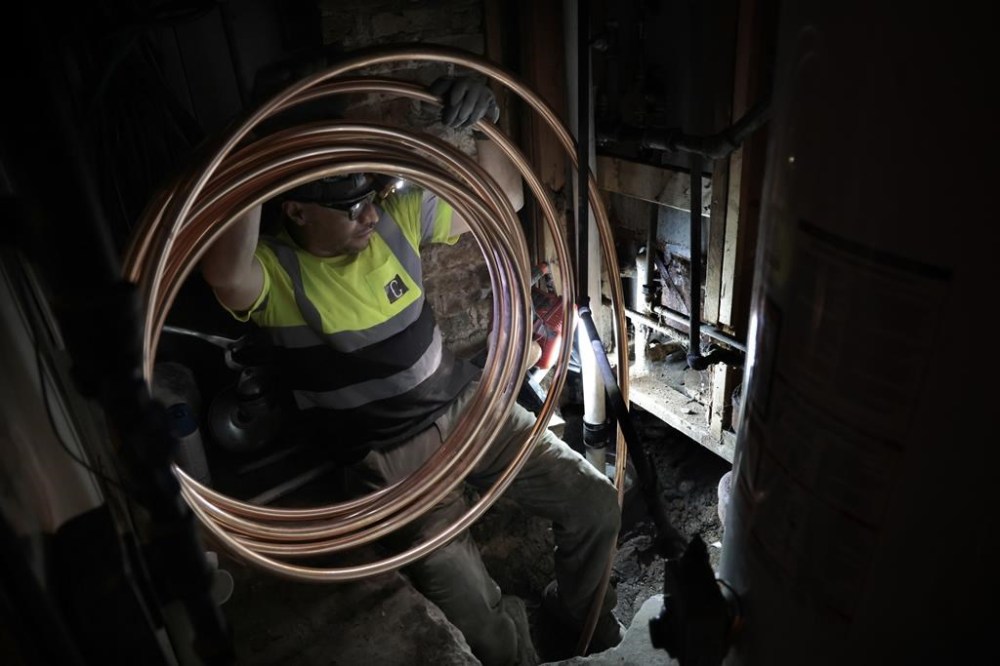
A laborer holds onto a coiled copper pipe as it is pulled from the home, under the ground and out to the street for connection to the water main during lead service replacement on April 10, 2023, in Chicago. Lead pipes that carry drinking water are a major source of exposure to the metal and the damage is usually permanent. (Antonio Perez/Chicago Tribune via AP)

That’s because EPA standards only say most homes – not all – can’t have dangerous amounts of lead.

Since Chicago was never forced to remove its lead pipe, it left most of it in the ground, relying on water treatment instead to lower the lead levels.

State and local officials say they had limited funds that needed to be used elsewhere. They also say local rules made removal work more difficult and more expensive.

WATER MAIN WORK

In 2012, the city began rapidly replacing its aged water mains. These are typically made of cast-iron, not lead. When road crews came across the lead pipes that branch off and serve individual homes, they only replaced a short piece near the water main with copper. Thousands and thousands of times, they reburied the junction and left the rest.

Just as the city was wrapping up that effort, the Illinois legislature made that method illegal.

Miguel Del Toral, a former EPA regulations manager who was also a whistleblower on the Flint, Michigan lead pipe disaster, said Chicago ignored the toxic effects of lead in drinking water.

“During the water main replacement program, there was no acknowledgement that there was an issue,” he said.

Del Toral was not the only one to object to the city’s actions. Two Chicago residents filed a proposed class action in 2017, arguing Chicago’s water main work increased people’s risk of lead exposure. They cited studies that said disturbing lead pipe and then leaving it in the ground can actually spike levels in tap water.

The next year, to protect against those spikes, the city finally started handing out water filters to residents in neighborhoods where public works crews were replacing mains. The lawsuit was eventually dismissed.

CHICAGO’S OFFICIAL VIEW

The EPA has said replacing lead pipes during water main work is not only safer, it is also about 20% cheaper. But Chicago Commissioner of Water Management Andrea Cheng said that’s not true in Chicago. State rules there required expensive construction methods until last year. Only recently did the city start waiving permit fees that can add thousands of dollars to lead replacement costs, she said.

Cheng said old water mains can rupture, and slowing their replacement by dealing with all the lead pipes would have been irresponsible and could expose people to bacteria. She said Chicagoans face a bigger threat of poisoning from lead paint and the city is trying to fight that.

The city of Detroit found success when it pressured residents to let road crews onto private property to remove lead pipes. Rules like that are not in place in Chicago.
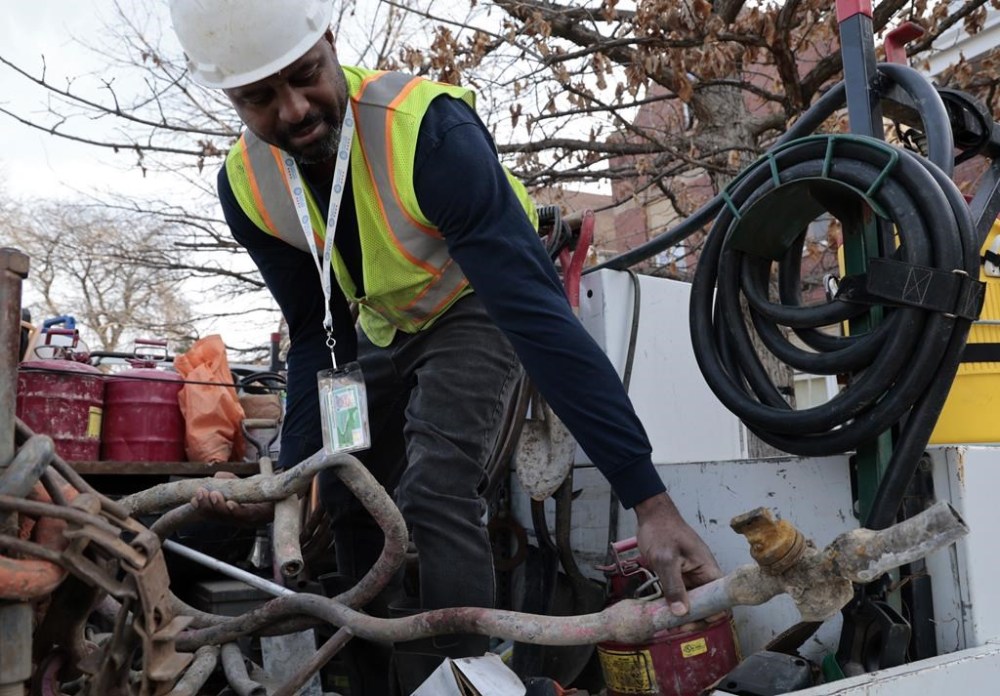
Blackhawk Sewer & Water contractor Khaild Waarith holds a lead pipe that was extracted in Chicago on April 10, 2023. Lead pipes that carry drinking water are a major source of exposure to the metal and the damage is usually permanent. (Antonio Perez/Chicago Tribune via AP)

“Do you know how many people want their yard dug up?” Cheng said. “Not many.”

Since the legislature changed the law, most residents have allowed workers on their property to replace pipes, she said.

Today, Chicago offers a limited, free lead pipe replacement program for low-income households and daycares and recently started replacing lead pipes when they break — a common occurrence in a city with harsh winters. But the city says it will take decades to replace all of them. Residents will continue to be exposed.

So three decades after the federal government imposed lead limits for drinking water, the vast majority of lead pipe is still in the ground not only in Chicago, but across the country.

Marc Edwards, a water treatment specialist at Virginia Tech, said proactive cities that replaced entire lenths of lead pipe are in better shape.

“You’re solving the problem once and for all,” he said. “It’s much more cost effective to do it all at one time than to just leave that problem for the homeowner to forget about and realize in 30 years that their kids have been lead poisoned.”

___

Fassett reported from Seattle.

___

The Associated Press receives support from the Walton Family Foundation for coverage of water and environmental policy. The AP is solely responsible for all content. For all of AP’s environmental coverage, visit https://apnews.com/hub/climate-and-environment


Report Error Submit a Tip

More Stories

Leila Avenue closed following serious two-vehicle crash

1 minute read Updated: 3:36 PM CDT

Leila Avenue was closed Sunday morning after a serious car crash.

Winnipeg Police Service spokesman Const. Pat Saydak confirmed the crash involved two vehicles near Leila and McGregor Street. He could not provide any more details on the crash, or say whether there were any injuries.

Westbound Leila from Powers Street to McGregor , and McGregor from Partridge Avenue to Templeton Avenue were closed Sunday morning.

The crash is being investigated.

Cabernet Sauvignon star of wine festival

Ben Sigurdson 5 minute read Preview

Cabernet Sauvignon star of wine festival

Ben Sigurdson 5 minute read Yesterday at 3:00 AM CDT

The Winnipeg Wine Festival will celebrate the king of red wine grapes next weekend — the theme of this year’s festival, which takes place Sept. 25 and 26 at the RBC Convention Centre, is Cabernet Sauvignon.

Cab Sauv, as it’s also known, is the world’s most widely planted wine grape of any colour, first coming to prominence in the 1800s in France’s Bordeaux region, where the grape is still popular. Rather than single-variety wines, Bordeaux reds tend to be blends, with those coming from the left bank of the Gironde estuary being Cabernet-dominant, while right-bank wines are Merlot-dominant, with Cabernet Sauvignon playing a supporting role. Cabernet and Merlot work well together and many other countries have followed suit in blending the two.

A team at University of California Davis put Cabernet Sauvignon through a DNA test in 1996 and discovered its parent grapes are Cabernet Franc and Sauvignon Blanc — it’s likely that at some point the two varieties, planted next to each other in some vineyard, crossed and mutated and became the grape we know today. (Someone growing grapes in the 19th century must have had an inkling of what was up, as the grape has been called Cabernet Sauvignon since long before the DNA test.)

Flavour-wise, most Cabernet Sauvignon wines are big and bold, with a core of deep dark berry flavours, some graphite and spice notes and relatively bright acidity. It’s a grape that is well-suited to barrel aging, with most examples seeing at least some time in wood.

Read
Yesterday at 3:00 AM CDT

‘She was looking to destroy me’: convicted harasser faces new charges

Dean Pritchard 6 minute read Preview

‘She was looking to destroy me’: convicted harasser faces new charges

Dean Pritchard 6 minute read Thursday, Sep. 17, 2026

When Agnieszka Ciochon-Newton moved into the 55-plus apartment building on Stradbrook Avenue last year, she came across as “timid, soft-spoken and sensitive,” said building manager Tanya Owen.

Little did Owen know the meek-looking 58-year-old woman would soon turn her life and the lives of many of her tenants upside down and threaten her career and family.

“She was looking to destroy me for a simple tenant disagreement,” Owen said Thursday.

Court records show Ciochon-Newton was arrested earlier this month and charged with seven counts of criminal harassment, two counts of uttering threats and one count each of fraud, breaking and entering, attempting to obstruct justice, intimidation of a justice official, mischief and defamatory libel.

Read
Thursday, Sep. 17, 2026

Former Bombers linebacker Gauthier enjoying career as electrician

Taylor Allen 6 minute read Preview

Former Bombers linebacker Gauthier enjoying career as electrician

Taylor Allen 6 minute read Friday, Sep. 18, 2026

Most professional football players don’t ride off into the sunset on their own terms.

Shayne Gauthier was well aware of that, but it didn’t make it sting any less when the Winnipeg Blue Bombers informed the veteran linebacker that they weren’t bringing him back for 2026.

“I was really hoping to play one more (season) because it would have been my 10th season, so, I’d say it didn’t really end the way I wanted,” Gauthier recently told the Free Press.

“It left a little sour taste in my mouth, but that’s part of pro sports. If everybody got the ending that they wanted, then it wouldn’t really work.”

Read
Friday, Sep. 18, 2026

Not falling back means time loop remains unclosed

Jen Zoratti 4 minute read Yesterday at 2:01 AM CDT

I demand restitution. Where’s my hour?

In the traditional fall-back, spring-forward time change set up — you know, ol’ trusty that’s been effect for lo these 63 years — we lost an hour in the spring that we got back in the fall.

That was the social contract: you commit to feeling like you’re on cold medication for a week in March because you know a glorious extra hour of sleep will be returned to you in November. (Unless, of course, you have little kids, but look: we all make our choices.)

Well, that transaction, flawed as it was, isn’t happening this year. That hour you sacrificed to the sun gods in the spring? Gone. Not coming back. We’ve sprung forward and we shan’t be falling back — not in November, and (possibly) not ever. The scale shall remain unbalanced and the loop shall remain unclosed as Manitoba has adopted permanent daylight time.

Steinbach Credit Union member warns others after scammer steals $10K

Scott Billeck 5 minute read Preview

Steinbach Credit Union member warns others after scammer steals $10K

Scott Billeck 5 minute read Friday, Sep. 18, 2026

A Winnipeg single mother whose bank account was drained of nearly $10,000 says Steinbach Credit Union needs to warn its members about what she believes is a broader security problem.

The woman, who is not being named to protect her identity, said a scammer gained access to her account earlier this week after calling SCU’s contact centre, claiming to be her and successfully completing the credit union’s authentication process.

She said she knows of at least six others who have experienced similar incidents in which callers impersonate SCU account holders and pass the authentication checks.

The woman discovered something was wrong when her minor son asked why money had been transferred out of an account they jointly hold.

Read
Friday, Sep. 18, 2026