‘An early warning’: Researchers see spike in opioids in Alberta wastewater samples

Advertisement

Advertise with us

CALGARY - Researchers say the amount of opioids and other illicit drugs found in a monitoring of Alberta wastewater jumped in June.

Read this article for free:


or

Already have an account? Log in here »

To continue reading, please subscribe:

Subscribe and receive a limited-edition Free Press branded hat or tote.

Digital Subscription

One year of digital access for only $205*

  • Enjoy unlimited reading on winnipegfreepress.com
  • Read the E-Edition, our digital replica newspaper
  • Access News Break, our award-winning app
  • Play interactive puzzles

*First annual payment billed as $205.00 + GST for one year. This annual subscription will automatically renew at $233.00 + GST every 52 weeks (10% off the regular annual price of $259.35). Offer available to new and qualified returning subscribers only. Cancel any time.

To continue reading, please subscribe:

Add Free Press access to your Brandon Sun subscription for only an additional

$1 for the first 4 weeks*

  • Enjoy unlimited reading on winnipegfreepress.com
  • Read the E-Edition, our digital replica newspaper
  • Access News Break, our award-winning app
  • Play interactive puzzles
Start now

*Your next Brandon Sun subscription payment will increase by $1.00 and you will be charged $17.95 plus GST for four weeks. After four weeks, your payment will increase to $24.95 plus GST every four weeks.

Hey there, time traveller!
This article was published 30/08/2023 (1137 days ago), so information in it may no longer be current.

CALGARY – Researchers say the amount of opioids and other illicit drugs found in a monitoring of Alberta wastewater jumped in June.

Wastewater testing is done weekly at six sites throughout the province as part of a pilot study funded by the Mathison Centre for Mental Health Research and Education at the Cumming School of Medicine and the Calgary Health Foundation that ends this fall.

There was four times the amount of carfentanil present in waste water in June compared to earlier in the year, said Dr. Monty Ghosh, an internist, addictions specialist and assistant professor at the University of Calgary and University of Alberta.
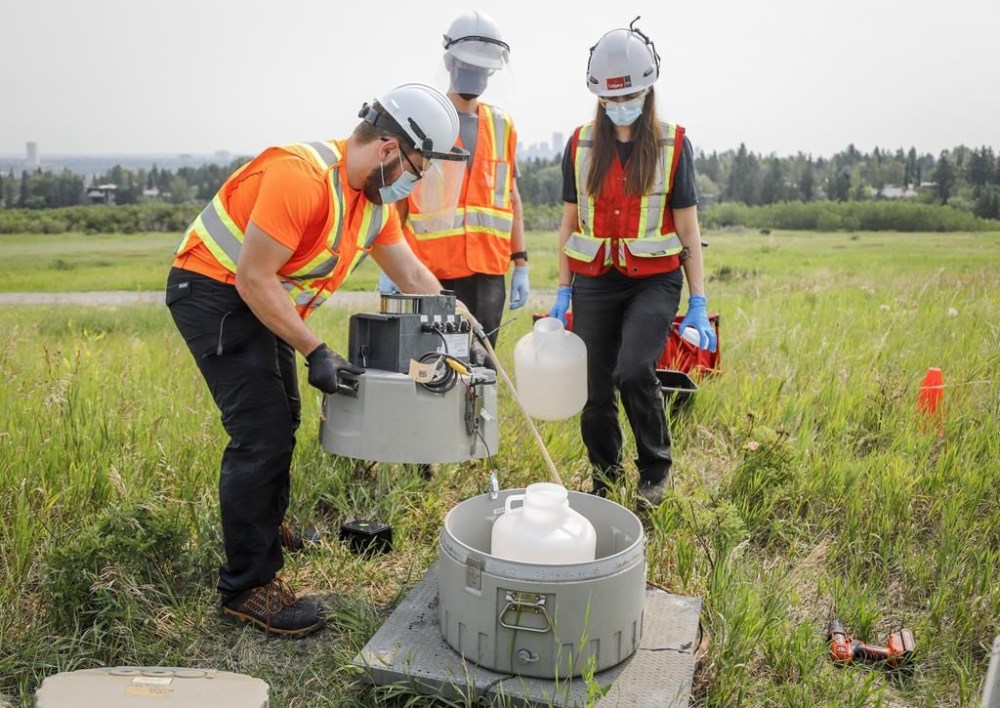
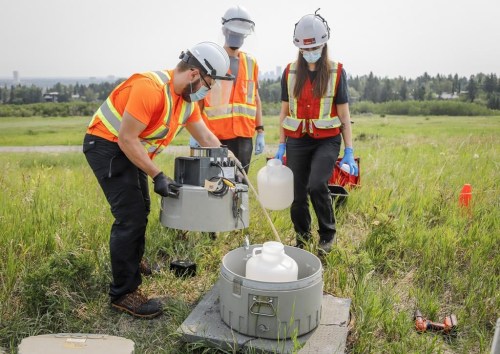
University of Calgary researchers check monitoring equipment as they track traces of COVID-19 in the wastewater system in Calgary on July 14, 2021. Researchers say the amount of opioids and other illicit drugs found in a monitoring of Alberta wastewater jumped in June. THE CANADIAN PRESS/Jeff McIntosh

“I don’t think people were aware of what was in the drug supply,” he said in an interview Wednesday.

“Our hypothesis, and we can’t confirm this of course, is that it was … a new cocktail of carfentanil, benzos and xylazine that might have come into the drug supply. We hadn’t seen this sort of this super concoction before.”

Studies have shown carfentanil to be 10,000 times more potent than morphine, 4,000 times more potent that heroin and 100 times more potent than fentanyl. It’s a synthetic opioid normally used in veterinary medicine to tranquilize large animals.

Ghosh said he’s saddened by the data, but not surprised. He said the subject of addictions is personal for him.

“I’ve lost so many patients to the drug poisoning crisis and there are people I knew who had worked in this field — peers, people with experience — who also lost their lives to this,” Ghosh said.

“We have more overdose and drug poisoning deaths in our province than we have heart attacks, car accidents and murders per day. It’s the biggest public health crisis facing our country.”

Ghosh shared the data with his network, but thinks emergency responders, health-care providers and government officials could benefit from the knowledge as well.

“It could be used as an early warning to provide more information about what is going on with the level of toxicity of the drug supply and possibly prevent deaths,” Ghosh said.

Ghosh is one of the principal investigators on the study, along with infectious disease specialist Dr. Michael Parkins, who was involved in an earlier wastewater study tracking COVID-19.

Parkins said the same detection system was revised to look for 48 substances connected to the use of illicit drugs.

“We are also monitoring for toxic agents that are added to illicit substances during their processing. Several of these diluents are associated with specific toxicities that can result in a range of rare adverse events that are difficult to diagnose,” Parkins said.

“Wastewater surveillance through our sentinel network offers the potential to warn health providers to be alert for those presenting with compatible symptoms.”

The research team isn’t disclosing the location of the sites, as Ghosh said that may increase stigma in these areas and leave the impression that illegal drug use is only happening in a few specific locations.

This report by The Canadian Press was first published Aug. 30, 2023.
Report Error Submit a Tip

More Stories

Towing company hands stolen car back, but not to owner

By Matthew Frank 4 minute read Preview

Towing company hands stolen car back, but not to owner

By Matthew Frank 4 minute read Yesterday at 4:29 PM CDT

A Manitoba man says he is dumbfounded after his car was stolen, impounded by a Winnipeg towing company and given back — to someone that wasn’t him.

Cody Lamb lives in the western Manitoba community of Douglas, about 18 kilometres east of Brandon, but spends weeks away from home working on oil rigs in Alberta.

The 24-year-old says on Sept. 11, while away for work, he heard from his girlfriend who told him his car wasn’t in their driveway. Lamb reported the car stolen to Brandon RCMP the same day.

After filing the report, he heard from Steinbach RCMP on Oct. 1 that his car was recovered that day in the community of Mitchell, roughly five km west of Steinbach.

Read
Yesterday at 4:29 PM CDT

Dozens of Uber, Lyft drivers switched to cheaper insurance coverage: MPI probe

Erik Pindera 5 minute read Preview

Dozens of Uber, Lyft drivers switched to cheaper insurance coverage: MPI probe

Erik Pindera 5 minute read Thursday, Oct. 8, 2026

Ride-service drivers have been defrauding Manitoba Public Insurance by improperly insuring their vehicles as for personal use.

The public insurer and the City of Winnipeg, which regulates ride-hailing services like Uber and Lyft, discovered the widespread fraud after MPI conducted a review in December last year.

“When a driver changes their coverage from ride-share insurance to a personal vehicle coverage and continues to operate as a ride-share driver, that is fraud, plain and simple,” said MPI chief executive officer Satvir Jatana at a news conference Thursday.

MPI’s review looked at a random sample of 408 ride-hailing vehicles and found 108 were operating without the proper vehicle-for-hire insurance coverage. In order to register with the city as a ride-service driver, a vehicle must have such insurance and proof must be provided to the ride-booking company.

Read
Thursday, Oct. 8, 2026

Nature doesn’t waste its time

Russell Wangersky 7 minute read Preview

Nature doesn’t waste its time

Russell Wangersky 7 minute read 2:01 AM CDT

Sixteen months in and the black burn from a forest fire somehow transitions from the foreground to the background. I’m not sure if it actually softens, if it really changes, or if is just that your eyes, now used to the background, start seeing less of it.

One thing’s for certain: nature doesn’t waste any time taking its opportunities. In the sheltered ground behind where the shed over our Newfoundland root cellar used to be, a forest of sorrel has arisen, its dark-green leaves with their distinctive double horns at their base crowding in tight amongst each other.

It’s no surprise: sorrel is new beginnings, often the first plant I see recultivating abandoned gardens or disturbed ground and I’m happy to have it around always. Its distinctive lemony bite is a fine addition to salads, though we’re not likely to choose it from that particular root cellar patch. Not with the way the asphalt roof shingles burned right around there. I shovelled up the heavy pats of congealed black tar last spring, right after the fire, bringing them up from inside the cellar in big plastic buckets to send to safe disposal. But there’s probably plenty of tar still in the ground and out of sight — hardly an appetizing thought.

From other areas, maybe we will eventually sample sorrel: it depends on how close they were to the house or shed or anything else that burned. And so very much burned. The province has said gardens are safe from contamination by fire-retardant chemicals as nothing has shown up in tests. But we know what way the wind was blowing — what burned, and where, is always part of the equation. It’s a strange calculation to make: I’m just glad our house wasn’t heated with fuel oil, was too old to contain asbestos, and didn’t have indoor plumbing for decades.

Read
2:01 AM CDT

Letters, Oct. 10

6 minute read 2:01 AM CDT

Investing in adult vaccines

Last week, provincial and territorial health ministers held an emergency meeting on the looming expiration of federal health funding and the financial pressures facing health systems across the country.

As they gather again in Winnipeg later this month, there is a critical piece missing from the conversation — prevention.

Canada has a strong public-health tradition, but its gains cannot be taken for granted. In 2021, Canada reported zero measles cases. By 2025, more than 5,400 cases had been reported, costing Canada its measles elimination status and Manitoba saw this firsthand.

Landlords will face fines for breaching confidentiality

Carol Sanders 4 minute read Preview

Landlords will face fines for breaching confidentiality

Carol Sanders 4 minute read Yesterday at 5:04 PM CDT

The province is amending legislation to allow landlords to be penalized if they breach the confidentiality of tenants who break their lease by obtaining a domestic violence certificate.

“Hopefully, now there’s going to be measures in place so that if this happens again, and God forbid it happens again to anyone else, that there would be penalties imposed on landlords who do that,” said one victim whose concerns were published on the front page of the Free Press last month.

Under current legislation, landlords must ensure that any information received from those tenants regarding the termination of the tenancy is kept confidential, but there are no penalties for landlords who violate that section of the act. After hearing from victims put at risk when landlords broke the law by violating their confidentiality, the government announced Monday that it is amending the Residential Tenancies Act to allow for penalties.

The young woman who spoke to the Free Press showed that her landlord copied her alleged abuser in email correspondence that included her personal email address and the domestic violence certificate she obtained in 2025 to end a tenancy agreement early and leave an abusive relationship.

Read
Yesterday at 5:04 PM CDT

Alberta wastewater records jump in carfentanil

Bill Graveland, The Canadian Press 3 minute read Preview

Alberta wastewater records jump in carfentanil

Bill Graveland, The Canadian Press 3 minute read Wednesday, Aug. 30, 2023

CALGARY - Researchers say the amount of opioids and other illicit drugs found in a monitoring of Alberta wastewater jumped in June.

Wastewater testing is done weekly at six sites throughout the province as part of a pilot study funded by the Mathison Centre for Mental Health Research and Education at the Cumming School of Medicine and the Calgary Health Foundation that ends this fall.

There was four times the amount of carfentanil present in waste water in June compared to earlier in the year, said Dr. Monty Ghosh, an internist, addictions specialist and assistant professor at the University of Calgary and University of Alberta.

"I don’t think people were aware of what was in the drug supply," he said in an interview Wednesday.

Read
Wednesday, Aug. 30, 2023