Quebec court upholds province’s COVID-19 curfew after Charter challenge
Advertisement
Read this article for free:
or
Already have an account? Log in here »
To continue reading, please subscribe:

Digital Subscription
One year of digital access for only $205*
- Enjoy unlimited reading on winnipegfreepress.com
- Read the E-Edition, our digital replica newspaper
- Access News Break, our award-winning app
- Play interactive puzzles
*First annual payment billed as $205.00 + GST for one year. This annual subscription will automatically renew at $233.00 + GST every 52 weeks (10% off the regular annual price of $259.35). Offer available to new and qualified returning subscribers only. Cancel any time.
To continue reading, please subscribe:
Add Free Press access to your Brandon Sun subscription for only an additional
$1 for the first 4 weeks*
- Enjoy unlimited reading on winnipegfreepress.com
- Read the E-Edition, our digital replica newspaper
- Access News Break, our award-winning app
- Play interactive puzzles
*Your next Brandon Sun subscription payment will increase by $1.00 and you will be charged $17.95 plus GST for four weeks. After four weeks, your payment will increase to $24.95 plus GST every four weeks.
Read unlimited articles for free today:
or
Already have an account? Log in here »
Hey there, time traveller!
This article was published 02/02/2024 (981 days ago), so information in it may no longer be current.
MONTREAL – A provincial court justice of the peace has upheld the Quebec government’s imposition of curfews during the COVID-19 pandemic, finding several people guilty of breaking the health order during a protest.
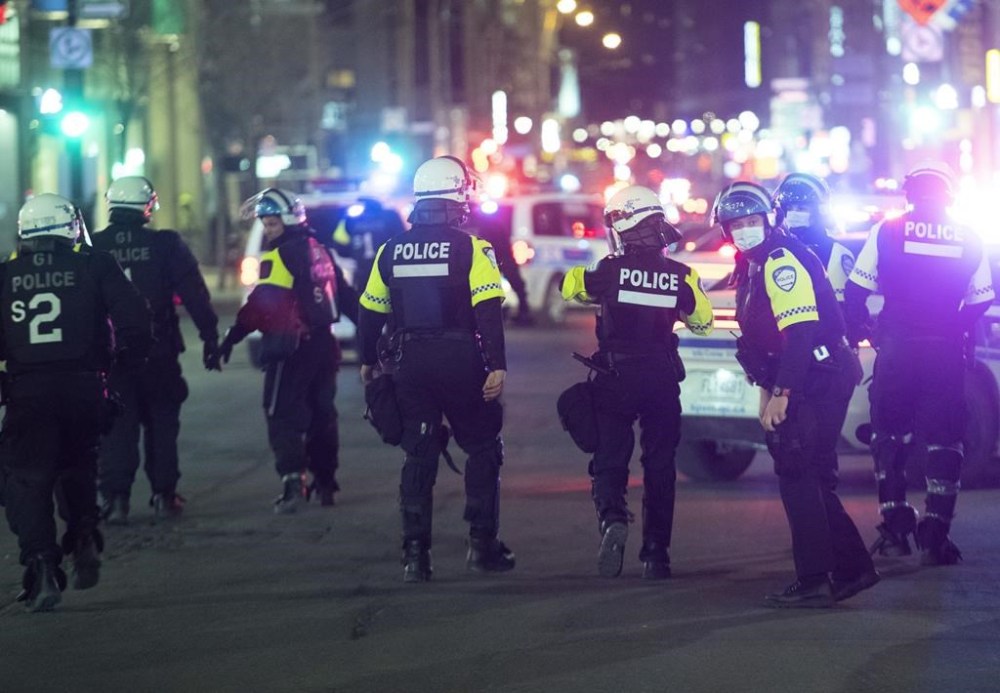
Marie-France Beaulieu of the Quebec court ruled Tuesday that the curfew — which forced Quebecers to stay indoors from 8 p.m. to 5 a.m. — infringed Charter-protected rights like freedom of expression and lawful assembly, but she said those violations were reasonable and justified given the public health context.
“The pandemic and the rapid increase in (COVID-19) cases constitute exceptional circumstances raising public health issues, this situation forced the government to adopt measures to reduce the risks of spread in order to protect the life and health of the population,” Beaulieu wrote in a 65-page ruling.
“In other words, as no one could predict with certainty what the long-term impacts of the upheavals caused by COVID-19 would be, it was necessary to take appropriate means, including the use of a curfew.”
Stéphanie Pépin, who along with seven others broke the curfew by holding a demonstration after 8 p.m. in January 2021, had raised a Charter challenge against the health order.
She and others demonstrated against the rules in Amos, Que., about 485 kilometres northwest of Montreal, in the Abitibi-Témiscamingue region. Her challenge was assisted by the Calgary-based Justice Centre for Constitutional Freedoms.
Lawyer Olivier Séguin, who represented Pépin, said the ruling will be appealed. In a statement, he argued it was evident that authorities had “no constitutional basis on which to act.”
With this week’s decision, the eight defendants were ordered to pay a $1,000 fine within six months.
Premier François Legault’s Coalition Avenir Québec government twice used nightly curfews during the pandemic. The first lasted nearly five months, starting on Jan. 9, 2021, until May 28, 2021. He imposed a second COVID-19 curfew on New Year’s Eve 2021 until Jan. 17, 2022. Breaking the curfew carried fines of between $1,000 and $6,000.
Quebec was the only province to prohibit its citizens from leaving their homes at night during the COVID-19 pandemic.
The Charter case heard testimony from senior Quebec public health officials at the time, including former public health director Dr. Horacio Arruda, and Dr. Richard Massé, another public health official.
In her ruling, Beaulieu said the global pandemic was an “exceptional context.” The government, she said, “had to plan and provide a reasonable framework for social activities and interactions, hence the adoption of specific measures.”
This report by The Canadian Press was first published Feb. 2, 2024.