Dengue is sweeping through the Americas early this year

Advertisement

Advertise with us

SAN JUAN, Puerto Rico (AP) — Dengue is surging across the Americas early this year from Puerto Rico to Brazil, with 3.5 million cases of the tropical disease reported so far, health officials said Thursday.

Read this article for free:


or

Already have an account? Log in here »

To continue reading, please subscribe:

Subscribe and receive a limited-edition Free Press branded hat or tote.

Digital Subscription

One year of digital access for only $205*

  • Enjoy unlimited reading on winnipegfreepress.com
  • Read the E-Edition, our digital replica newspaper
  • Access News Break, our award-winning app
  • Play interactive puzzles

*First annual payment billed as $205.00 + GST for one year. This annual subscription will automatically renew at $233.00 + GST every 52 weeks (10% off the regular annual price of $259.35). Offer available to new and qualified returning subscribers only. Cancel any time.

To continue reading, please subscribe:

Add Free Press access to your Brandon Sun subscription for only an additional

$1 for the first 4 weeks*

  • Enjoy unlimited reading on winnipegfreepress.com
  • Read the E-Edition, our digital replica newspaper
  • Access News Break, our award-winning app
  • Play interactive puzzles
Start now

*Your next Brandon Sun subscription payment will increase by $1.00 and you will be charged $17.95 plus GST for four weeks. After four weeks, your payment will increase to $24.95 plus GST every four weeks.

Hey there, time traveller!
This article was published 28/03/2024 (925 days ago), so information in it may no longer be current.

SAN JUAN, Puerto Rico (AP) — Dengue is surging across the Americas early this year from Puerto Rico to Brazil, with 3.5 million cases of the tropical disease reported so far, health officials said Thursday.

That tally is three times the number of cases reported at this point last year, said Dr. Jarbas Barbosa, director of the Pan American Health Organization, the regional office of the World Health Organization in the Americas.

Last year, there were a record 4.5 million cases in the region, and PAHO officials said they expect this year will set a new record.
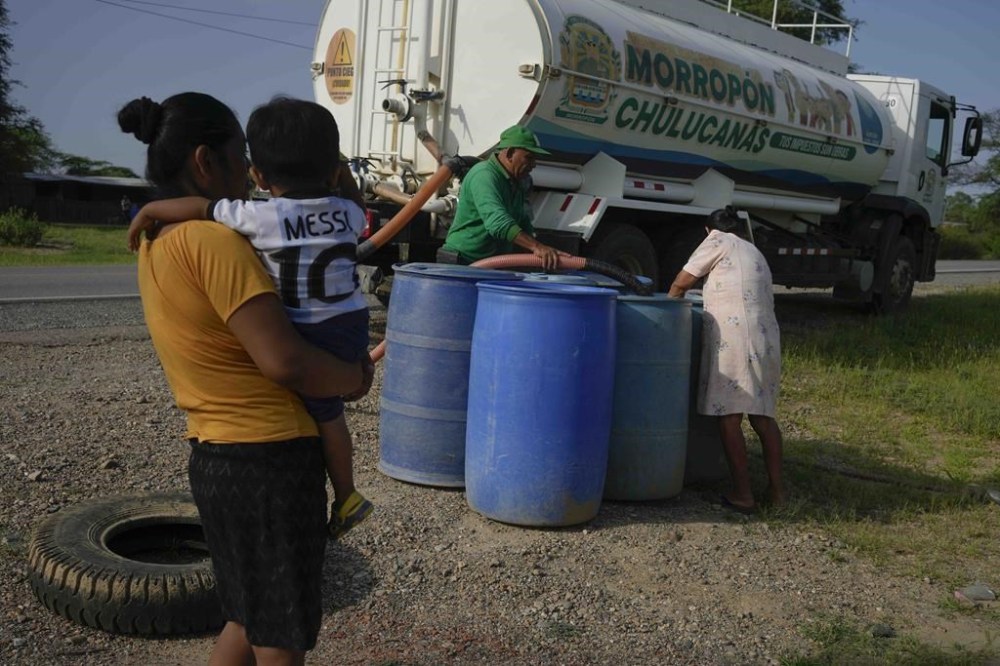
A water distribution worker fills an empty barrel for resident Santos Suyon in Santa Rosa, Chulucanas, Peru, one of many areas where a health emergency was declared due to rising dengue cases, Wednesday, Feb. 28, 2024. Once a week, residents in this area fill barrels with water from a distribution truck and use it for all their water needs. (AP Photo/Martin Mejia)

Usually dengue spikes during the wet season, which is still months away. And some areas are reporting dengue for the first time, officials said.

The dengue virus is spread to people when they are bitten by infected mosquitoes. Driving the surge are rising temperatures, rapid urbanization, droughts and floods linked to climate change, and poor sanitation and a lack of robust health systems in some countries, health officials said.

The virus can cause crushing headaches, fever, vomiting, a rash and other symptoms. While most infected people don’t get symptoms, severe cases can lead to death. There’s no specific treatment other than pain medications.

Most of the current cases are in the Southern Hemisphere, with more than 80% in Brazil, followed by Paraguay, Argentina, Peru and Colombia. Some 1,000 deaths have been reported in the Americas so far this year.

In the Caribbean alone, more than 25,000 cases have been reported, with French Guiana, Martinique, Guadeloupe, Puerto Rico and the Dominican Republic most affected, said Dr. Rhonda Sealey-Thomas, PAHO’s assistant director.

On Monday, Puerto Rico’s health secretary declared an epidemic, with more than 540 cases, with at least 341 people hospitalized. The numbers are concerning because parts of the island are currently under a moderate drought, and the rainiest month isn’t until August.

The surge in cases forced Rio de Janeiro to declare a public health emergency last month ahead of Carnival. Peru did the same for most of its provinces, and others have followed suit.

There are four different dengue viruses circulating in the Americas, said the PAHO’s Dr. Sylvain Aldighieri. “We have to be prepared for this.”

Some countries have released specially bred mosquitoes that contain a bacteria called Wolbachia that fights dengue.

Last month, Josian Bruno, who lives in the San Juan capital of Puerto Rico, developed a fever and body aches. A lab test confirmed that the 38-year-old had kidney failure because of severe dehydration. He spent six days in the hospital, and the day after being released, his test results came back positive for dengue.

“When they tell you it’s renal failure, that’s scary,” he said.

A month has passed, and Bruno still has difficulty moving his arms and walking, and he hasn’t been able to resume his thrice-weekly runs.

While a new dengue vaccine is available in limited supply, it requires two doses with a three-month interval. Barbosa said officials are monitoring how well it actually works. He said a single-shot vaccine won’t be available until next year.


Report Error Submit a Tip

More Stories

Letters, Oct. 9

7 minute read 2:01 AM CDT

Manitoba Hydro at it again

As a former resident of Windsor Park, I often ride my bicycle through the neighbourhood or walk the shaded pathway from Elizabeth Road to Cottonwood Drive. It’s a favourite walkway for residents with dogs as well. While passing the pathway at Elizabeth Road the other day I was dismayed to see crews clear-cutting the mature trees between the pathway and the CPKC tracks that stretch the length of Archibald Street.

At first I thought that the crews were clearing out the dense bushes and trees at the start of the pathway. I made a note to return to see if that was all that was going to be done. (When) I drove by the trees had been clear-cut to the end of the first street and access point to it, much to my dismay and horror. I parked my car and went to speak with a worker doing the tree removal.

I was informed that it was a Hydro corridor and that the work would clear-cut every tree between Elizabeth Road and Cottonwood Road. Perhaps the plan is to continue on through Southdale and Island Lakes. At a time of diminishing tree canopies around Winnipeg and the drive to plant a million trees, this decision is outrageous and lacks respect for our current climate situation and neighbourhood esthetics.

‘Please excuse us from writing these notes …’

Editorial 4 minute read Preview

‘Please excuse us from writing these notes …’

Editorial 4 minute read 2:01 AM CDT

It’s a common-sense prescription for the health-care system. The only wonder is that it took so long to happen.

On Oct. 1, new provincial legislation came into effect that will stop employers from requiring employees to get a sick note from a physician unless the employee has been absent for more than a week or has called in sick 10 or more times in a calendar year.

And the legislation could have a big effect.

Doctors Manitoba has calculated that its members write over 600,000 sick notes every year — a process that costs the provincial health-care system approximately $8 million annually. And the effort doesn’t even help sick workers get better: one-third of sick notes are written for patients who don’t even have symptoms anymore, making them little more than a comfortable fiction. To put it simply, doctors have to trust that a symptom-less patient was sick and write a note saying they were ill, in order to satisfy an employer who doesn’t share that same level of trust.

Read
2:01 AM CDT

Other cities build rapid transit, while we wait

Ken Klassen 4 minute read Preview

Other cities build rapid transit, while we wait

Ken Klassen 4 minute read 2:00 AM CDT

Winnipeg’s civic election campaign has produced no shortage of promises to improve transit safety and fix problems with the new network. Those issues are real and urgent. But they should not distract from a larger failure — while other Canadian urban regions secure billions in federal support to transform their transit systems, Winnipeg is falling further behind.

The Winnipeg Transit Master Plan, approved in 2021, sets the right vision — frequent, reliable service anchored by an expanded bus rapid transit (BRT) network. Yet not a single additional BRT corridor has been approved for construction. The modest network proposed in the plan is not projected to be completed until 2045 or beyond. Despite that, city council voted this summer to delay updating the master plan by two years.

The full BRT network was estimated at $588 million to $1.1 billion in 2020 — or roughly $720 million to $1.34 billion today, after accounting for construction inflation. That is substantial, but modest compared with what other cities are spending. Calgary, Edmonton, Hamilton, Ottawa and Quebec City have rapid transit projects under way or recently completed, totalling about $26 billion and backed by $7.3 billion in federal commitments. Vancouver, Toronto and Montreal are spending billions more with federal support.

Other cities build. Winnipeg waits.

Read
2:00 AM CDT

Nurses disciplined for botched IV infusion

Nicole Buffie 4 minute read Preview

Nurses disciplined for botched IV infusion

Nicole Buffie 4 minute read Updated: Yesterday at 4:36 PM CDT

Two nurses working at the Grace Hospital have been reprimanded and fined $2,500 each for an IV infusion gone bad and an attempted coverup.

The incident happened on November 23, 2023 when a nurse asked a colleague to set up an IV infusion on him in an unused operating room.

During the attempted IV start, the nurse lost consciousness. The nurse who attempted the IV drip and another who was in the room called for help and several staff responded.

The nurse regained consciousness and vomited, but recovered and continued to work his shift, a March 18 decision by the College of Registered Nurses of Manitoba says.

Read
Updated: Yesterday at 4:36 PM CDT

Dog feces vandalism shuts down food pantry

Kelly-Anne Riess 4 minute read Preview

Dog feces vandalism shuts down food pantry

Kelly-Anne Riess 4 minute read Yesterday at 6:54 PM CDT

A few shelves set up beneath a West End community notice board were meant to offer a place where neighbours could leave food for anyone who needed it.

Read
Yesterday at 6:54 PM CDT

Mayoral race all sideshow, little substance

Editorial 4 minute read Preview

Mayoral race all sideshow, little substance

Editorial 4 minute read Yesterday at 2:00 AM CDT

Well, there’s one thing that can be said about Winnipeg’s 2026 mayoral race that sets it apart from most previous campaigns for city council’s top position:

Read
Yesterday at 2:00 AM CDT