In some classrooms in Senegal, deaf and hard-of-hearing students now study alongside everyone else

Advertisement

Advertise with us

PIKINE, Senegal (AP) — Mouhamed Sall stepped to the chalkboard with a glance and quick question in sign language to an assistant. Then he solved the exercise to the silent approval of his classmates, who waved their hands in a display of appreciation.

Read this article for free:


By clicking the button above, an account will be created and you will begin to receive some of our recommended newsletters. You may opt out of any newsletter by visiting your Email and Communication Preferences page or by clicking "unsubscribe" at the bottom of any email.

or

Already have an account? Log in here »

To continue reading, please subscribe:

Digital Subscription

One year of digital access for only $1.44 a week*

  • Enjoy unlimited reading on winnipegfreepress.com
  • Read the E-Edition, our digital replica newspaper
  • Access News Break, our award-winning app
  • Play interactive puzzles

*Billed as $5.77 plus GST every four weeks. After 52 weeks, price increases to the regular rate of $19.95 plus GST every four weeks. Offer available to new and qualified returning subscribers only. Cancel any time.

To continue reading, please subscribe:

Add Free Press access to your Brandon Sun subscription for only an additional

$1 for the first 4 weeks*

  • Enjoy unlimited reading on winnipegfreepress.com
  • Read the E-Edition, our digital replica newspaper
  • Access News Break, our award-winning app
  • Play interactive puzzles
Start now

*Your next Brandon Sun subscription payment will increase by $1.00 and you will be charged $17.95 plus GST for four weeks. After four weeks, your payment will increase to $24.95 plus GST every four weeks.

Hey there, time traveller!
This article was published 10/04/2024 (926 days ago), so information in it may no longer be current.

PIKINE, Senegal (AP) — Mouhamed Sall stepped to the chalkboard with a glance and quick question in sign language to an assistant. Then he solved the exercise to the silent approval of his classmates, who waved their hands in a display of appreciation.

Sall and three other students are part of a new approach in a small number of schools in Senegal that seat those who are deaf and hard of hearing with the rest of the class.

Some classmates at the sun-washed Apix Guinaw Rails Sud school in a suburb of the capital, Dakar, have embraced the chance to learn sign language in the months since Sall arrived. The class is lively and cheeky: “No teachers allowed in this room,” graffiti scrawled above the chalkboard says.
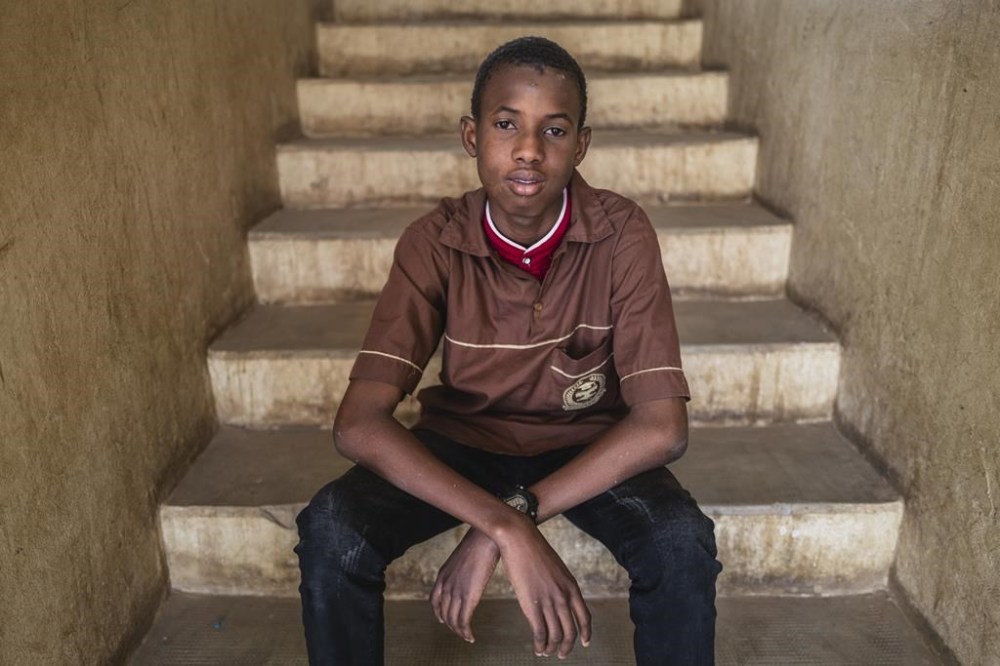
Mouhamed Sall, who is deaf, sits on the steps of the Guinaw Rail Sud public high school in Pikine, Senegal, Monday, March 18, 2024. Sall and three other students are part of a new approach in a small number of schools in Senegal that seat those who are deaf and hard of hearing with the rest of the class. (AP Photo/Sylvain Cherkaoui)

“I have no problem communicating with some colleagues I went to primary school with,” Sall said as his mother spoke. “The new colleagues don’t know sign language but we still play together.”

“We’ve been friends, so it was easy to learn sign language,” said classmate Salane Senghor, who also knew Sall in primary school. New classmates were curious, looking to the assistant to find out what he was saying.

The United Nations children’s agency says about 60% of children with disabilities in Senegal are not going to school. But the government lacks comprehensive data on the issue and counts only children who are formally registered as having a disability.

“We’re looking for progress from the government to ensure every child, regardless of ability, has the opportunity to learn,” said Sara Poehlman with UNICEF Senegal.

Senegal lacks a national strategy for inclusive education, but it is developing one. Recent political instability in the West African nation has hindered progress.

The challenges are compounded by a stigma that some in Senegal associate with disabilities. Some parents hide their children and prevent them from participating in society.

But attitudes are changing. In 2021, Senegal’s football team for deaf and hard of hearing players won the first African football championship for such teams and played in the world championship, to the congratulations of Senegal’s president. During the recent election, the National Association for the Promotion of the Deaf in Senegal and the International Foundation for Electoral Systems organized a workshop to teach hard-of-hearing voters over 100 election-related terms in sign language.

Now there’s more visibility in classrooms.

The organization Humanity and Inclusion last year began partnering with Senegal’s education ministry for mixed classes in four public secondary schools with inclusive education practices. Apix is one of them. Humanity and Inclusion funds the hiring of assistants who can communicate in sign language.

“We see that all children are on an equal footing, and that’s why we make an inclusive class or school by harmonizing with the hearing pupils,” said Papa Amadou, one assistant.

Sall is receiving education free of charge, a big advantage in a part of the world where school fees can be a constant source of stress for parents.

Until now, Senegal has had mostly specialized schools for children with disabilities, but they are often private and expensive.

Sall’s mother, Khadija Koundio, at first paid about $17 every month for him to attend an activity center for children with learning challenges in their neighborhood. Then he was able to enter primary school with the support of a similar Humanity and Inclusion program created several years ago in a small number of schools for younger students.

Omar Diop, head supervisor at Apix, praised the new secondary school program but said challenges continue.

“It’s their first year for the teachers, so that poses a problem because the children come with a much higher level of sign language,” Diop said.

Mamadou Konte, the Apix school director, emphasized the need for more teacher training. “We’ve seen success at our school, but this model needs to be replicated nationwide,” Konte added.

Challenges remain for students and families, too. Koundio, president of the parents’ association for the school’s deaf and hard-of-hearing students, said some of her son’s classmates live farther away and struggle with the cost of commuting.

Poehlman with UNICEF highlighted government initiatives like the Carte de l’Égalité, which provides financial assistance to families so children can access specialized schools, but she stressed the importance of programs implemented in public schools.

Jandira Monteiro with Humanity and Inclusion urged collaboration between Senegal’s ministries of health and education to ensure holistic support for children with disabilities.

Sall said he feels accepted by his peers. The teachers at Apix commend him on his intelligence and his artistic talents in crafting bright models of houses and traditional boats called pirogues.

His mother wants him to pursue his passions, including art.

“One day, when I’m gone, he’ll have enough to support himself,” she said.

___

Ndeye Sene Mbengue in Dakar, Senegal, contributed to this report.

___

The Associated Press receives financial support for global health and development coverage in Africa from the Bill & Melinda Gates Foundation Trust. The AP is solely responsible for all content. Find AP’s standards for working with philanthropies, a list of supporters and funded coverage areas at AP.org.
Report Error Submit a Tip

More Stories

In some classrooms in Senegal, deaf and hard-of-hearing students now study alongside everyone else

Andrei Popoviciu, The Associated Press 5 minute read Preview

In some classrooms in Senegal, deaf and hard-of-hearing students now study alongside everyone else

Andrei Popoviciu, The Associated Press 5 minute read Wednesday, Apr. 10, 2024

PIKINE, Senegal (AP) — Mouhamed Sall stepped to the chalkboard with a glance and quick question in sign language to an assistant. Then he solved the exercise to the silent approval of his classmates, who waved their hands in a display of appreciation.

Sall and three other students are part of a new approach in a small number of schools in Senegal that seat those who are deaf and hard of hearing with the rest of the class.

Some classmates at the sun-washed Apix Guinaw Rails Sud school in a suburb of the capital, Dakar, have embraced the chance to learn sign language in the months since Sall arrived. The class is lively and cheeky: “No teachers allowed in this room,” graffiti scrawled above the chalkboard says.

“I have no problem communicating with some colleagues I went to primary school with,” Sall said as his mother spoke. “The new colleagues don’t know sign language but we still play together."

Read
Wednesday, Apr. 10, 2024

U of W, former professor sued over alleged sex assault

Erik Pindera 4 minute read Preview

U of W, former professor sued over alleged sex assault

Erik Pindera 4 minute read Wednesday, Oct. 21, 2026

A woman who studied and worked at the University of Winnipeg has filed a lawsuit against the post-secondary institution and her former professor — a convicted sex offender — who she alleges drugged and sexually assaulted her.

Read
Wednesday, Oct. 21, 2026

Gillingham says Portage and Main underground should stay open

Joyanne Pursaga 6 minute read Preview

Gillingham says Portage and Main underground should stay open

Joyanne Pursaga 6 minute read Wednesday, Oct. 21, 2026

Scott Gillingham said he hopes to keep the circular concourse beneath Portage Avenue and Main Street open, if he’s re-elected mayor next week.

“I would like to find a way for it to stay,” said Gillingham during the mayoral debate hosted by CJOB Wednesday.

The downtown intersection reopened to pedestrians at street level in June 2025.

When he first supported that hotly debated reopening in 2024, Gillingham called for the underground mall to be closed. At the time, the city estimated it would take $73 million and up to five years of traffic-snarling construction to repair the leaking membrane under the street that protects the properties below.

Read
Wednesday, Oct. 21, 2026

Hydro is getting ahead of itself

Tim Sale 5 minute read 2:00 AM CDT

Manitoba Hydro is pressing ahead with its proposed $3-billion gas-turbine project in Brandon as though approval was a foregone conclusion. Six weeks of Public Utilities Board hearings exposed serious doubts about the need for three turbines, their escalating cost and whether more affordable alternatives have been adequately examined. Yet before the PUB has delivered its recommendations and the government has authorized the investment, Hydro applied for an environmental license on Oct. 8.

Starting the environmental review early may save time but proceeding before the premier and his cabinet have made a decision risks reducing regulatory scrutiny and political approval to mere formalities. Has the government already given Hydro the green light?

Few dispute that Manitoba will need more capacity as demand grows. Daymark Energy Advisors, the PUB’s independent consultant, concluded that Hydro had established a need for additional capacity by 2030. However, Daymark questioned the size of the projected shortfall, Hydro’s load forecasts and its turbine cost assumptions. Hydro itself acknowledged that its planning costs were based on 2024 information, and that surging North American demand for gas turbines has since put significant upward pressure on prices. Then there’s the impact of Trump’s trade war. These are not minor details, but updated costs have not been obtained.

The bigger problem is how Hydro has framed the alternatives. Interim CEO Hal Turner recently argued that wind and battery storage alone cannot reliably carry Manitoba through prolonged extreme cold. Fair enough. However, critics are not proposing wind and batteries alone.

Builder beefs up security after string of blazes

Morgan Modjeski 3 minute read 2:01 AM CDT

A Winnipeg builder said he’s had to beef up security around his developments after one of his projects sustained significant damage Wednesday in suspected arson cases.

“This is so bad for me,” said Rupinder Brar. “This is so sad.”

Firefighters were sent to the construction site at 297 Regal Ave., shortly before 4 a.m. Heavy smoke and flames were coming from the two homes on the site and threatened to jump to nearby buildings.

Winnipeg Police Service Const. Claude Chancy said police are investigating the blaze, as well as two fires in St. Boniface that were five days apart.

Don’t let good health reforms fade or fossilize

Alan Menkis 5 minute read 2:00 AM CDT

When Canada’s health ministers left Winnipeg on Oct. 16, they took with them a promise to keep talking. The federal health minister did not commit to long-term funding. She offered one-year extensions for programs that were about to run out, and asked officials to begin work on “the next 10 years.”

The provinces, in the words of Manitoba Health Minister Uzoma Asagwara, wanted to avoid “fiscal cliffs” and needed “predictable, stable, sustainable funding.”

Both sides have a point. And both are talking almost entirely about money — how much, for how long, under what formula.

Missing from the conversation is the question that decides whether any of it works — once the money flows, who must answer for what it does, or does not, achieve? We have been here before. In 2002, a Senate committee chaired by Michael Kirby warned that new federal money “must be used to buy change, not merely to support the system as it is presently structured.” It proposed an independent national health care commissioner, reporting every year to the public on how the system and the health of Canadians were faring.