Last year’s deadly heat wave in metro Phoenix didn’t discriminate
Advertisement
Read this article for free:
or
Already have an account? Log in here »
To continue reading, please subscribe:

Digital Subscription
One year of digital access for only $205*
- Enjoy unlimited reading on winnipegfreepress.com
- Read the E-Edition, our digital replica newspaper
- Access News Break, our award-winning app
- Play interactive puzzles
*First annual payment billed as $205.00 + GST for one year. This annual subscription will automatically renew at $233.00 + GST every 52 weeks (10% off the regular annual price of $259.35). Offer available to new and qualified returning subscribers only. Cancel any time.
To continue reading, please subscribe:
Add Free Press access to your Brandon Sun subscription for only an additional
$1 for the first 4 weeks*
- Enjoy unlimited reading on winnipegfreepress.com
- Read the E-Edition, our digital replica newspaper
- Access News Break, our award-winning app
- Play interactive puzzles
*Your next Brandon Sun subscription payment will increase by $1.00 and you will be charged $17.95 plus GST for four weeks. After four weeks, your payment will increase to $24.95 plus GST every four weeks.
Read unlimited articles for free today:
or
Already have an account? Log in here »
Hey there, time traveller!
This article was published 27/05/2024 (859 days ago), so information in it may no longer be current.
PHOENIX (AP) — Priscilla Orr, 75, was living in her old white Kia in a supermarket parking lot last summer after telling her family she lost her money and home to a romance scam.
But the car broke down, and the air conditioner stopped working, leaving her vulnerable to the dangerous desert heat. Orr collapsed last July as she walked on the lot’s scalding asphalt, which registered 149 degrees Fahrenheit (65 C) as the air temperature topped the triple digits.
She was dead by the time paramedics arrived.
Orr was among over 400 people who died last year in metro Phoenix from heat-associated causes during a 31-day streak of sizzling days of 110 F (43.3 C) or higher that stretched from the last day of June through all of July.
That’s about two-thirds of 645 heat-related deaths confirmed from the whole year in Maricopa County, home to Phoenix and Arizona’s most populous county. No other major metropolitan area in the U.S. has reported such high heat-associated death figures.
“This should not have happened to her,” said Anna Marie Colella, Orr’s former daughter-in-law and the mother of her three adult granddaughters. “She should have lived until she was 100, because that was just Priscilla.”
Heat is the top cause of weather-related deaths, killing more people than hurricanes, tornadoes and floods combined, said Tom Frieders, the agency’s warning coordination meteorologist in Phoenix.
Lives are at risk again this summer as the National Weather Service predicts above-normal temperatures and below-normal precipitation.
“We’re just hoping it’s not to the extreme level we saw last year,” Frieders said.
HOTTER SUMMERS
Climate change is causing heat waves that bake more of the population for a longer time, with higher temperatures over wider areas, according to a study released this spring by Science Advances.
Last summer, Phoenix experienced the hottest three months since record-keeping began in 1895, including the hottest July and the second-hottest August. The daily average temperature of 97 F (36.1 C) in June, July and August passed the previous record of 96.7 F (35.9 C) set in 2020.
Of all heat-related deaths in Maricopa County last year, drugs or alcohol were a factor in nearly two-thirds, most commonly methamphetamine, followed by fentanyl. About 45% of the victims were homeless.
The July heat wave was noted by the pathologist who wrote the report on Doris Marie Long, an 89-year-old with heart disease and diabetes who died in her mobile home in the eastern suburb of Apache Junction.
Because only one of two air conditioning units were working, Long stayed most of the time in her home’s cooler section. But when she was found, the indoor temperature was 116 F (44.6 C)
EVERYONE’S AT RISK
Taken together, the medical examiner reports for last year’s heat wave deaths make clear that extreme weather does not discriminate.
The victims were old and young, male and female, homeless and well-to-do. They were Black, white, Hispanic, Asian American and Native American.
They ranged from a 19-year-old man addicted to fentanyl who collapsed in a roasting alley to a 96-year-old military veteran who died in a hospital after he was found unresponsive in his sweltering home without air conditioning.
Left vulnerable to the unrelenting heat after her eviction, Orr remained in frequent contact with relatives who tried to sort out exactly how she had been scammed and tried to keep her safe.
She initially stayed with different family members for a few days or weeks but always left for fear she was becoming a burden, said Hailey Orr, her youngest granddaughter.
The grandmother had been living in her car in the supermarket parking lot for several weeks before she died; family members would bring her cold water and tried to care for her.
The younger Orr told of missing her grandmother’s sense of humor and love of animals, commenting on a favorite photograph of her smiling and holding a tiny kitten. She said she wishes her grandmother had accepted the family’s offers for help.
VULNERABLE OLDER PEOPLE
Like Orr, almost two-thirds of the people who died were 50 or older. As people age, it becomes harder for the body to regulate its internal temperature. Older people also tend to have health conditions that make them more vulnerable to the heat, such as diabetes, heart and kidney problems, or high blood pressure. Prescription medicines like diuretics can cause dehydration, especially during warm weather in an area as arid as central Arizona.
For the aged, dementia can be a factor. An 83-year-old woman with Alzheimer’s and a habit of wandering was found dead by her niece, collapsed in the stifling alley behind her home.
Most of the older heat victims were alone in their own homes, including a 73-year-old widow who died with her dog Pumpkin when the air conditioning in her $1 million Scottsdale house malfunctioned. An 85-year-old woman of limited means who lived in an old parsonage in exchange for minimal rent and maintenance duties also died with insufficient cooling.
As the heat wave drew to an end, a caregiver found 79-year-old Concetta Davies, bedbound with dementia, and her husband, 74-year-old Ronald Davies, in the 102 F (38.8 C) heat of their home.
Not everyone who died was old.
Nathan Perkins, 33, died on a Sunday morning when he went hiking by himself in a remote desert area. The senior engineer at the utility cooperative Salt River Project was engaged to be married.
“He was a bright engineer who talked a lot about his family, fiancée and future of being a husband and dad,” his supervisor Maria Naff wrote in an online tribute.
A pregnant 33-year-old woman with a history of drug use and schizophrenia was discovered on a scalding street and died on her way to the hospital. A 50-year-old homeless man died slumped at a bus stop.
LONESOME DEATHS
One thing most victims shared was isolation, spending their last moments without the comfort of loved ones or friends as the arid weather dried their sweat before they even noticed how overheated they were becoming. Heat stroke set in, their skin got hot and red, their pulse quickened and body temperature rose before they lost consciousness.
Many older victims were people originally from the Midwest who retired in Arizona to escape cold winters, usually living alone far from relatives and without much contact with neighbors who may have checked on them. Or they were living in the street, without shelter to protect them from the brutal desert heat.
A 51-year-old man who had once been proud to be a former firefighter for the U.S. Bureau of Indian Affairs died by himself far from his native Navajo Nation on a blistering Phoenix sidewalk the morning after he left a detox facility and went binge drinking.
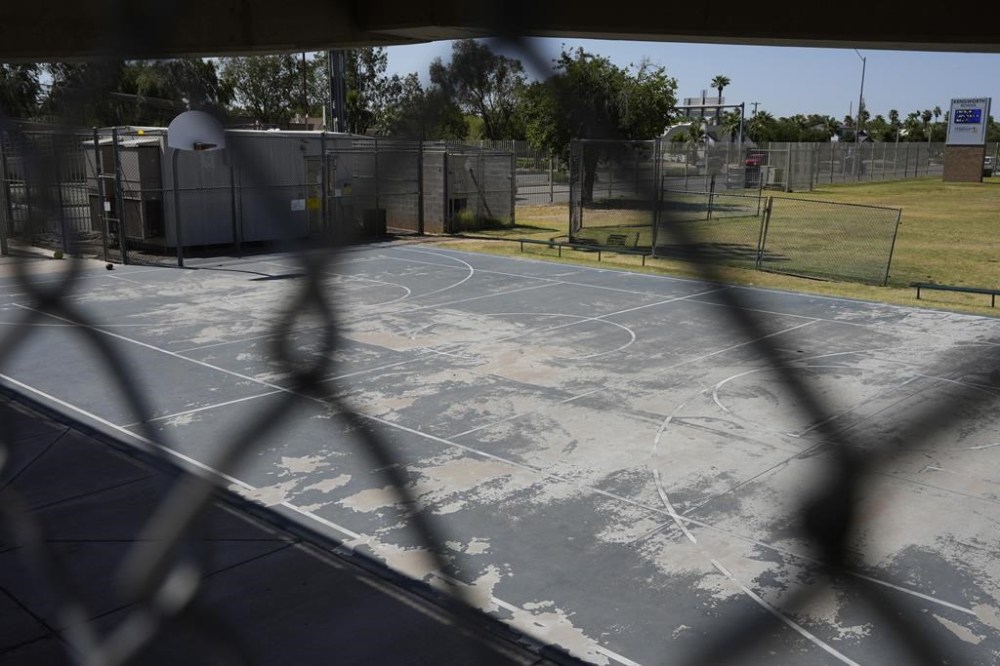
A maintenance crew at a Phoenix elementary school discovered the body of a 60-year-old homeless man, Ronald Rogers, after he jumped over a 10-foot (3-meter) fence to get to the shaded grassy area next to a basketball court, breaking both legs in a jump or fall. County authorities never found his next of kin.
Rogers was later buried in Maricopa County’s White Tanks Cemetery, where the dead are laid to rest if they they have no known family. Located in a rural area far west of Phoenix, the graves are lined up neatly in rows, each marked with a single red brick bearing a name and date of birth.
Michele Castañeda-Martinez’s job as a division administrator for the county’s Department of Public Health includes ensuring a proper cremation and interment of the ashes of people who die such lonesome deaths. Military veterans are entitled to interment at a national or state cemetery, but White Tanks becomes the final resting place for hundreds of people annually, with 513 burials there last year.
“Many times, there isn’t anyone, even after all of our efforts,” she said.