Scientists show how pregnancy changes the brain in innumerable ways

Advertisement

Advertise with us

Neuroscientist Liz Chrastil got the unique chance to see how her brain changed while she was pregnant and share what she learned in a new study that offers the first detailed map of a woman's brain throughout gestation.

Read this article for free:


or

Already have an account? Log in here »

To continue reading, please subscribe:

Subscribe and receive a limited-edition Free Press branded hat or tote.

Digital Subscription

One year of digital access for only $205*

  • Enjoy unlimited reading on winnipegfreepress.com
  • Read the E-Edition, our digital replica newspaper
  • Access News Break, our award-winning app
  • Play interactive puzzles

*First annual payment billed as $205.00 + GST for one year. This annual subscription will automatically renew at $233.00 + GST every 52 weeks (10% off the regular annual price of $259.35). Offer available to new and qualified returning subscribers only. Cancel any time.

To continue reading, please subscribe:

Add Free Press access to your Brandon Sun subscription for only an additional

$1 for the first 4 weeks*

  • Enjoy unlimited reading on winnipegfreepress.com
  • Read the E-Edition, our digital replica newspaper
  • Access News Break, our award-winning app
  • Play interactive puzzles
Start now

*Your next Brandon Sun subscription payment will increase by $1.00 and you will be charged $17.95 plus GST for four weeks. After four weeks, your payment will increase to $24.95 plus GST every four weeks.

Hey there, time traveller!
This article was published 16/09/2024 (727 days ago), so information in it may no longer be current.

Neuroscientist Liz Chrastil got the unique chance to see how her brain changed while she was pregnant and share what she learned in a new study that offers the first detailed map of a woman’s brain throughout gestation.

The transition to motherhood, researchers discovered, affects nearly every part of the brain.

Although the study looks at only one person, it kicks off a large, international research project that aims to scan the brains of hundreds of women and could one day provide clues about disorders like postpartum depression.
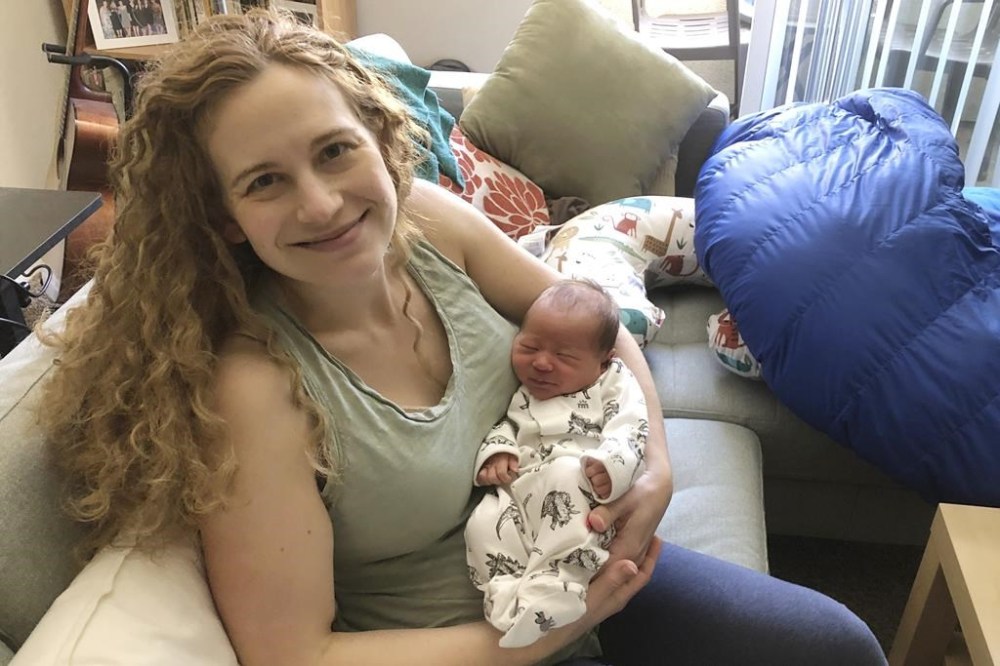
In this photo provided by Liz Chrastil, a neuroscientist with the University of California, Irvine, she her holds her newborn son in May 2020. (Courtesy Liz Chrastil via AP)

“It’s been a very long journey,” said Chrastil, co-author of the paper published Monday in Nature Neuroscience. “We did 26 scans before, during and after pregnancy” and found “some really remarkable things.”

More than 80% of the regions studied had reductions in the volume of gray matter, where thinking takes place. This is an average of about 4% of the brain — nearly identical to a reduction that happens during puberty. While less gray matter may sound bad, researchers said it probably isn’t; it likely reflects the fine-tuning of networks of interconnected nerve cells called “neural circuits” to prepare for a new phase of life.

The team began following Chrastil — who works at the University of California, Irvine, and was 38 years old at the time — shortly before she became pregnant through in vitro fertilization.

During the pregnancy and for two years after she gave birth, they continued doing MRI brain scans and drawing blood to observe how her brain changed as sex hormones like estrogen ebbed and flowed. Some of the changes continued past pregnancy.

“Previous studies had taken snapshots of the brain before and after pregnancy, but we’ve never witnessed the brain in the midst of this metamorphosis,” said co-author Emily Jacobs of the University of California, Santa Barbara.

Unlike past studies, this one focused on many inner regions of the brain as well as the cerebral cortex, the outermost layer, said Joseph Lonstein, a professor of neuroscience and psychology at Michigan State University who was not involved in the research. It’s “a good first step to understanding much more about whole-brain changes that could be possible in a woman across pregnancy and postpartum,” he said.

Research in animals has linked some brain changes with qualities that could be helpful when caring for an infant. While the new study doesn’t address what the changes mean in terms of human behavior, Lonstein pointed out that it describes changes in brain areas involved in social cognition, or how people interact with others and understand their thoughts and feelings, for example.

The researchers have partners in Spain and are moving forward with the larger Maternal Brain Project, which is supported by the Ann S. Bowers Women’s Brain Health Initiative and the Chan Zuckerberg Initiative.

Eventually, they hope scientists can use data from a large number of women for things like predicting postpartum depression before it happens.

“There is so much about the neurobiology of pregnancy that we don’t understand yet, and it’s not because women are too complicated. It’s not because pregnancy is some Gordian knot,” Jacobs said. “It’s a byproduct of the fact that biomedical sciences have historically ignored women’s health.”

___

The Associated Press Health and Science Department receives support from the Howard Hughes Medical Institute’s Science and Educational Media Group. The AP is solely responsible for all content.
Report Error Submit a Tip

More Stories

Highway-safety upgrades in progress after tragic Interlake crash

Chris Kitching 5 minute read Preview

Highway-safety upgrades in progress after tragic Interlake crash

Chris Kitching 5 minute read Updated: Yesterday at 6:25 PM CDT

Provincial workers have started to update or install safety measures at a rural Interlake intersection where four teenage friends died in a crash on Labour Day weekend.

Pavement markings were repainted at Highway 8 and Provincial Road 229, just west of Winnipeg Beach, ahead of work to refresh worn-down rumble strips, starting Monday, and install flashing lights atop two stop signs, following an assessment earlier this week.

“They will also need to incorporate any information from the RCMP report that might be helpful if we were to consider any additional safety measures at this intersection,” Transportation and Infrastructure Minister Lisa Naylor said of department staff.

“The most important thing is safety, and any kinds of changes we make at any intersection actually have to make it safer.”

Read
Updated: Yesterday at 6:25 PM CDT

Is Trump about to poke Quebec’s political beehive?

Peter McKenna 5 minute read Preview

Is Trump about to poke Quebec’s political beehive?

Peter McKenna 5 minute read 2:00 AM CDT

When was the last time that a U.S. president seriously stirred the hornet’s nest of Quebec politics?

My best recollection is former U.S. president Bill Clinton. During the 1994 Quebec referendum campaign, Clinton made clear that the U.S. wholly endorsed a united and strong federal Canada — as opposed to a dismembered one. He went on to add that an independent Quebec would have no guarantee of joining the North American Free Trade Agreement as a full-fledged member.

Today, we see U.S. President Donald Trump inserting himself — unwittingly or wittingly — into the electoral and sovereignty politics of Quebec. It’s pretty clear that the resurgent Coalition Avenir Québec government is trying to make the Oct. 5 provincial election about anything other than its own governmental record and more about Trump’s economic coercion against Canada. Of course, the Parti Québécois, the odds-on-favourite, wants to make the electoral contest a referendum on the CAQ and its party leader, Christine Fréchette.

But what if Trump really wanted to make his presence felt in Quebec’s political life? How much influence could he have on shaping political outcomes in Quebec? How much of an “X factor” could he be?

Read
2:00 AM CDT

City to hire consultant to analyze 911 staffing levels amid skyrocketing calls

Joyanne Pursaga 4 minute read Preview

City to hire consultant to analyze 911 staffing levels amid skyrocketing calls

Joyanne Pursaga 4 minute read Yesterday at 5:36 PM CDT

The Winnipeg Fire Paramedic Service is ordering a detailed analysis of its 911 communications staffing level to cope with a surge in emergency calls and the demands of new technology.

WFPS emergency communications staff handled calls for 136,198 separate incidents in 2025. That number has risen every year since at least 2020, when 104,250 incidents were reported, the service’s annual report notes.

The total number of calls to the centre reached almost 275,000 last year. That broader figure also includes multiple calls per event and administrative calls.

“Things have changed in the last decade and call volumes have increased dramatically. That puts pressure on our systems,” said Coun. Vivian Santos (Point Douglas).

Read
Yesterday at 5:36 PM CDT

Artist’s inspired work brings Red River Métis story back to Portage and Main

Conrad Sweatman 8 minute read Preview

Artist’s inspired work brings Red River Métis story back to Portage and Main

Conrad Sweatman 8 minute read Updated: Yesterday at 2:47 PM CDT

Jennine Krauchi calls them the “grandmothers.” “They speak to you very silently. You never hear a word, but they speak,” Krauchi says, referring to the antique pieces of Métis needlework she’s carefully studied for years. But there are few precedents for her latest art project: a 85-foot-wide by 32-foot-high chain curtain of Métis needlework that drapes over the historic Bank of Montreal’s neoclassical facade.

Read
Updated: Yesterday at 2:47 PM CDT

Fallis’s comic thriller infiltrates book club

Ben Sigurdson 3 minute read Preview

Fallis’s comic thriller infiltrates book club

Ben Sigurdson 3 minute read 6:00 AM CDT

The Free Press Book Club and McNally Robinson Booksellers are pleased to welcome Toronto author Terry Fallis to the next virtual meeting on Tuesday, September 29 at 7 p.m. to read from and discuss his novel The Marionette.

Fallis, a former lawyer, bureaucrat and political consultant, is the author of 10 bestselling novels and the two-time winner of the Stephen Leacock Medal for Humour (in 2015 for No Relation and in 2008 for The Best Laid Plans, which also won CBC’s Canada Reads in 2011).

His 11th novel, An End In Itself, will be published in November by McClelland & Stewart, who also published The Marionette in October 2025 (and which was also longlisted for the Leacock medal).

The Marionette follows James Norval, bestselling author of a series of thrillers featuring fictional CIA agent Hunter Chase. While in Tajikistan researching his next Hunter Chase novel, Norval is detained by local officials and subsequently freed and ferried away by the Canadian Security Intelligence Service (CSIS).

Read
6:00 AM CDT

Canadians loving Carney’s decision to stand tall against floundering U.S. bully

Tom Brodbeck 5 minute read Preview

Canadians loving Carney’s decision to stand tall against floundering U.S. bully

Tom Brodbeck 5 minute read Yesterday at 12:11 PM CDT

It’s hard to imagine a more dramatic political contrast than the one unfolding on opposite sides of the Canada-U.S. border.

Mark Carney is fighting a trade war with Donald Trump, taking the occasional verbal punch from the American president and imposing retaliatory tariffs on U.S. products.

And the prime minister is being rewarded for it politically.

Trump, meanwhile, is fighting pretty much everyone he can find — including some of America’s closest allies — and his own voters are increasingly giving him the political equivalent of a raised middle finger. That’s quite a tale of two leaders.

Read
Yesterday at 12:11 PM CDT