Quebec plans to force new doctors to stay in the province and work in public system

Advertisement

Advertise with us

MONTREAL - The Quebec government is planning to force new doctors trained in the province to work in Quebec's public health-care system for the first few years of their practice, in a bid to slow the loss of physicians to the private sector and to other provinces.

Read this article for free:


or

Already have an account? Log in here »

To continue reading, please subscribe:

Subscribe and receive a limited-edition Free Press branded hat or tote.

Digital Subscription

One year of digital access for only $205*

  • Enjoy unlimited reading on winnipegfreepress.com
  • Read the E-Edition, our digital replica newspaper
  • Access News Break, our award-winning app
  • Play interactive puzzles

*First annual payment billed as $205.00 + GST for one year. This annual subscription will automatically renew at $233.00 + GST every 52 weeks (10% off the regular annual price of $259.35). Offer available to new and qualified returning subscribers only. Cancel any time.

To continue reading, please subscribe:

Add Free Press access to your Brandon Sun subscription for only an additional

$1 for the first 4 weeks*

  • Enjoy unlimited reading on winnipegfreepress.com
  • Read the E-Edition, our digital replica newspaper
  • Access News Break, our award-winning app
  • Play interactive puzzles
Start now

*Your next Brandon Sun subscription payment will increase by $1.00 and you will be charged $17.95 plus GST for four weeks. After four weeks, your payment will increase to $24.95 plus GST every four weeks.

Hey there, time traveller!
This article was published 04/11/2024 (702 days ago), so information in it may no longer be current.

MONTREAL – The Quebec government is planning to force new doctors trained in the province to work in Quebec’s public health-care system for the first few years of their practice, in a bid to slow the loss of physicians to the private sector and to other provinces.

Health Minister Christian Dubé says he will table a bill by the end of the legislative session, to be debated next spring, that would require family doctors and specialists to start their careers in Quebec’s public network.

“While too many Quebecers are still waiting to be treated, too many doctors decide, from the start of their career, to leave the Quebec public network,” he said in a statement Sunday evening. “We will take steps to ensure that the population has access to the care for which they pay.”
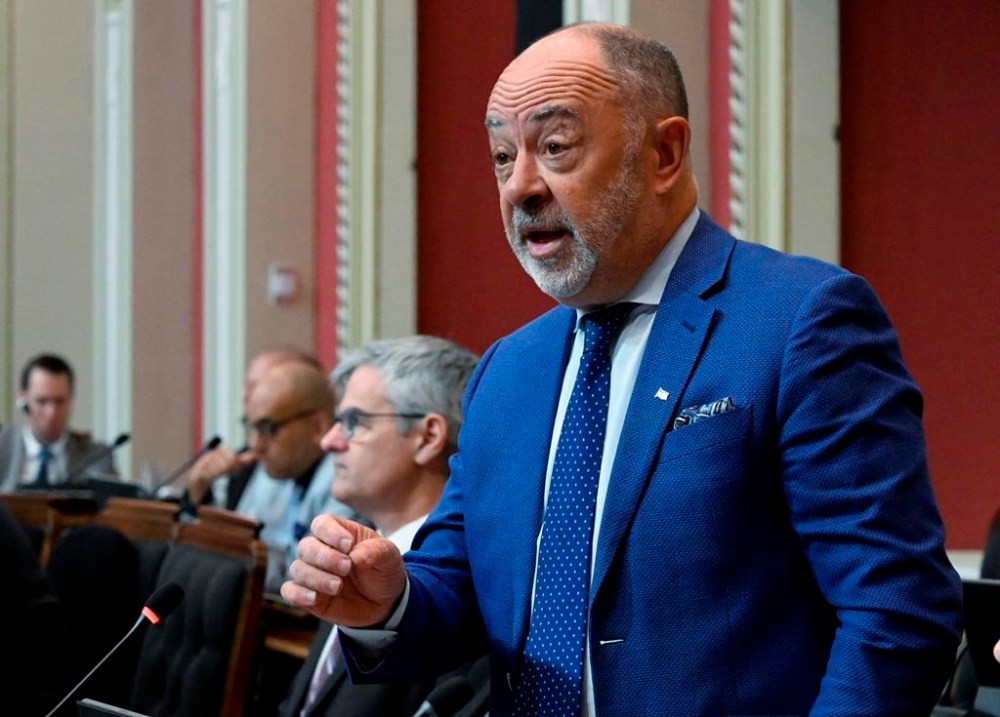
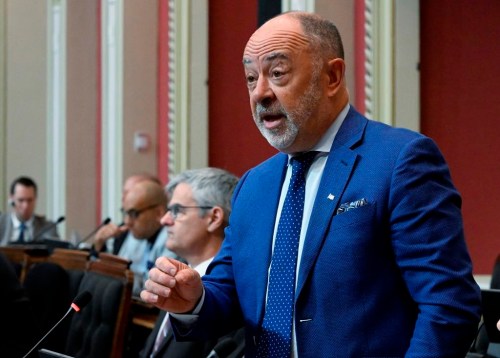
Quebec Health Minister Christian Dubé responds to the Opposition during question period Thursday, Oct. 24, 2024, at the legislature in Quebec City. New doctors trained in Quebec universities will have to spend the first years of their practice in the province and in the public health care system, the Quebec government says. THE CANADIAN PRESS/Jacques Boissinot

Dubé told a Montreal radio station on Monday morning that those who want to leave Quebec or work in the private system will face “consequences,” though he offered no details. It’s also unclear how long new doctors would be required to practise in Quebec’s public network.

The Quebec government estimates it costs between $435,000 and $790,000 to train a doctor, including during their residency. It says that 775 of Quebec’s 22,479 practising physicians are working exclusively in the private sector, a 70 per cent increase since 2020. The trend is especially notable among new doctors, according to the province.

A spokesperson for Dubé told The Canadian Press that 400 of the 2,536 doctors who completed their studies between 2015 and 2017 have left Quebec for other jurisdictions. Moreover, 2,355 doctors trained in Quebec are practising in Ontario, including 1,675 who attended McGill University.

Data from the Canadian Institute for Health Information show that just 60 per cent of family doctors who had recently graduated in Quebec were still practising in the province in 2022, while nearly 20 per cent had moved to Ontario. The number was higher for specialists, with 77 per cent of recent graduates still practising in Quebec.

In Ontario, 85 per cent of recently graduated family doctors and 80 per cent of specialists were still in the province in 2022. In Nova Scotia, however, just 42 per cent of family doctors and 38 per cent of specialists remained in the province.

Krystle Wittevrongel, director of research with the Montreal Economic Institute, said the new proposal doesn’t address the underlying issues that are pushing doctors toward the private system, including the prospect of dealing with less red tape and having greater power to set their own schedules. The government’s plan “is actually putting more constraints on them and making it more rigid,” she said.

Quebec is unique in Canada for the high number of doctors migrating to private medicine, in large part due to provincial rules that let doctors easily opt in and out of the public network. “It’s virtually none (leaving) or very few in the rest of Canada compared to hundreds, and it’s a growing number, in Quebec,” Wittevrongel said.

She said a better solution would be to allow doctors to have a “mixed practice,” which would let them work in both the public and private sectors.

Quebec’s college of physicians said it supports the government’s plan. “For us, this is a question of social responsibility,” it said in a statement. “But we will want to see the terms of this bill.”

On Monday, the college released a set of guiding principles for the role of the private sector in health care, which included a call for the expansion of the private health system to be “suspended immediately.”

This report by The Canadian Press was first published Nov. 4, 2024.
Report Error Submit a Tip

More Stories

Scare up some social reconnection this fall

Maureen Scurfield 4 minute read Yesterday at 2:00 AM CDT

DEAR MISS LONELYHEARTS: I’m an emotional mess. My lesbian girlfriend and I broke up in August, and now I hold the lease on the apartment we shared. It’s a great big old place with two spacious balconies.

I just got new roommates — two younger friends who really love it here — but secretly I’m still feeling lonely. Every minute of living here reminds me of my girlfriend because we decorated the place together and hung out on the balconies to sunbathe in the summer.

Would it help to move out of my beloved old block with its memory triggers? Maybe, but what if I died of loneliness in a new place? I need people around me, and no one but my ex-girlfriend has really been the right person. Please help. I feel sick about this.

— Love-Nest Sadness, Winnipeg

Manitoba tourism reached new heights in 2025

Aaron Epp 5 minute read Preview

Manitoba tourism reached new heights in 2025

Aaron Epp 5 minute read Yesterday at 9:34 PM CDT

Despite a devastating wildfire season, tourism in Manitoba hit record highs in 2025.

The province welcomed more than 11 million visitors who spent a total of $2.4 billion, generating nearly $450 million in provincial tax revenues, Travel Manitoba announced on Tuesday.

“Manitoba is a bit of a hidden secret, so it’s really exciting to see more and more people from across the country and internationally discovering everything that we have to offer,” said Angela Cassie, interim president and CEO of the Crown corporation.

Manitobans accounted for the bulk of tourism, with 9.37 million of the total 11.1 million visits. Spending grew 6.6 per cent year-over-year to $1.27 billion.

Read
Yesterday at 9:34 PM CDT

Taste of home: Winnipeg transplant shares Singaporean flavours at pop-ups

AV Kitching 6 minute read Preview

Taste of home: Winnipeg transplant shares Singaporean flavours at pop-ups

AV Kitching 6 minute read Yesterday at 5:51 PM CDT

Anyone who lives far away from the place they consider home will tell you that while you can adapt to life in a new country, a new work culture and a completely unfamiliar climate, there’s one thing that will remain stubbornly non-negotiable: the appetite.

For Malvin Soh, 49, like so many whose lives straddle two worlds, food is a gateway to childhood memories, culture and heritage.

Originally from Singapore, Soh and his family moved to Canada in 2014 and settled in Winnipeg.

The urban designer began cooking familiar favourites to combat his own cravings when studying and working in Australia, where he lived for nearly 10 years.

Read
Yesterday at 5:51 PM CDT

Quebec plans to force new doctors to stay in the province and work in public system

Maura Forrest, The Canadian Press 4 minute read Preview

Quebec plans to force new doctors to stay in the province and work in public system

Maura Forrest, The Canadian Press 4 minute read Monday, Nov. 4, 2024

MONTREAL - The Quebec government is planning to force new doctors trained in the province to work in Quebec's public health-care system for the first few years of their practice, in a bid to slow the loss of physicians to the private sector and to other provinces.

Health Minister Christian Dubé says he will table a bill by the end of the legislative session, to be debated next spring, that would require family doctors and specialists to start their careers in Quebec's public network.

"While too many Quebecers are still waiting to be treated, too many doctors decide, from the start of their career, to leave the Quebec public network," he said in a statement Sunday evening. "We will take steps to ensure that the population has access to the care for which they pay."

Dubé told a Montreal radio station on Monday morning that those who want to leave Quebec or work in the private system will face "consequences," though he offered no details. It's also unclear how long new doctors would be required to practise in Quebec's public network.

Read
Monday, Nov. 4, 2024

Police seize cocaine valued at $1.5M, about $750K in cash in raid on St. Vital house

Scott Billeck 5 minute read Preview

Police seize cocaine valued at $1.5M, about $750K in cash in raid on St. Vital house

Scott Billeck 5 minute read Yesterday at 3:30 PM CDT

A St. Vital homeowner and her husband were going about their business during an afternoon last month when police officers in tactical gear suddenly appeared, walking across their front lawn.

The target was a few doors down: a maroon bi-level home on a quiet stretch of Satinwood Place, within earshot of children playing outside at a nearby school.

The homeowner, who asked not to be named to protect their privacy, said the police presence caught the couple by surprise in the Southglen neighbourhood, where they weren’t accustomed to seeing that kind of activity.

“We never heard the (police) cars pull up, but there were cars blocking the entrance to the street from both sides,” said the neighbour. “They had a shield, a battering ram — everything. Just not used to seeing that.”

Read
Yesterday at 3:30 PM CDT

Sky is the limit for Lavoie

Joshua Frey-Sam 7 minute read Preview

Sky is the limit for Lavoie

Joshua Frey-Sam 7 minute read Yesterday at 6:09 PM CDT

Anisha Kinnarath Salam is gearing up for an important week.

AK Soccer Academy, the Winnipeg-based club Kinnarath Salam and her father started in 2019, is in Surrey, B.C., this week for the Canada Soccer National Championships — a first for the 15U girls team — and Kinnarath Salam believes her side has a legitimate shot at winning it all.

“We’ve had the squad, but this is a very talented group,” said Kinnarath Salam. “A few of these girls have been with us since they were five years old. A few have been with us since they were like 10. But we got some powerhouses last year.”

One of those new headlining talents is winger Quinn Lavoie, a product of West St. Paul who has brought a tantalizing blend of speed, technical skill and high IQ on the pitch.

Read
Yesterday at 6:09 PM CDT